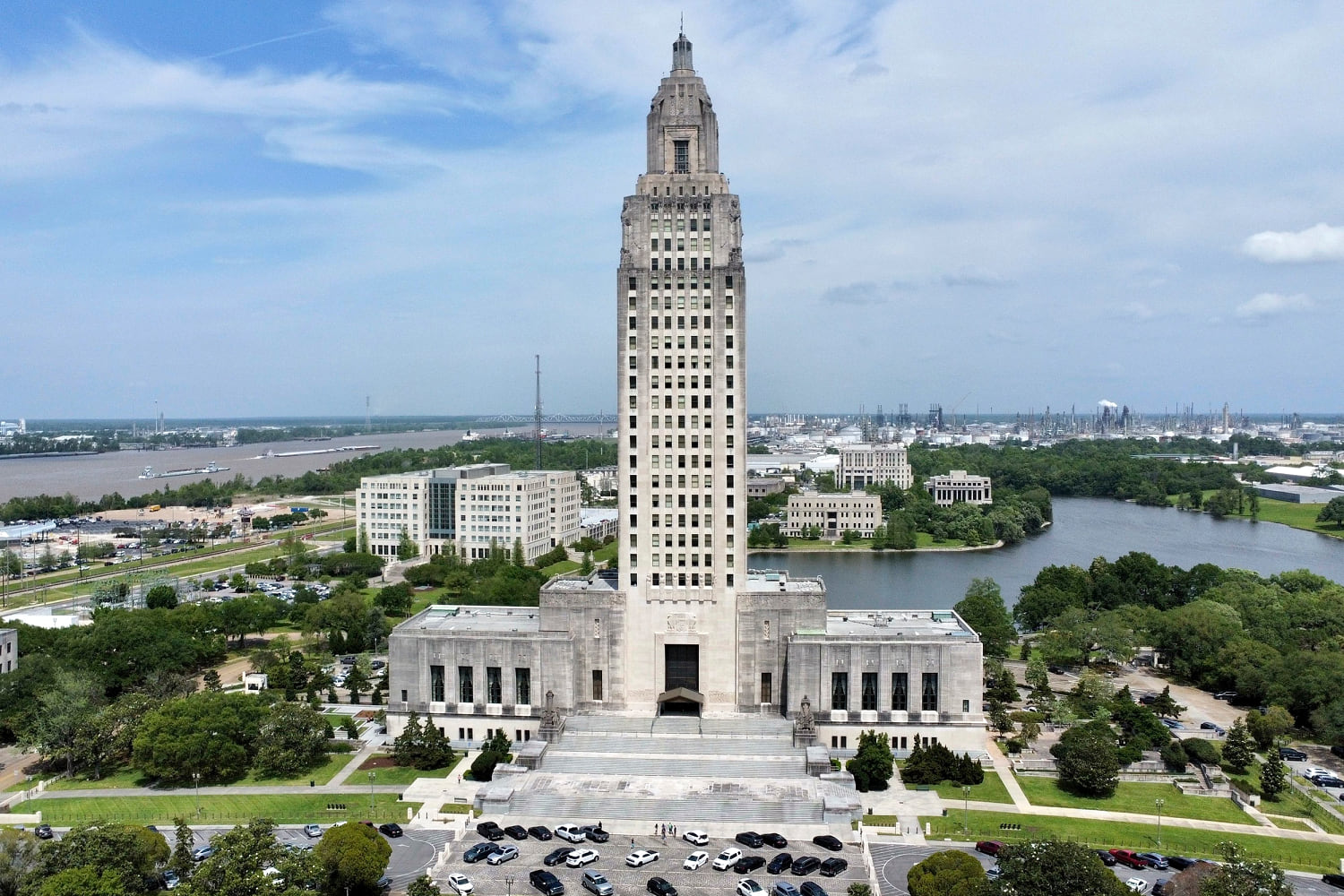
Louisiana lawmakers completed a rapid rewrite of the state's congressional boundaries, eliminating a majority-Black district to secure an additional seat for the Republican Party ahead of the critical midterm elections.
The state Senate voted 28-10 to approve the new map, sending it directly to Governor Jeff Landry for an assured signature. The legislative maneuver unseats a map that had stood for only one election cycle. It marks the culmination of a multi-year legal war that concluded at the U.S. Supreme Court, where a conservative majority issued a ruling that fundamentally redefined federal voting protections. By wiping out the sprawling, 200-mile 6th Congressional District—which stretched from Baton Rouge to Shreveport to unite Black communities—lawmakers have effectively reverted Louisiana to a 5-1 Republican-heavy delegation.
This is not a local boundary dispute. It is a calculated blueprint for how national legislative power will be brokered moving forward.
The Callais Precedent and the Death of Intent
To understand how Louisiana dismantled a district that Black voters fought decades to achieve, one must look at the judicial permission slip issued by Washington.
The legal justification centers on Louisiana v. Callais. In that case, the Supreme Court struck down the state's previous, two-district map as an unconstitutional racial gerrymander. The ruling shifted the legal landscape under Section 2 of the Voting Rights Act. Historically, the law acted as a shield for minority voters against vote dilution, forcing states with deep histories of discrimination to draw districts where minority communities could elect their preferred candidates.
The high court altered that framework. The justices ruled that Section 2 only guards against political boundaries drawn with the explicit, provable intent of discriminating based on race. If a map happens to obliterate minority voting power but is justified by a state as a pursuit of "political goals" or partisan advantage, the court decided it passes constitutional muster.
The ruling decoupled race from politics in a state where the two are functionally inseparable. In Louisiana, voting is deeply polarized along racial lines. Overwhelmingly, Black voters support Democrats, while white voters back Republicans. By declaring that partisan optimization is a valid legal defense for mapmakers, the court gave the Republican-dominated legislature a blank check to unpack Black voters from competitive areas and pack them into a single, isolated district.
The Mechanics of Surgical Extraction
The new legislative map performs a precise geographical operation on the state’s population centers.
The previous map featured two majority-Black access points: the historic 2nd District centered around New Orleans, and the newly carved 6th District represented by Democratic Representative Cleo Fields. The 6th District was a lifeline for representation, reflecting the reality that Black residents comprise roughly one-third of Louisiana's total population.
Lawmakers dissolved the 6th District entirely. They redistributed its Black communities among surrounding, safely white, conservative districts where their voting strength is mathematically neutralized.
- The 6th District Reborn: The new 6th District is no longer a sprawling connector of urban Black centers. It has been compressed into a compact, heavily white territory encompassing the suburban ring of Baton Rouge and portions of southern Louisiana. It is customized for a Republican pickup.
- The 2nd District Sponge: To ensure neighboring districts remain safely conservative, lawmakers used the New Orleans-based 2nd District, held by Democratic Representative Troy Carter, as a geographic sponge. They packed additional Black voters from Baton Rouge into this single district, deliberately elevating its Democratic concentration to protect surrounding Republican incumbents.
Old Map: 4 Safe R | 2 Majority-Black / Safe D
New Map: 5 Safe R | 1 Majority-Black / Safe D
Republican State Senator Jay Morris acknowledged the strategy during floor debate, noting that the lines were drawn to maximize Republican advantages for incumbent members of Congress.
The Shield Around the Speaker
The national implications of this redistricting process extend to the leadership of the U.S. House of Representatives.
The survival of the narrow Republican House majority depends on protecting incumbents from sudden demographic or political shifts. Among those incumbents is House Speaker Mike Johnson, whose home district lies in northwest Louisiana.
Initial proposals from hardline state conservatives aimed for a total 6-0 sweep of the state's congressional delegation. That plan was rejected by legislative leadership as a strategic liability. To create six districts that would all lean Republican, mapmakers would have been forced to bleed Black voters out of New Orleans and Baton Rouge and scatter them across all six zones. Doing so would have diluted conservative margins in every single district, making them vulnerable to future demographic shifts or high Democratic turnout.
By maintaining a 5-1 map, leadership chose a defensive strategy. They conceded one seat to Democrats to fortify the remaining five. This move insulates Speaker Johnson and other high-profile incumbents from competitive challenges, transforming their seats into safe strongholds.
The Failure of Partisan Cover
Civil rights advocates and Democratic lawmakers argue that the legislature's open admission of partisan motivation is a dangerous cover for systemic exclusion.
During the floor debates, Democratic State Senator Sam Jenkins argued that Republicans are using partisan survival as a legal shield to enact discriminatory practices against Black voters. The argument highlights a systemic vulnerability in the post-VRA legal framework: when party affiliation and race align perfectly, any action taken to suppress a political party inevitably suppresses a racial minority.
The state’s defense relies on this ambiguity. By framing the erasure of the 6th District as a purely political effort to maintain control of Congress, the state insulates itself from racial discrimination claims under the Callais standard.
The immediate casualty of this strategy is the state's unique election timeline. To enact the new boundaries before the upcoming midterms, Governor Landry pushed through delays to the state’s traditional election schedule, moving the primary dates to November 3. The change occurred even as thousands of overseas and mail-in ballots under the old map had already been processed, highlighting the frantic nature of the redistricting effort.
Legal challenges from civil rights organizations will continue, but the Supreme Court's clear signal in April means the new map will almost certainly govern the upcoming midterms. The era of federal court intervention to protect minority voting majorities in the Deep South has encountered a formidable legal wall. Power in Baton Rouge is no longer restrained by the Voting Rights Act; it is governed strictly by the survival instincts of the ruling party.
Analyses on Black political power and redistricting provides an essential breakdown from political analysts regarding the broader national impact of Louisiana's map change on federal representation.