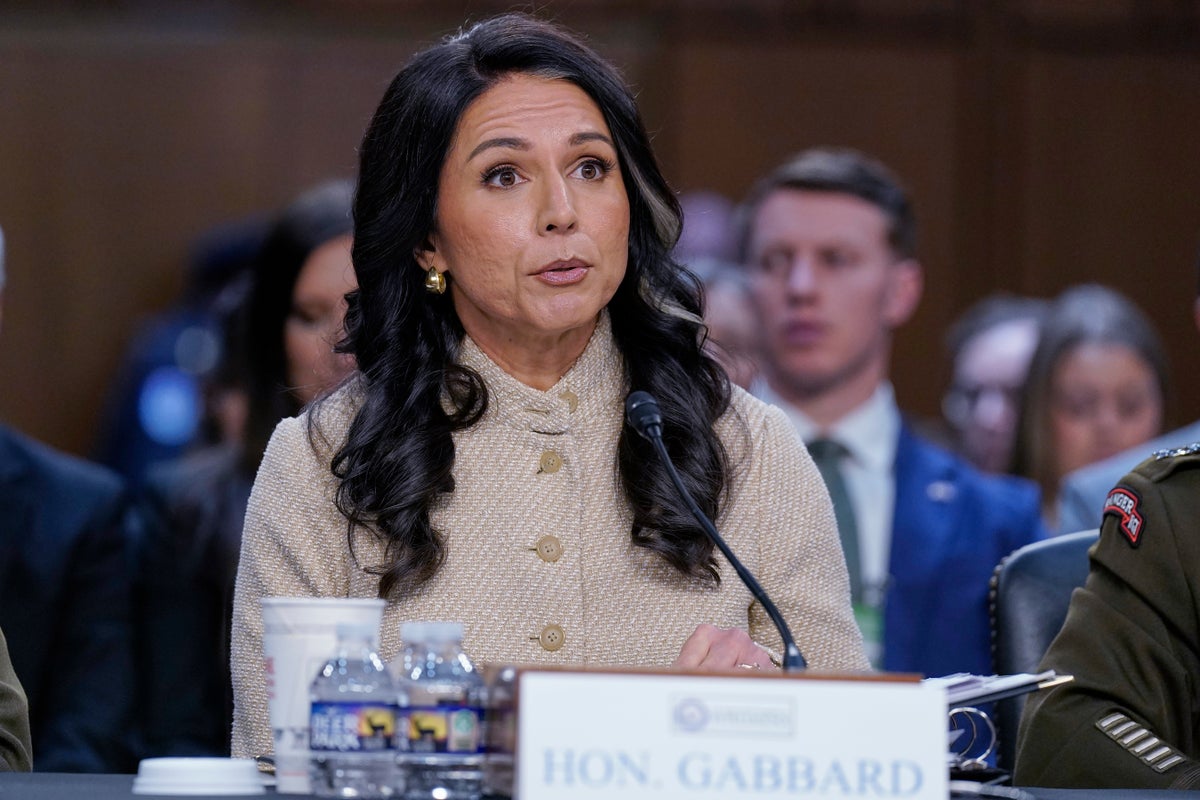
Tulsi Gabbard occupies a space in American politics that defies standard categorization, moving from a Democratic congresswoman to a key figure in a Republican administration. Her recent ascent to the role of Director of National Intelligence (DNI) has triggered a firestorm of scrutiny regarding her past statements on Syria, her skepticism of federal law enforcement, and her perceived alignment with foreign interests. The core tension lies in whether her "America First" restraint is a principled stance against interventionism or a dangerous pivot that benefits adversaries like Russia and Iran. Critics argue her rhetoric mirrors Kremlin talking points, while supporters see a veteran determined to stop the cycle of regime-change wars that have drained American resources for decades.
This is not a simple story of partisan flip-flopping. It is an investigation into how a single political figure can become a lightning rod for the most sensitive intelligence concerns in the Western world. When Russian state media refers to a high-ranking American official as a "friend," the alarm bells in Langley and Fort Meade do not just ring; they deafen.
The Kremlin Connection and the Friend Label
The most damaging optics for any intelligence chief involve praise from a primary adversary. Russian state television hosts have repeatedly characterized Gabbard as an ally of their worldview. This isn't accidental. The Russian propaganda machine excels at identifying Western voices that challenge the status quo and amplifying them to create internal division.
Gabbard’s skepticism of the war in Ukraine and her early suggestions that the conflict could have been avoided by acknowledging Russia’s "security concerns" regarding NATO expansion provided the perfect fodder for Moscow. To the average observer, this might look like a nuanced take on international relations. To the counterintelligence community, it looks like a "useful idiot" scenario where an American leader's genuine beliefs are harvested to validate an aggressor's narrative.
The danger here isn't necessarily that Gabbard is a "Russian asset" in the cinematic, cloak-and-dagger sense. The reality is often more mundane and more complicated. If the DNI shares the same geopolitical priorities as the Kremlin—specifically the weakening of NATO and the withdrawal of U.S. influence from Eastern Europe—the result is the same regardless of her intent. The intelligence community relies on a unified front to deter Russian aggression. When the head of that community suggests the "other side" has a point, the entire foundation of Western deterrence begins to crack.
The Iran Dilemma and the Limits of Isolationism
While Russia dominates the headlines, Gabbard’s stance on Iran reveals the friction between her anti-war philosophy and the practical demands of national security. During her questioning by lawmakers and the media, she often pivots away from direct condemnation of Iranian regional proxy wars, focusing instead on the failures of the 2015 nuclear deal or the risks of a hot war.
Iran remains the most active state sponsor of terrorism, according to the very agencies Gabbard now leads. Her historical reluctance to support aggressive containment strategies puts her at odds with the career analysts at the CIA and the NSA. These analysts spend their lives tracking Iranian shipments of drones to Russia and missiles to Hezbollah.
If the DNI viewed the Iranian threat through a lens of extreme skepticism toward intelligence findings—the same skepticism she applied to chemical weapons reports in Syria—the flow of actionable information could slow to a crawl. Agencies might become hesitant to present findings that they fear will be dismissed as "warmongering" or "deep state" fabrication. This creates a feedback loop where the intelligence product is tailored to fit the boss's worldview, rather than the objective reality on the ground.
The Syria Precedent and the Trust Gap
To understand why the intelligence community is in a state of quiet revolt over Gabbard, one must look back to 2017. Her unannounced trip to Damascus to meet with Bashar al-Assad remains the original sin of her political career in the eyes of the foreign policy establishment.
Assad had already been accused of using sarin gas on his own people. Gabbard returned and expressed doubt about those reports, despite a mountain of evidence gathered by both U.S. and international investigators. For someone to lead the 18 agencies that make up the U.S. intelligence apparatus after publicly doubting their most critical findings is unprecedented. It raises a fundamental question of trust. Can she lead people whose work she has historically dismissed as propaganda?
She argues that her skepticism is a necessary check on an "intelligence industrial complex" that lied about weapons of mass destruction in Iraq. That argument resonates with a large portion of the American public that is tired of endless conflicts. However, there is a massive difference between healthy skepticism and a blanket dismissal of forensic evidence in favor of a dictator's denials.
Rebuilding or Replacing the Intelligence Apparatus
The "America First" movement sees the intelligence community not as a shield, but as a weapon used against domestic political opponents. Gabbard has been vocal about "de-politicizing" these agencies. In practice, critics fear this means a purge of career professionals who provide inconvenient truths.
If the goal is to dismantle the "Deep State," Gabbard is the perfect architect. She knows the system from the inside but views it with the hostility of an outsider. This creates a volatile environment for the thousands of analysts who operate on the principle of "speaking truth to power." If the power they are speaking to believes they are part of a cabal, the truth becomes a secondary concern.
The shift toward a more isolationist intelligence posture would have immediate effects on global partnerships. The "Five Eyes" alliance—comprising the U.S., UK, Canada, Australia, and New Zealand—runs on the absolute certainty that shared secrets will not be mishandled or used to satisfy the whims of a foreign adversary. If London or Canberra suspects that the head of U.S. intelligence is too "friendly" with Moscow, the pipeline of shared signals intelligence could dry up overnight.
The Logistics of Dissent
Managing 18 different agencies requires more than just a political philosophy; it requires a mastery of the federal bureaucracy. The DNI is responsible for the National Intelligence Program budget and the integration of diverse missions ranging from satellite surveillance to human assets in hostile territory.
Gabbard's lack of traditional experience in managing large government bureaucracies is a point of contention. Her supporters argue that her military background as a Lieutenant Colonel in the Army National Guard provides the necessary perspective. Yet, there is a vast gulf between leading a battalion and overseeing a $70 billion intelligence budget. The technical complexity of modern espionage, involving quantum computing, AI-driven encryption, and cyber warfare, demands a leader who can grasp the nuances of the "how" as much as the "why."
The Impact on National Security
The most immediate risk is a loss of focus. When the leadership of the intelligence community is embroiled in constant political controversy, the mission suffers. Resources that should be spent tracking North Korean missile launches or Chinese naval movements are instead diverted to damage control and internal loyalty tests.
Foreign adversaries are currently testing these cracks in the American armor. China, in particular, benefits from a distracted and divided U.S. intelligence community. As Gabbard focuses on Russia and Iran—either as friends or as manageable threats—Beijing continues its long-term strategy of technological and economic hegemony.
The ultimate test for Gabbard will not be a televised interview or a social media post. It will be the first time a high-level defector brings evidence of a planned attack, or the moment a satellite detects a new silo in the desert. In those moments, the "why" of her past statements will matter far less than her ability to act on the "how" of the intelligence presented to her.
The weight of the office has a way of crushing or refining the people who hold it. Whether Gabbard adapts to the grim realities of the world as it is, or attempts to force the world to fit her non-interventionist mold, will determine the safety of the nation for the next decade. There is no middle ground when you are the gatekeeper of the world's most dangerous secrets.
Ask yourself if the person holding the keys to the kingdom truly believes in the walls they are supposed to guard.


.jpeg?width=1200&auto=webp&trim=0%2C0%2C399%2C0)