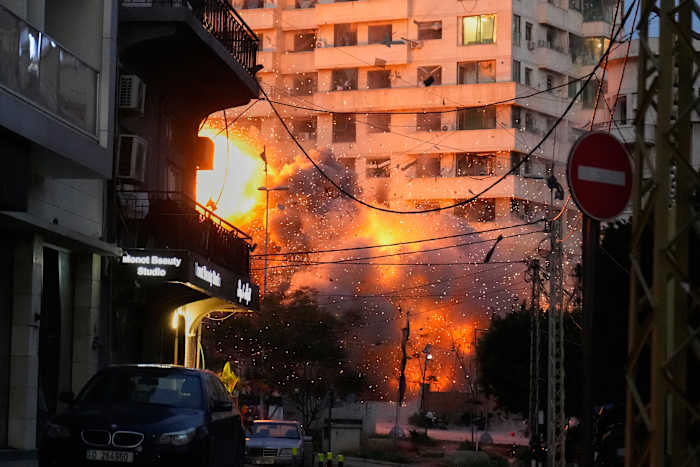
The United Nations Human Rights Office has issued a stark warning regarding the escalating Israeli air campaign in Lebanon, suggesting that the systematic targeting of civilian infrastructure and the resulting high death toll may constitute war crimes under international law. This assessment comes as the conflict enters a more lethal phase, characterized by strikes on densely populated residential blocks and essential public services. International law is not a suggestion. It is a set of binding rules designed to prevent total anarchy during wartime, and the current pattern of strikes suggests a disregard for the principles of distinction and proportionality that form the bedrock of the Geneva Conventions.
The core of the issue lies in the sheer scale of civilian displacement and the nature of the targets being hit. When an entire village is leveled or an apartment complex in central Beirut is vaporized, the justification of "military necessity" faces extreme scrutiny. The UN rights office points to specific incidents where the military advantage gained appeared negligible compared to the catastrophic loss of non-combatant life. This is the legal threshold for a war crime.
The Disproportionate Toll on Lebanese Society
Modern warfare is often sanitized through the language of precision strikes and surgical interventions. The reality on the ground in Lebanon tells a different story. Hospitals, schools, and water pumping stations have been damaged or rendered inoperable. Over a million people have been forced from their homes, creating a humanitarian vacuum that the Lebanese state, already reeling from years of economic collapse, is entirely unequipped to fill.
The laws of war require a constant evaluation of proportionality. $P = V - C$ is the grim, informal calculus used by military lawyers, where the perceived value of a target ($V$) must outweigh the expected civilian cost ($C$). If the cost is excessive in relation to the concrete and direct military advantage anticipated, the strike is illegal. In the current campaign, the "cost" side of that equation is skyrocketing while the "value" of many targets—often low-level operatives or suspected storage sites in residential basements—remains highly debatable.
The Erosion of Protected Status
Under the Geneva Conventions, certain buildings enjoy "protected status." This includes medical facilities, places of worship, and cultural heritage sites. To lose this protection, the site must be used for "acts harmful to the enemy." Israel frequently claims that Hezbollah uses these locations as human shields, effectively turning every civilian structure into a potential military target.
While the use of human shields is itself a war crime, it does not grant the opposing force a free pass to destroy the protected site without limit. The obligation to minimize civilian harm remains. The UN's concern stems from the fact that "warning shots" or "roof knocks" are increasingly absent or insufficient, leaving families with minutes, or sometimes seconds, to evacuate multi-story buildings.
The Logistics of Destruction
Investigative analysis of the munitions used reveals a reliance on heavy, unguided or "dumb" bombs in areas where precision is mandatory. Even when JDAM (Joint Direct Attack Munition) kits are used to turn these into smart bombs, the explosive yield is often far too high for an urban environment. Using a 2,000-pound bomb to take out a single room in a crowded neighborhood is like using a sledgehammer to perform brain surgery. The collateral damage is not an accident; it is a mathematical certainty.
There is also the question of the "double tap" strike. This involves hitting a target and then striking the same location again minutes later, often as first responders and neighbors arrive to pull survivors from the rubble. This practice is a direct violation of international humanitarian law, as it intentionally targets those who are no longer taking part in hostilities—the wounded and the medics. Documentation from Lebanese civil defense units suggests this has become a recurring tactic in the southern suburbs of Beirut and the border regions.
The Breakdown of International Oversight
The primary reason this crisis has reached a tipping point is the perceived paralysis of the UN Security Council. When the bodies responsible for enforcing international law are split by geopolitical interests, the rules of engagement become fluid. The UN rights office acts as a monitor, but it lacks the enforcement power of the International Criminal Court (ICC).
For a war crime to be prosecuted, there must be a clear chain of command and intent. Proving intent in the heat of an aerial campaign is notoriously difficult. However, the sheer volume of "errant" strikes creates a pattern of negligence that legal experts argue is indistinguishable from intent. If a military knows its actions will result in disproportionate civilian death and continues those actions anyway, the legal distinction between an accident and a crime begins to vanish.
The Economic Warfare Component
Beyond the immediate kinetic strikes, there is a broader strategy of atmospheric pressure. By destroying the infrastructure of daily life—bakeries, small businesses, and agricultural land in the south—the campaign seeks to turn the civilian population against Hezbollah. This is a form of collective punishment.
Collective punishment is expressly forbidden by Article 33 of the Fourth Geneva Convention. You cannot punish a population for the actions of a group they do not control. Yet, by making Lebanon uninhabitable, the strategy appears to be the forced migration of hundreds of thousands of people, creating a "dead zone" that serves as a buffer. This isn't just a military tactic; it is a fundamental reconfiguration of Lebanese geography through fire.
The Intelligence Failure and the Civilian Cost
A significant portion of the strikes are based on intelligence that is often outdated or incomplete. In the fog of war, "suspected" weapons caches often turn out to be grain silos or garages. The burden of proof rests on the attacking force. They must do everything feasible to verify that the objectives to be attacked are neither civilians nor civilian objects.
The frequency of strikes on multi-generational family homes, where ten or fifteen members of the same family are killed in a single blast, suggests a failure of this verification process. The UN's investigation is focusing on these specific instances where no clear military presence was detected post-strike.
Sovereignty and the Precedent of Impunity
The international community is currently watching a live-streamed erosion of the rules-based order. If the destruction of Lebanese civilian life is accepted as a standard cost of counter-insurgency, the precedent is set for every other conflict globally. This is not just about Lebanon; it is about whether the concept of "war crimes" still holds any meaning in the 21st century.
The UN Human Rights Office is calling for an immediate cessation of strikes on civilian areas and a transparent, independent investigation into the conduct of the Israeli Defense Forces (IDF). Without accountability, the cycle of violence is guaranteed to expand. The evidence is no longer anecdotal; it is structural.
The next logical step for international observers and legal bodies is the formal submission of forensic evidence to the ICC to determine if the "systematic" nature of these strikes reflects a policy decision rather than a series of tactical errors.