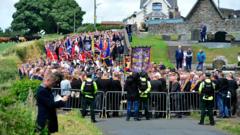
The friction between statutory regulatory bodies and constitutional rights of assembly establishes a recurring point of failure in public administration. When a high court intervenes to quash a restriction on an annual demonstration, the legal mechanism extends far beyond a localized dispute. It exposes the structural limitations of administrative bodies tasked with balancing competing civil liberties under pressure. Analyzing these judicial interventions requires mapping the statutory thresholds, the evidentiary burdens placed on regulatory commissions, and the downstream systemic consequences that follow judicial correction.
The Statutory Architecture And Regulatory Overreach
Regulatory oversight of public processions typically operates via delegated legislative authority. In jurisdictions with specialized public processions acts, independent commissions evaluate notifications submitted by organizers. These bodies are granted statutory discretion to impose route conditions, reroute marches, or prohibit assemblies entirely.
The legal justification for restriction usually rests on specific statutory criteria:
- The prevention of public disorder or property damage
- The mitigation of severe disruption to the life of the local community
- The preservation of inter-community relationships
- The protection of the rights and freedoms of others, notably residential privacy and freedom from harassment
When a commission issues a restrictive determination, it exercises an administrative power that must remain strictly proportionate. A high court quashes such a decision when the regulatory body fails the test of administrative law reasonableness. This failure typically materializes in two distinct ways.
First, the commission may assign improper weight to speculative threats rather than substantiated empirical evidence of disorder. Second, it may misinterpret the scope of human rights law, disproportionately suppressing the freedom of peaceful assembly under Article 11 of the European Convention on Human Rights, or equivalent constitutional protections, without demonstrating a pressing social need for the restriction.
The Mechanics Of Judicial Review In Contentious Processions
Challenging a regulatory restriction involves navigating a compressed judicial review timeline. Because public processions are time-sensitive events, litigation must move rapidly through the administrative court system. The applicant—typically the organizing lodge or association—must establish that the commission's determination was irrational, procedurally flawed, or legally misdirected.
The judicial review mechanism operates on a strict separation of powers. Courts do not substitute their own discretion for that of the commission; they evaluate whether the decision-making process complied with legal standards.
[Notification Filed]
       │
       ▼
[Commission Risk Assessment] ──(Disproportionate Weight)──> [Legal Challenge]
       │                                                            │
       ▼                                                            ▼
[Restrictive Determination] ────────────────────────> [High Court Review & Quashing]
When a high court quashes a restriction, it invalidates the specific determination, forcing the regulatory body to reconsider the notification in accordance with correct legal principles. However, a quashing order does not automatically grant an unhindered right-of-way. It resets the administrative clock, creating operational paralysis if time runs out before a lawful, revised determination can be issued.
The Cost Function Of Institutional Impasse
The repeated cycle of restriction, legal challenge, and judicial intervention generates a high systemic cost function. This friction can be broken down into three quantifiable variables.
The first variable is administrative overhead. Every legal challenge requires substantial expenditure of public funds for legal representation, expert testimony, and court administration, alongside the internal operational costs incurred by the regulatory commission defending its rationale.
The second variable is policing resource allocation. Contentious processions demand ring-fenced security operations. Uncertainty regarding the legality of a route until days or hours before the event prevents efficient rostering, intelligence gathering, and logistical deployment for law enforcement agencies.
The third variable is the degradation of community trust. When administrative determinations are routinely overturned in court, public perception of the regulator shifts from an independent arbitrator to an ideologically or politically compromised actor. This erodes institutional authority, making voluntary local accommodation increasingly unachievable.
Strategic Operational Playbook
Resolving structural regulatory failure in public assembly management requires moving past endless litigation cycles. Administrators, legal practitioners, and organizers must implement a standardized operational framework to eliminate ambiguity.
- Codify Evidentiary Standards: Regulatory bodies must establish a quantitative threshold for public disorder risk. Speculative community opposition or historical precedent alone must be legally insufficient to justify a restriction without contemporaneous intelligence.
- Mandatory Mediation Windows: Introduce a strict statutory timeframe requiring structured, facilitated dialogue between organizers and resident coalitions 90 days prior to any notification. Failure to engage in good faith must carry procedural penalties in subsequent determinations.
- Decoupled Route Approvals: Separate traditional, recurring annual parades from reactive counter-protests or secondary mobilizations. Treating them as distinct administrative entities prevents a veto dynamic where opposing groups can manufacture disorder to secure a ban.
- Binding Arbitration Frameworks: Establish a fast-track arbitration panel composed of retired jurists to resolve route disputes within 14 days of an initial determination, bypassing the protracted expense of high court litigation while preserving judicial oversight principles.