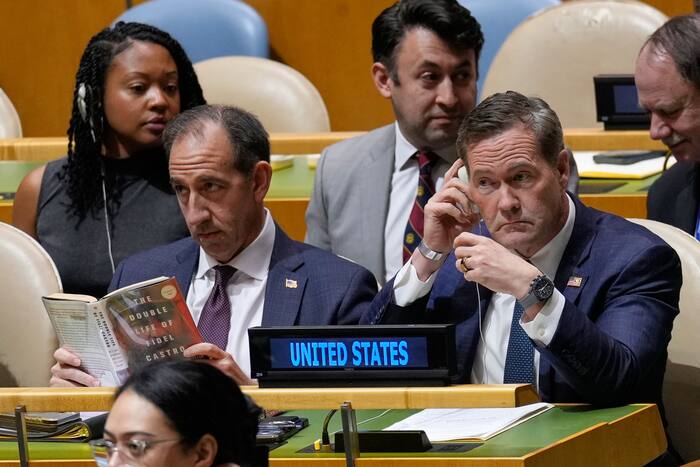
Mutual vetoes and abstentions inside the United Nations Security Council regarding the Western Sahara dispute are not diplomatic accidents; they are the predictable output of a zero-sum geopolitical pricing model. When the United States and Russia introduce competing resolutions on the mandate of the United Nations Mission for the Referendum in Western Sahara (MINURSO) and both fail to pass, the outcome reveals a fundamental structural breakdown in international conflict resolution. Rather than advancing a political settlement between Morocco and the Polisario Front, Security Council voting mechanics have institutionalized a permanent stalemate where procedural survival takes precedence over territorial resolution.
To understand why rival drafts collapse simultaneously, analysts must look past diplomatic rhetoric and examine the underlying power dynamics, the procedural thresholds of the UN Charter, and the shifting alliance structures in North Africa and the Sahel.
The Anatomy of Security Council Deadlock
A Security Council resolution requires nine affirmative votes out of fifteen members and zero vetoes from the five permanent members (P5: China, France, Russia, the United Kingdom, and the United States) to pass. When rival drafts are tabled on the same agenda item, failure occurs through two distinct mechanical pathways: direct P5 veto or failure to reach the nine-vote threshold due to coordinated abstentions.
In the context of Western Sahara, the United States acts as the "penholder"—the Council member responsible for drafting the primary text and leading negotiations. Historically, this position allowed Washington to dictate the baseline parameters of MINURSO’s mandate renewals. However, the introduction of a competing Russian draft signals a direct challenge to penholder monopoly.
The Three Drivers of Competing Resolutions
- Divergent Sovereignty Definitions: The core dispute rests on whether Western Sahara is a non-self-governing territory awaiting a decolonization referendum (the Polisario Front and Algerian position) or an integral part of Moroccan territory eligible only for limited autonomy (the Moroccan position).
- Great Power Proxy Alignment: Following the 2020 Abraham Accords, the United States formally recognized Moroccan sovereignty over Western Sahara in exchange for Rabat normalizing relations with Israel. This shift compromised Washington's perceived neutrality as penholder in the eyes of Moscow and Algiers. Conversely, Russia has deepened military and diplomatic ties with Algeria—the primary financial and military backer of the Polisario Front—while seeking to expand its influence across the Sahel.
- Asymmetric Mandate Objectives: The US drafting strategy prioritizes stability, counterterrorism cooperation with Rabat, and framing Morocco’s 2007 Autonomy Plan as the sole realistic basis for negotiation. The Russian counter-strategy emphasizes strict adherence to historical UN resolutions mandating a self-determination referendum, human rights monitoring within MINURSO’s operational scope, and rolling back language that legitimizes Moroccan administrative control.
When both drafts are put to a vote, they neutralize one another. A US draft that leans too heavily toward Moroccan autonomy triggers either a Russian veto or enough abstentions from non-permanent members (such as African or non-aligned states) to fall short of nine votes. Simultaneously, a Russian draft demanding immediate referendum timelines and expanded human rights oversight faces an automatic veto from the United States and France, both of which protect Moroccan strategic interests.
The Structural Flaws in the Penholder System
The simultaneous defeat of rival texts exposes a critical vulnerability in how the Security Council manages protracted conflicts. The penholder system relies on the assumption that the drafting nation can broker a consensus text acceptable to both the conflict parties and the P5. When the penholder abandons neutrality to adopt the maximalist position of one belligerent, the drafting process ceases to be a mediation tool and becomes an instrument of unilateral policy projection.
This creates a diplomatic bottleneck. For years, MINURSO mandate renewals passed through constructive ambiguity—using carefully calibrated phrases like "realism and a spirit of compromise" to satisfy Morocco without explicitly extinguishing the Polisario Front’s claim to a referendum. Once Washington recognized Moroccan sovereignty, maintaining that ambiguity became impossible. Every subsequent US draft attempted to nudge Council language closer to endorsing autonomy as the exclusive outcome.
Russia exploited this shift by positioning itself as the defender of international law and historical UN precedent. By introducing a rival resolution, Moscow forced Council members into a binary choice, stripping away the diplomatic cover that abstentions usually provide. The failure of both resolutions demonstrates that neither superpower possesses the diplomatic leverage to force its preferred framework through the Council without triggering systemic pushback.
Geopolitical Cost Functions of the Stalemate
To evaluate the persistence of this deadlock, one must calculate the cost-benefit matrix for the primary actors involved. In international relations, a frozen conflict persists when the cost of maintaining the status quo is lower than the political or security cost of making a concession.
Morocco’s Consolidation Strategy
For Rabat, a deadlocked Security Council is a net positive, provided MINURSO’s core ceasefire-monitoring function is not entirely dismantled or replaced with a human rights monitoring mandate. While the diplomatic deadlock continues, Morocco executes facts on the ground:
- Infrastructure Integration: Massive capital investment in the Dakhla Atlantic port, renewable energy grids, and highway networks physically binds the territory to the Moroccan economy.
- Diplomatic Recognition: Bilateral lobbying has secured consulates from over two dozen nations in Laayoune and Dakhla, bypassing the UN framework entirely.
- Buffer Zone Control: Since the collapse of the 1991 ceasefire in November 2020, the Royal Moroccan Armed Forces have expanded their defensive sand wall (the Berm) to seal off the Guerguerat crossing into Mauritania, limiting Polisario Front maneuverability.
Algeria and the Polisario Front’s Attrition Strategy
For Algiers and the Polisario Front, accepting a US-drafted resolution that codifies Moroccan autonomy is an existential defeat. A failed US resolution—even if the Russian alternative also fails—is viewed as a tactical victory because it denies Rabat the multilateral legitimacy it seeks. The cost of prolonged exile in the Tindouf refugee camps is absorbed by humanitarian aid and Algerian state subsidies, while low-intensity warfare along the Berm keeps the conflict on the international agenda without escalating into a full-scale regional war.
Superpower Signaling Costs
For Washington and Moscow, the Western Sahara vote is largely a secondary theater for broader global competition. The United States absorbs minor reputational damage among international law purists to secure a reliable North African security partner and preserve the Abraham Accords architecture. Russia incurs virtually zero domestic cost by tabling a doomed resolution; the action serves to solidify arms sales and energy coordination with Algeria while demonstrating to the Global South that Moscow can obstruct Western diplomatic initiatives.
Operational Consequences on the Ground
When Security Council resolutions fail, the immediate operational victim is MINURSO. Established in 1991 to organize a referendum and monitor the ceasefire, the mission has been reduced to an under-resourced observation force operating in a hostile environment.
The breakdown of consensus in New York directly degrades mission capabilities in three ways:
- Restricted Freedom of Movement: Since the resumption of hostilities in late 2020, both the Moroccan military and the Polisario Front have imposed severe restrictions on UN peacekeepers. Without a unified Security Council threatening targeted sanctions for non-cooperation, MINURSO patrols cannot verify ceasefire violations or access key sectors east of the Berm.
- Supply Chain Vulnerabilities: UN team sites rely on logistical corridors traversing disputed territory. Political friction at the Council level translates into administrative delays for visas, fuel deliveries, and equipment rotations, pushing several observation posts to the brink of operational shutdown.
- Erosion of the Personal Envoy’s Mandate: The UN Secretary-General’s Personal Envoy for Western Sahara depends on unified P5 backing to compel the parties to the negotiating table. When the US and Russia openly clash over the terms of reference, neither Rabat nor the Polisario Front feels compelled to make substantive concessions to the Envoy.
Limitations of Current Diplomatic Mechanisms
Standard diplomatic prescriptions—such as appointing a new envoy, calling for "good-faith negotiations without preconditions," or extending MINURSO’s mandate for shorter six-month intervals—are structurally incapable of breaking this impasse.
Shortening mandate renewals from twelve months to six months, a tactic previously used by the US to pressure the parties, backfires under current conditions. Instead of accelerating compromise, biannual votes double the frequency of superpower confrontations in New York, consuming diplomatic bandwidth and hardening positions.
Furthermore, relying on the African Union (AU) to mediate is blocked by institutional asymmetry. The Sahrawi Arab Democratic Republic (SADR), proclaimed by the Polisario Front, is a full member state of the AU. Morocco rejoined the bloc in 2017 specifically to neutralize AU intervention, insisting that the UN Security Council holds exclusive jurisdiction over the file. Consequently, regional mediation mechanisms are dead on arrival.
Strategic Forecasts and Policy Adjustments
The defeat of rival US and Russian resolutions marks the definitive end of the post-1991 diplomatic consensus on Western Sahara. Continuing to draft resolutions based on obsolete frameworks will only produce further procedural paralysis and accelerate the degradation of UN peacekeeping operations in North Africa.
To exit this cycle, diplomatic strategy must shift from rhetorical coercion to structural compartmentalization:
- Decouple Mandate Renewal from Political Frameworks: The Security Council must separate the technical renewal of MINURSO’s peacekeeping and demining operations from ideological language regarding the final political status of the territory. A purely technical rollover resolution strips both Washington and Moscow of the incentive to attach poison-pill amendments, preserving the physical presence of international observers on the ground.
- Transfer Penholder Responsibilities: The United States cannot simultaneously act as a bilateral guarantor of Moroccan sovereignty and an impartial Council penholder. Transferring drafting authority to a neutral coalition of elected non-permanent members (the E10) would remove the Great Power zero-sum dynamic from the initial text generation, forcing Washington and Moscow to negotiate from a balanced baseline rather than reacting to each other's maximalist drafts.
- Establish Direct Bilateral De-escalation Channels: Because multilateral UN frameworks are paralyzed, risk reduction must move to bilateral military-to-military channels facilitated by neutral third parties with leverage over both Rabat and Algiers. Preventing an accidental escalation between Morocco and Algeria—which severed diplomatic relations in 2021—requires concrete border security protocols and drone-use deconfliction agreements that operate entirely outside the Security Council’s voting architecture.