The captain of a VLCC—a Very Large Crude Carrier—doesn’t see the world in maps. He sees it in minutes. As his vessel, a steel island the size of three football fields, enters the Strait of Malacca, the air changes. It becomes thick with the scent of brine, diesel, and the invisible weight of a billion lives. He knows that if he stops, the lights go out in Shanghai. If he turns, the factories in Shenzhen fall silent.
We often talk about the Strait of Hormuz as the world’s pressure point. It is the dramatic flare-up, the place of sea mines and theatrical standoffs. But Hormuz is a distraction. It is the loud argument in the front yard while the real intruder is climbing through the back window. The back window is Malacca. Don't miss our earlier coverage on this related article.
For China, this narrow strip of water between Indonesia, Malaysia, and Singapore is not just a trade route. It is a jugular vein.
The Narrowing of the World
Imagine a funnel. At the top, you have the vast, open Indian Ocean, a blue expanse where a ship can disappear for weeks. At the bottom, you have the South China Sea. To get from one to the other, nearly 100,000 vessels a year must squeeze through a gap that, at its narrowest point off Singapore, is only 1.7 miles wide. If you want more about the context here, BBC News provides an excellent summary.
This is the Phillips Channel. It is a geographical quirk that dictates the fate of superpowers. If you are sitting in a boardroom in Beijing, you are looking at this 1.7-mile gap and seeing a noose. More than 80% of China’s oil imports pass through this single straw. Think about that. A nation of 1.4 billion people, the "factory of the world," depends on a waterway it does not control and cannot easily defend.
This is what former President Hu Jintao famously called the "Malacca Dilemma." It is the realization that no matter how many hypersonic missiles you build or how many skyscrapers you erect, your entire economy can be flicked off like a light switch by a handful of well-placed frigates.
The Silent Watcher in the Andaman
While the world watches the South China Sea, the real chess move is happening 800 miles to the west.
Enter India.
For decades, the Andaman and Nicobar Islands were seen as a sleepy tropical outpost, a place for naval officers to serve out quiet rotations. That has changed. These islands sit like a string of emerald sentries right at the mouth of the Malacca Strait. They are "unsinkable aircraft carriers."
From the Great Nicobar Island, the Indian Navy doesn't just watch the traffic; they breathe down its neck. They see every tanker, every bulk carrier, and every gray-hulled warship that makes the turn toward the Pacific.
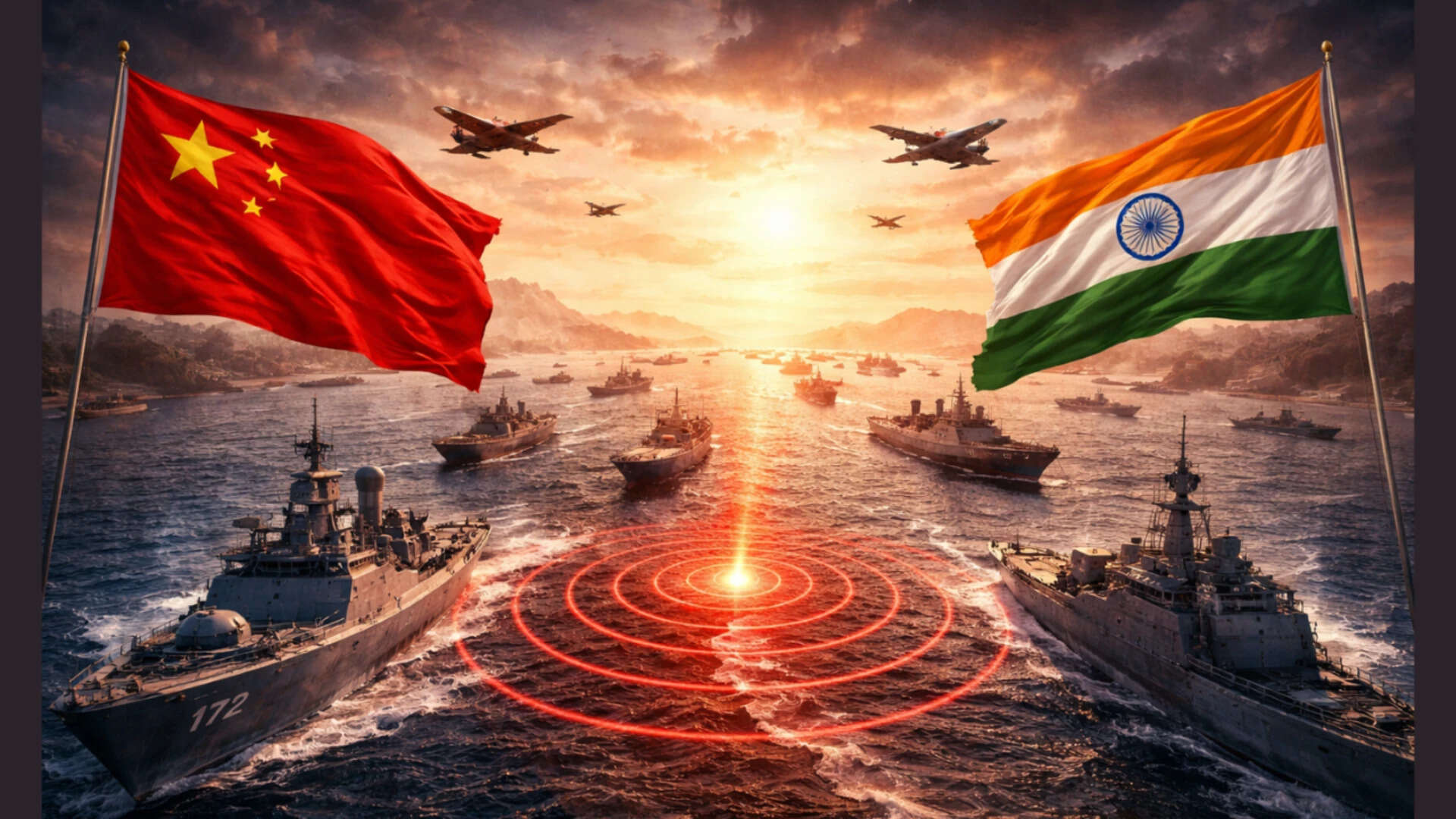
Consider a hypothetical scenario: a localized conflict breaks out over a border dispute in the Himalayas. In the old days, the fighting would stay in the mountains. Today, the response doesn't happen at 15,000 feet in the snow. It happens at sea level. India doesn't need to win a land war in Tibet if it can simply park a carrier battle group at the entrance of the funnel and tell the world’s oil tankers to drop anchor.
It is a silent, terrifying leverage. It is the ability to win a war without firing a single shot, simply by letting the clocks run down and the fuel gauges hit empty.
The Great Circumvention
China is not waiting for the noose to tighten. Their response is a frantic, multi-billion-dollar exercise in geography-defiance known as the Belt and Road Initiative.
They are building pipelines through the jungles of Myanmar. They are carving roads through the Karakoram mountains in Pakistan to reach the port of Gwadar. They are even eyeing the melting ice of the Arctic to create a "Polar Silk Road."
But geography is a stubborn opponent.
A pipeline through Myanmar can be sabotaged by a single rebel group with a bag of explosives. A road through the Pakistani mountains is prone to landslides, terrorism, and staggering logistical costs. None of these alternatives can handle the sheer volume of a VLCC. A single supertanker carries two million barrels of oil. To move that much fuel by truck or train is a nightmare of inefficiency.
The math is brutal. The sea is cheap. The land is expensive. And the sea belongs to those who sit at the gates.
The Human Cost of a Clogged Vein
We treat "geopolitics" as a game of Risk played by men in suits, but the stakes are measured in dinner tables.
If Malacca were to close for even a week, the ripples would be felt in your pocketbook before you even saw the news. The cost of shipping a container would triple. The price of plastic, which starts as oil, would spike. The semiconductor chips that run your phone and your car—most of which travel through these waters—would vanish from the shelves.
This isn't just about China’s nightmare; it is a global fragility. We have built a modern civilization on the assumption of "just-in-time" delivery. We assume the straw will never be pinched.
But the pinch is the point. India knows it. The United States knows it. And Beijing feels it every time a tanker rounds the tip of Sumatra.
The Ghost at the Table
There is a specific kind of tension that exists in the Indo-Pacific right now. It is not the hot, explosive tension of the Cold War. It is a cold, calculated pressure.
Every time India conducts a naval exercise in the Andaman Sea, a desk in the Central Military Commission in Beijing gets a little more crowded with maps. They are looking for a way out. They are looking at the Kra Isthmus in Thailand, dreaming of digging a canal that would bypass Malacca entirely—a "Thai Canal" that would cost $30 billion and take a decade to build.
Even then, the problem remains. A canal is just a narrower funnel, another target, another point of failure.
The reality is that we are living in the age of the Chokehold. The world’s power is no longer measured solely by who has the biggest army, but by who has their hand on the valve. The Strait of Malacca is that valve.
As the sun sets over the Andaman Sea, the silhouette of a lone Indian patrol aircraft crosses the horizon. Below it, a line of tankers stretches to the vanishing point, their hulls heavy with the lifeblood of an empire. They move slowly, dutifully, through the narrow gap, unaware that they are the most important pawns on the board.
The nightmare isn't a storm or a shipwreck. The nightmare is the silence that follows when the music of trade stops.
In the high-stakes theater of global power, the loudest sounds are often the ones we never hear: the soft creak of a ship’s hull, the low hum of an engine, and the steady, rhythmic breathing of a watcher on a distant island, waiting for the moment the world decides to hold its breath.
The ocean looks empty, but the gates are manned, and the keys are being held with a grip that is only getting tighter.