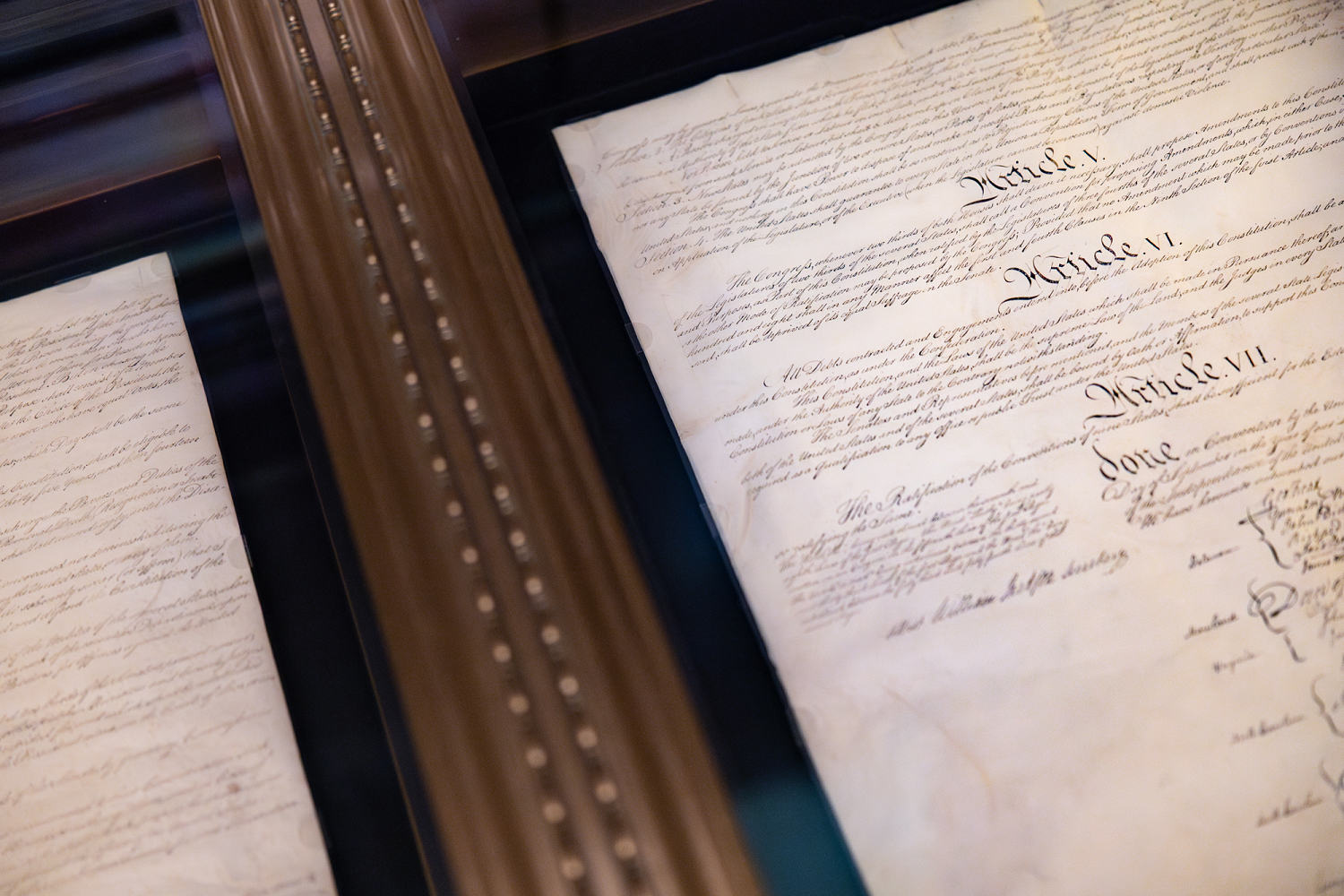
The parchment smells like old dust and quiet ambition, locked behind heavy glass in Washington. It is easy to forget that ink on cotton paper was once a desperate weapon. Men with ink-stained cuffs argued over every comma in Philadelphia, sweating through a brutal summer, terrified they were building a machine that would either devour liberty or tear itself apart before it could even draw breath.
They settled on friction.
They designed a system where power would never rest easy. Ambition would check ambition. Branches would grind against branches. For more than two centuries, we called this genius. We called it checks and balances.
Today, we call it a standstill.
Step inside a congressional hearing room on a Tuesday morning, and you can smell the staleness of recycled air and performative anger. The desks are polished mahogany. The microphones catch every dry swallow and paper shuffle. But the real action is invisible. It lives in the silent calculations of politicians who know that compromise is treated as treason by their own primary voters.
Nothing moves. Everything stalls.
Consider a hypothetical citizen named Elena, living in a mid-sized town where the bridge over the local river has been rated structurally deficient for six consecutive years. She drives her sedan across it twice a day, gripping the steering wheel a little tighter every time a heavy truck rumbles past, feeling the concrete shudder. Elena does not care about legislative filibusters or procedural votes. She cares about a bridge that might not hold until Tuesday.
When she writes to her representatives, she receives automated replies crafted by twenty-something staffers whose primary job is defense, not governance. The letters speak of opposing visions, constitutional duties, and steadfast resistance. They read like eulogies for a government that used to function.
Why has the founding document of American democracy ground to a halt?
The answer requires looking past the daily cable news shouting matches and examining the mechanics of our current political architecture. The framers anticipated disagreement. They did not anticipate hyper-polarized political parties sustained by algorithmic outrage and partisan gerrymandering that turns legislative districts into safe, ideological echo chambers.
When winning an election depends entirely on surviving a primary from your party's extreme flank, moderation becomes a liability. Cooperation becomes a scandal.
This brings us to the core structural paralysis of the modern era. The Constitution creates a high barrier to entry for any federal action. To pass a bill, you need a majority in the House, a complex supermajority threshold to break friction in the Senate, and the signature of a president who might belong to the opposing party. It is a system built for consensus in an era defined by tribal warfare.
Think of it like a massive, rusted flywheel. It takes an immense amount of energy to turn it even an inch. When both sides are pulling in opposite directions with maximum force, the flywheel does not spin faster. It locks up. Gears strip. Metal shatters.
The public feels this friction as a dull, exhausting ache.
We watch federal budgets lurch from one manufactured crisis to the next, resolved only by midnight stopgap measures that solve nothing and defer everything. We watch judicial nominations turn into nuclear standoffs. We watch major societal problems—from crumbling infrastructure to shifting technological landscapes—float past while lawmakers debate procedural technicalities.
The standstill is not an accident. It is the natural consequence of applying an eighteenth-century operating system to a twenty-first-century digital reality.
Yet, to blame the Constitution entirely is to misread the machinery. The document gives the tools of governance, but it relies on an unwritten code of institutional norms to make them work. Those norms assumed a baseline of good faith. They assumed that leaders, when pushed to the brink, would step back for the preservation of the republic.
Good faith is in short supply.
When norms are treated as mere tactical obstacles to be smashed, the constitutional machinery breaks down. A rule designed to protect the minority voice becomes a veto point used to grind all legislative output to dust. A mechanism meant to ensure careful deliberation becomes an engine of total obstruction.
We have perfected the art of the veto. We have forgotten the art of the craft.
Look closely at the desk of any modern lawmaker. Piles of briefing books sit untouched, replaced by smartphones pinging with fundraising text alerts and polling updates. The incentive structure has inverted. Governing used to be the path to glory. Now, blocking the other side is the path to survival.
The cost of this deadlock is paid in quiet, unmeasured increments. It is paid by towns waiting for federal disaster relief that gets bogged down in partisan fights. It is paid by scientific agencies stalled by leadership vacuums. It is paid by a citizenry that looks at Washington and sees not a beacon of democracy, but a monument to paralysis.
There is a strange comfort in the standstill for those who profit from division. If nothing changes, the grievances remain fresh. If no compromise is struck, the fundraising emails write themselves. The stalemate is a self-sustaining ecosystem.
Break the system, and you lose the enemy you need for the next campaign.
History suggests that systems built on permanent friction eventually reach a snapping point. Either the pressure forces a re-engineering of the rules, or the structure cracks under the weight of its own immobility. The framers knew this. They left an amendment process, a way to rewrite the code when the machinery jammed permanently.
That process, too, is frozen.
So the bridge continues to vibrate beneath Elena's tires. The bills pile up unread. The debates circle the drain of procedural grievance, echoing through marble halls that were once meant to house the boldest experiments in human freedom.
Outside, the river keeps rising against the concrete piers, indifferent to the rules of order, waiting for someone to finally start building again.