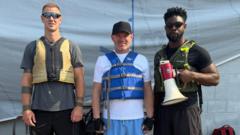
The water of the upper Hudson River does not care about your ambition. At 4:00 AM, just outside of Albany, it is a thick, ink-black mirror that swallows the light of the stars and reflects nothing but cold. If you drop an oar into it, the sound doesn't echo. It just vanishes into the trees lining the banks.
Rooney adjusted his grip on the carbon fiber handle. His hands were already a mess of yellowing calluses and fresh, weeping blisters that stung against the salt of his own sweat. Behind him, Hart breathed in a ragged, rhythmic hiss. Behind Hart, Richards kept the count.
One. Two. Slide. Drive.
To the casual observer standing on a concrete pier in Manhattan, a river looks like a highway. It seems linear. You start at point A, you pull a piece of wood through the water a few thousand times, and you arrive at point B. But anyone who has ever sat in a wooden or fiberglass shell three inches above the waterline knows the truth. A river is a living, breathing antagonist. It has moods. It has teeth. And when you decide to row its entire length, you are not engaging in a sporting event. You are entering into a prolonged negotiation with an entity that has all the time in the world to watch you break.
The Geography of Exhaustion
The human body is poorly designed for sustained agony. After the first twenty miles, the initial burst of adrenaline—that clean, sharp high that gets you away from the dock—evaporates completely. What remains is a cold calculation of resources.
Consider the mechanics of the stroke. Your legs drive against the footboards, transferring power through your core, up your spine, and out through your shoulders into your arms. It is a full-body contraction executed thirty times a minute, hour after hour. By mid-morning, the burning in the quadriceps ceases to be a sharp pain and becomes a dull, heavy ache, like wet cement pouring through the veins.
Rooney felt it first in his lower back. A tight, iron band seemed to clamp down across his lumbar spine, pinching with every layback. He didn't say a word. In a three-man boat, silence is a currency. If you complain, you steal energy from the man behind you. If you show weakness, the rhythm falters. And the rhythm is the only thing keeping the boat afloat.
The Hudson changes character as it moves south. It widens, losing its pastoral innocence and taking on the heavy, industrial weight of the towns that grew up along its shores. The water changes color, shifting from a clean, tea-colored brown to a brackish, greasy grey. The smell changes too. The scent of pine and damp earth gives way to diesel fumes, old wood, and the faint, metallic tang of civilization.
Hart shifted his weight slightly, a microscopic movement that resonated through the entire hull. The boat rolled a fraction of an inch to the port side.
"Watch the set," Richards muttered from the stern. His voice was cracked, dry from hours of breathing in the humid, river air.
That was the problem with the middle miles. The mind begins to wander. It drifts away from the physical reality of the blade entering the water and starts to contemplate the sheer distance left to travel. That is where the danger lives. When you begin to think about the sixty miles still ahead, rather than the single stroke you are currently making, the water wins.
The Trap of the Tides
People forget that the Hudson is not a normal river. It is an estuary. The Native Americans called it Mahicantuck—the river that flows both ways. For twice a day, the Atlantic Ocean pushes its way north, forcing millions of gallons of saltwater up into the channel, reversing the current and turning the river into a wall.
They hit the wall just north of Poughkeepsie.
The wind came out of the south, blowing directly against the downward flow of the water. The result was a chaotic, chopping mess of waves that slapped against the bow, throwing freezing spray into Rooney's face. The boat slowed. Every stroke felt like trying to drag a plow through wet clay.
Progress became measurable not in miles, but in landmarks that refused to move. An old, rusted railroad bridge stayed on their right horizon for what felt like centuries. They would pull, thirty times a minute, teeth bared, muscles screaming, and ten minutes later, the same iron girder would be mocking them from the exact same angle.
Despair is a physical weight. It sits on your chest and makes it impossible to draw a full breath. Hart’s shoulders began to rise, a sure sign that his legs were giving out and he was relying entirely on his upper body to move the blade. It was ugly rowing. It was survival rowing.
But consider what happens next when the body surrenders: the mind takes over. Or rather, a strange, feral part of the brain wakes up. It is the part that doesn't care about medals, or records, or the articles that might be written about three men in a boat. It only cares about the next green light on the water. It cares about survival.
Rooney closed his eyes for three strokes, letting his muscle memory take the oars. He knew exactly where Hart’s blade was by the sound of the swirl in the water. He didn't need to see. He just needed to follow the ghost of the man in front of him.
The Monoliths of the Lower River
By the time the George Washington Bridge loomed in the distance, the sun was dropping behind the Palisades, casting long, bruised shadows across the water. The cliffs rose up like the walls of a fortress, grey and indifferent to the three tiny figures crawling along their base.
The city introduces a new kind of terror.
Upstate, the river was empty. Here, it was crowded with the monsters of modern commerce. Massive commuter ferries tore across the channel, leaving behind deep, rolling wakes that threatened to flip the low-slung rowing shell. Water taxis zipped past, their passengers looking out the windows at the three men with a mixture of confusion and mild amusement.
The contrast was absurd. Inside the ferry cabins, people were checking their phones, thinking about dinner reservations, complaining about the air conditioning. Three hundred feet away, Rooney, Hart, and Richards were locked in a primordial struggle against physical collapse. Their world had shrunk to a space three feet wide and twenty feet long.
The noise became deafening. The roar of traffic on the West Side Highway, the thrum of helicopter blades overhead, the deep, bass rumble of cruise ships backing out of their slips. It was a sensory assault after the long, monastic silence of the upper river.
"Ten more," Richards called out. His voice was barely a whisper now, ruined by the salt and the effort. "Give me ten heavy ones."
They didn't speed up. They couldn't. But the depth of the blade changed. They buried the carbon fiber deeper into the black water, pulling with the absolute last remnants of their reserves. Rooney’s fingers had frozen into a permanent curve around the handle. He wasn't sure if he could open his hands even if he wanted to.
The hull scraped against the floating dock at the end of the line with a sharp, hollow sound.
None of them moved. They sat in the dark, oars splayed out on the water like the legs of a dying insect, their heads resting on their knees. The river lapped gently against the fiberglass, unchanged, unbothered, already preparing for the next turn of the tide.
A lone man walking his dog stopped on the promenade above, looking down at them for a moment before moving on into the neon glow of the city. He saw three guys in a boat. He didn't see the hundred and fifty miles of ghosts trailing behind them in the dark.