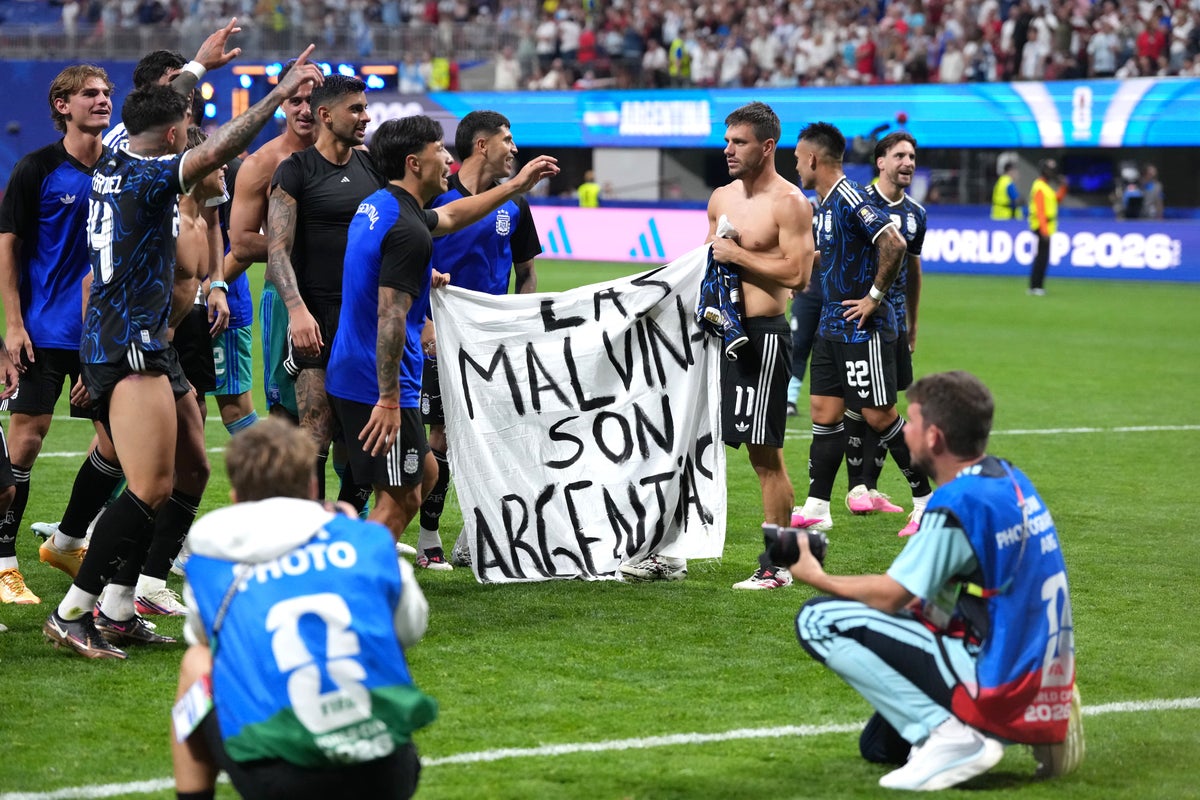
The final whistle had barely echoed through the rafters of the Mercedes-Benz Stadium in Atlanta before a geopolitical brushfire ignited on the pitch. Argentina had just dispatched England 2-1 in a grueling, ill-tempered World Cup semifinal, securing a spot in the ultimate match against Spain. What followed was not the standard choreography of elite athletes celebrating a victory. Instead, several prominent Argentine international players hoisted a large banner retrieved from the stands. It carried four words that instantly transformed a sporting triumph into an international incident. Las Malvinas son Argentinas.
The assertion that the Falkland Islands belong to Argentina is a deeply ingrained article of faith in Buenos Aires. In London, it is viewed as an unacceptable provocation against British sovereignty. FIFA regulations explicitly forbid players from transmitting political messages during competition. Yet, the real shockwaves did not emanate from Zurich or Buenos Aires, but from Washington. In a move that stunned diplomats on both sides of the Atlantic, the White House stepped forward to defend the Argentine squad. Andrew Giuliani, serving as the head of the White House FIFA Task Force, declared that the players were well within their rights because the United States respects free speech.
This justification represents a profound departure from traditional diplomatic protocols. A host nation usually preserves absolute neutrality during international sporting tournaments. By invoking domestic constitutional principles to shield foreign athletes from sports governance bodies, Washington did something entirely unexpected. It prioritized an ideological stance over the anxieties of its closest European ally. The decision has left Downing Street reeling and has exposed significant fractures within the transatlantic alliance. It reveals a modern reality where international sporting events are no longer insulated from shifting geopolitical alignments.
An Unexpected Diplomatic Fracture in Atlanta
The match itself was an exhausting display of athletic tension. Thomas Tuchel’s England had fought valiantly, but a late surge by the defending champions broke British hearts. As the technical staff traded tense handshakes, the focus shifted to the eastern touchline. Lisandro Martínez, Cristian Romero, and Giovani Lo Celso were among the core contingent seen holding the controversial banner. They smiled for the cameras while brandishing a message that directly references the 1982 South Atlantic conflict. That war cost the lives of hundreds of servicemen and remains an unhealed scar for both societies.
Downing Street responded with immediate, measured fury. A spokesperson for Prime Minister Keir Starmer stated unequivocally that while the World Cup might belong to someone else, the Falkland Islands definitely remain British. The British government immediately backed demands for a thorough FIFA investigation. British Business Secretary Peter Kyle went further, labeling the display an egregious violation of the core tenets of international football. The United Kingdom expects sports to remain entirely separate from sovereignty disputes. They wanted swift, punitive action against the Argentine Football Association to deter future demonstrations.
Then came the intervention from Washington. Giuliani's defense of the Argentine squad was immediate and unyielding. He stated that the United States believes in the right to express personal views, specifically citing the protections afforded by the American legal framework. This logic suggests that because the matches are played on American soil, domestic liberties take precedence over the private statutes of an international sports federation. It is a radical interpretation of host-country responsibility. Foreign diplomats are now scrambling to understand whether this policy was a deliberate calculated choice or an impulsive misstep by an overzealous task force.
Washington Shields a Geopolitical Gambit
To understand why the White House chose this specific hill to fight on, one must look beyond the immediate sphere of football. The current American administration is managing a delicate balancing act across the Western Hemisphere. Argentina, under the leadership of President Javier Milei, has aggressively repositioned itself as a key strategic partner for Washington in South America. Milei has pursued radical economic reforms and aligned his foreign policy tightly with American security objectives. Washington wants to reward this loyalty. Abandoning Buenos Aires during a moment of intense nationalistic fervor would have complicated those efforts.
The White House task force likely viewed the situation through a domestic political lens rather than a purely diplomatic one. Defending free speech is always a safe position within American political discourse. It resonates strongly with domestic voters who view constitutional liberties as absolute truths that should apply globally. By framing the defense around the First Amendment, the administration found a way to support Argentina without explicitly endorsing their territorial claim over the islands. This legal maneuvering was intended to minimize blowback at home while signaling solidarity to the Milei administration.
The strategy possesses significant vulnerabilities. It treats the United Kingdom's concerns as secondary to regional alliances in South America. British officials privately express dismay that Washington would dismiss an issue involving territorial integrity so casually. The Falkland Islands government issued a sharp statement expressing deep disappointment that their home was used as a political football. For the residents of Port Stanley, the banner was not an abstract exercise in expression. It was a reminder of an invasion that traumatized their community decades ago. By defending the players, Washington inadvertently minimized that historical trauma.
The Legal Illusion of the First Amendment on the Pitch
The reliance on constitutional arguments to defend players participating in a FIFA tournament rests on flawed legal foundations. FIFA is a private, Swiss-governed entity with its own independent legal structures. When a nation agrees to host the World Cup, it signs binding agreements promising to respect and enforce FIFA’s internal regulations. These statutes explicitly state that political demonstrations are prohibited within the stadium footprint. The First Amendment protects citizens from government censorship. It does not dictate how a private global sports federation enforces its internal code of conduct against tournament participants.
Past precedents offer a clear picture of how these matters are handled. In 2014, FIFA fined the Argentine federation after players displayed a nearly identical banner before a friendly match against Slovenia. During the 2012 London Olympics, soccer authorities disciplined a South Korean player for holding a sign regarding a territorial dispute with Japan. In all these instances, the international governing bodies asserted their absolute right to police the sporting environment. The argument brought forward by the White House sets a troublesome precedent. If every host country used its local laws to override FIFA regulations, the uniform administration of global tournaments would collapse entirely.
Consider the logical extension of this stance. If the upcoming final were hosted in a nation with restrictive speech laws, that government could theoretically penalize athletes for expressions that are totally legal in their home countries. International sports rely on a shared understanding that the stadium operates under a distinct, neutral legal framework for the duration of the tournament. By attempting to insert American constitutional supremacy into this neutral zone, Washington is undermining the stability of the entire system. It is a short-sighted approach that creates significant legal uncertainty for future global events.
London Reconsiders the Special Relationship
The fallout in London has been severe. British politicians across the political spectrum view the American defense as a betrayal of the traditional relationship between the two powers. Keir Starmer has taken the unusual step of publicly indicating a preference for Spain in the upcoming final, a subtle diplomatic rebuke that reflects deep irritation within the cabinet. The timing of this friction is awkward. The British government is currently trying to manage complex domestic transitions and economic pressures. It did not need a public dispute with its most crucial security partner over a soccer match.
Senior British defense officials are worried about the broader strategic implications of this shift. The United Kingdom has spent decades maintaining a costly military presence in the South Atlantic to guarantee the security of the islanders. They rely on the assumption that Washington will back them if tensions escalate with Buenos Aires. When the White House chooses to legitimize nationalistic stunts on the world stage, it sends a dangerous signal to the Argentine military and political establishment. It suggests that American commitment to British sovereignty in the region may be conditional rather than absolute.
This tension is compounded by the behavior of Argentina’s leadership. Vice President Victoria Villarruel used the incident to launch a series of aggressive social media posts, describing the match as an opportunity to put invaders in their place. She praised the players for smuggling the message into the stadium, bragging that the sentiment cannot be contained by international bans. President Milei was more calculated, acknowledging that a FIFA fine was probable, but describing the display as perfectly valid. This coordinated rhetorical offensive demonstrates how effectively the Argentine state has utilized Washington's diplomatic cover to advance its objectives.
The Weaponization of Footballing Nostalgia
The intersection of soccer and nationalism in Argentina has a long history. The sport is deeply intertwined with the national identity, and matches against England are always viewed through a historical lens. Diego Maradona's performance in the 1986 World Cup remains the definitive example of this phenomenon, where his goals were celebrated as a symbolic victory for the casualties of the Falklands War. The current generation of players grew up immersed in this mythos. Leandro Paredes noted after the match that the team felt they were playing for the veterans of that conflict, emphasizing the lingering emotional weight carried by the squad.
This emotional connection explains why the players acted on impulse, but it does not excuse the broader manipulation of the event. Political leaders in Buenos Aires are using the popularity of the national team to distract from severe domestic economic challenges. High inflation and shifting fiscal policies have created widespread hardship across the country. A major victory on the pitch, wrapped in nationalistic symbolism, provides a powerful tool for unifying a fractured public. The White House, by offering defensive rhetoric, has inadvertently assisted this domestic distraction strategy.
The independent disciplinary committee at FIFA is now facing intense pressure. If they issue a minor financial penalty, they will be accused of bowing to American political influence and failing to protect the integrity of the tournament. If they issue suspensions that impact key players ahead of the final against Spain, they will trigger an immense backlash from South American fans and American organizers who want to protect the commercial value of the championship match. The governing body has been placed in an impossible position by a host nation that refused to follow the standard script of sports diplomacy. Washington wanted a simple way to validate a regional ally, but it has created a complicated diplomatic mess that will persist long after the trophy is raised.