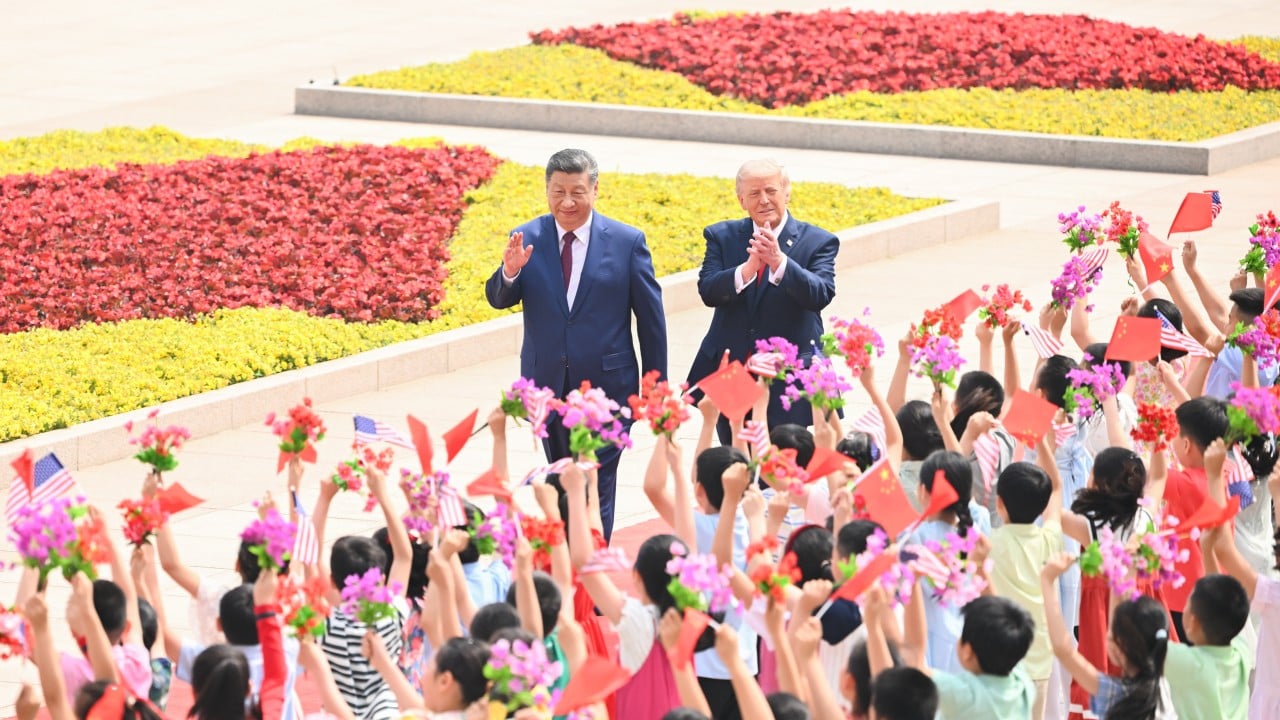
Donald Trump spent the morning of May 14, 2026, walking through the Temple of Heaven in Beijing, praising the "extraordinary distinction" of President Xi Jinping while systematically avoiding any mention of the island that could trigger a third world war. This calculated silence on Taiwan marks a fundamental departure from decades of American foreign policy. By refusing to reiterate the "inviolable" nature of U.S. support for Taipei during a high-stakes state visit, the Trump administration has signaled that the security of the self-governing democracy is no longer a non-negotiable principle, but rather a high-value chip in a larger transactional game involving rare earth minerals, trade deficits, and the cooling of a looming conflict with Iran.
The silence was deafening during the welcome ceremony at the Great Hall of the People. While Xi Ning, the Chinese foreign ministry spokesperson, was quick to post on social media that the "Taiwan question" remains the most important issue—warning of "clashes and even conflicts" if mishandled—Trump chose to pivot. He focused instead on the "magic" of American CEOs like Tim Cook and Elon Musk, who accompanied him to Beijing. This isn't just a lapse in messaging. It is a deliberate strategy to commodify geopolitical alliances.
The Geography of Interest
Trump’s recent rhetoric has grounded his hesitation in the cold reality of distance and cost. "We're 9,500 miles away," he remarked earlier this week in Washington, contrasting it with the 67 miles of water separating Taiwan from the Chinese mainland. This geographic reductionism simplifies a complex security framework into a logistical inconvenience. For a president who views the world through a profit-and-loss statement, the cost of defending a distant island is becoming harder to justify when compared to the immediate benefits of a "stable" relationship with the world's second-largest economy.
Beijing understands this transactional nature better than most. By leveraging control over rare earth elements—essential for everything from F-35 fighter jets to Tesla batteries—China has created a point of pressure that the Trump administration found impossible to ignore. A temporary truce on these export controls, reached in late 2025, is set to expire in November. The current summit is, in many ways, an attempt to trade political concessions on Taiwan for continued access to the minerals that keep the American industrial machine humming.
The Arms Sale Veto
The most alarming development for Taipei isn't just the rhetoric, but the potential freeze on military hardware. Trump has openly admitted he will discuss U.S. arms sales to Taiwan directly with Xi. This breaks the 1982 "Six Assurances," a cornerstone of U.S.-Taiwan relations that explicitly forbids consulting Beijing on such sales.
- The $14 Billion Package: A massive backlog of weaponry, including F-16 components and Harpoon missiles, remains in limbo.
- The Delay Tactic: In February 2026, the White House delayed a mandatory notification to Congress regarding these exports, citing "regional sensitivities."
- The Leverage: China has suggested that reducing these sales is a "red line" for continued economic cooperation and leader-level engagement.
The message to Taipei is clear. Your defense is contingent on the status of our trade balance.
The Iran Variable
While the world watches the Taiwan Strait, the Trump administration is looking toward the Strait of Hormuz. The ongoing conflict with Iran has strained global energy markets and put the U.S. military on high alert. Trump needs China’s cooperation to pressure Tehran into a new deal that would reopen the shipping lanes. China, as a major purchaser of Iranian oil, holds significant sway.
By softening the stance on Taiwan, the White House may be attempting to secure Chinese assistance in the Middle East. It is a grand realignment. If Beijing helps "solve" the Iran crisis, Washington might look the other way as China increases its "gray zone" pressure on Taiwan’s ADIZ (Air Defense Identification Zone). This is the new "Art of the Deal" on a global scale, where one region's stability is traded for another's.
Economic Stabilisation Over Strategic Integrity
The timing of this summit is not accidental. With the 2026 midterm elections approaching, the administration is desperate to avoid further economic shocks. High energy prices and supply chain hiccups have made the "trade war" rhetoric of Trump’s first term a political liability. The focus has shifted to "tactical stabilisation."
Business leaders in the delegation are pushing for a "Board of Trade" to manage commerce in non-sensitive sectors, effectively creating a two-tier relationship where trade continues regardless of political friction. The TikTok joint venture finalized in January 2026, which saw Oracle take control of U.S. operations while ByteDance retained a minority stake, has become the blueprint. If technology can be "managed," the administration believes territorial disputes can be "parked."
The Erosion of Deterrence
The danger of this approach lies in the erosion of "strategic ambiguity." For decades, the U.S. kept Beijing guessing whether it would intervene in a conflict over Taiwan. By signaling that everything is up for negotiation, that ambiguity is replaced by a predictable price tag.
Critics in Congress, led by a bipartisan group of senators, have urged the President to declare that support for Taiwan is not a bargaining chip. They argue that once the precedent is set—that an ally's security can be traded for trade concessions—the entire U.S.-led security architecture in the Indo-Pacific begins to crumble. Tokyo, Seoul, and Manila are watching this summit with profound unease, wondering if their own security guarantees have an expiration date.
The reality on the ground in Beijing is a masterclass in optics. Trump receives the "royal" treatment he craves, while Xi receives the one thing he needs most: the acknowledgment that China’s interests in its own backyard are valid and negotiable. As the two leaders move from the Great Hall to the state banquet, the residents of Taipei are left to wonder if they are still a partner or merely a line item on a ledger.
The summit will likely end without a formal joint statement, a sign of the deep-seated mistrust that remains beneath the smiles and handshakes. But the lack of a statement is, in itself, a statement. By not saying "Taiwan," Donald Trump said everything.