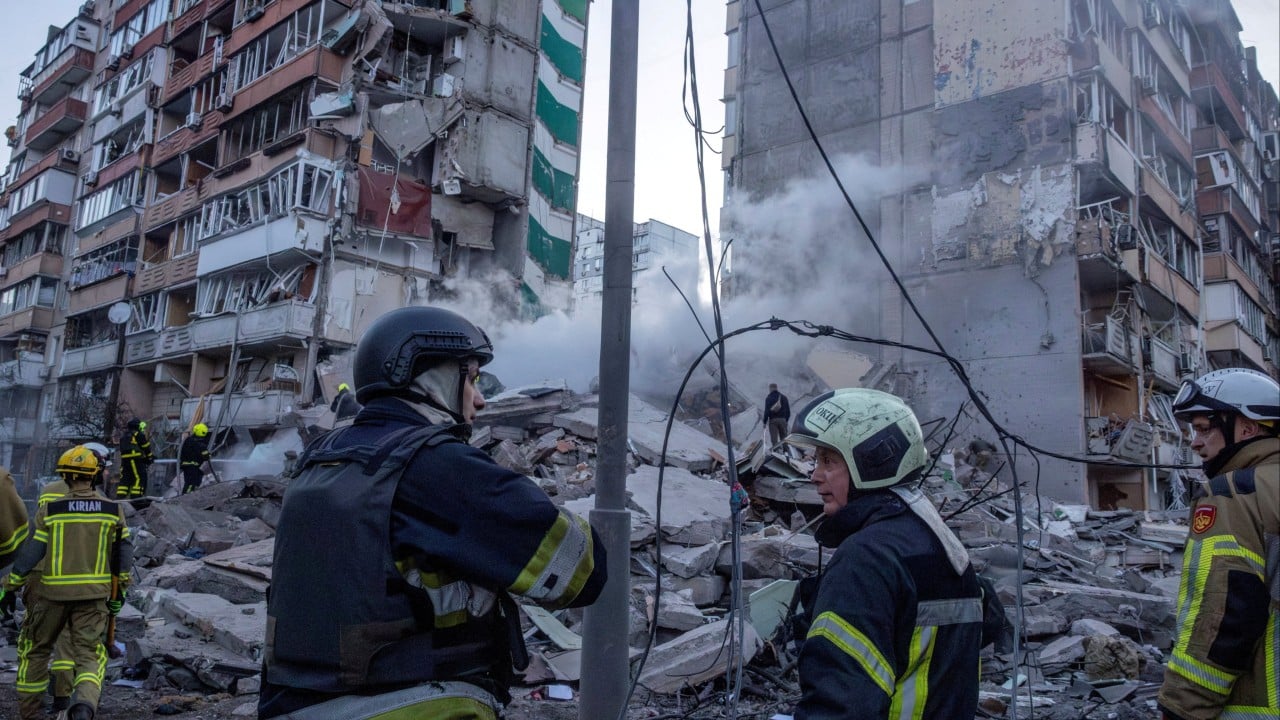
The skies over Ukraine just turned into a graveyard of hardware and hope. When 1,500 attack drones swarm across a border in a single massive wave, it isn't just another headline about a regional conflict. It’s a loud, buzzing notification that any talk of a peace deal right now is a fantasy. This recent escalation by Russia didn't just target power grids or military depots. It targeted the very idea that 2026 might be the year the guns go silent.
You’ve probably heard the talking heads on cable news debating "negotiation tables" and "frozen lines." Forget all that. When one side launches an armada of 1,500 loitering munitions, they aren't looking for an exit ramp. They're looking for a collapse. This isn't subtle. It’s a brute-force attempt to overwhelm air defenses that are already stretched thin.
Why 1,500 Drones Change Everything
Quantity has a quality all its own. That’s an old military proverb, but we’re seeing it play out in real-time with terrifying efficiency. Ukraine's air defense teams are some of the best in the world, yet even the most advanced systems have a breaking point. It’s a simple math problem. If you have 10 interceptor missiles and 50 drones are coming at you, 40 are getting through.
Russia isn't just using high-end tech here. They’re mixing expensive precision tools with cheap, "garage-built" cardboard and plywood drones designed to do one thing: make Ukraine waste its expensive Patriot or IRIS-T missiles. It’s an economic war as much as a kinetic one. Shooting down a $20,000 Shahed-style drone with a $2 million missile is a losing strategy in the long run.
I’ve looked at the data coming out of the Ukrainian General Staff and independent monitors like the Institute for the Study of War. The sheer volume of these strikes suggests Russia has shifted its domestic production into an overdrive we haven't seen since the start of the full-scale invasion. They’ve moved past the "buy from Iran" phase. They’re building these things in repurposed shopping malls and factories deep inside their own territory.
The Psychological Toll on Civilians
It’s easy to get lost in the numbers, but the human cost of 1,500 drones is staggering. These aren't silent threats. They have lawnmower engines that scream as they approach. Imagine living in Kyiv, Kharkiv, or Odesa and hearing that sound for six hours straight every night. You don't sleep. Your kids don't sleep.
The strategy here is clear. Russia wants to break the will of the Ukrainian people. They want the population to get so tired, so drained, and so cold—since many of these strikes hit energy infrastructure—that they beg their government to stop the war at any cost. But based on what I’m seeing from on-the-ground reports and polling within the country, it’s having the opposite effect. It’s hardening the resolve. People aren't sad; they're furious.
The Peace Prospect Mirage
Western diplomats keep floating the idea of a "land for peace" deal. They talk about it in quiet rooms in Brussels and D.C. like it’s a realistic option. It’s not. This massive drone wave is a direct response to that kind of talk. It’s Russia’s way of saying they don't want a piece of the pie; they want the whole bakery.
When you see 1,500 drones in the air, you’re looking at a rejection of diplomacy. It’s a signal to the international community that the Kremlin believes it can win a war of attrition. They’re betting that the West will run out of money and patience before Russia runs out of cheap drones. Honestly, looking at the political gridlock in various NATO capitals, you can see why they’d make that bet.
The Technical Evolution of the Swarm
We need to talk about how these drones have changed. They aren't just flying in straight lines anymore. We’re seeing evidence of basic AI integration for terminal guidance. Some of these drones now carry electronic warfare suites to jam local Ukrainian defenses.
Others act as decoys, flying at different altitudes to confuse radar operators. It’s a sophisticated, multi-layered attack. The goal isn't just to hit a target. The goal is to "soak" the airspace, creating so much noise and clutter that the real high-threat missiles can slip through unnoticed.
How Ukraine is Fighting Back Without Breaking the Bank
If Ukraine tried to fight this with only Western missiles, they’d be broke and defenseless in a month. Instead, they’ve gotten scrappy. You’ve probably seen the videos of "Mobile Fire Groups"—basically guys in the back of pickup guns with heavy machine guns and searchlights.
It looks like something out of a low-budget action movie, but it works. These teams are responsible for a huge percentage of drone shoot-downs. It’s a low-cost solution to a low-cost threat. They use tablets with custom apps that track the sound of the drones, allowing them to predict the flight path and set up an ambush.
- Acoustic Sensors: Networks of microphones across the country detect the specific engine hum.
- Searchlight Integration: Old-school tech meets new-school data to pinpoint targets at night.
- Cheap Kinetic Interceptors: Using FPV drones to ram into larger attack drones.
This last point is wild. We’re seeing "drone vs. drone" dogfights in the sky. A Ukrainian pilot sitting in a basement miles away uses a $500 racing drone to take out a $30,000 Russian strike drone. That’s the kind of innovation that keeps Ukraine in the fight.
The Role of Western Intelligence
Don't think for a second that Ukraine is doing this alone. The "invisible" part of this drone war is the data. Satellite feeds, signals intelligence, and high-altitude reconnaissance from NATO assets provide the early warning. Without that "eye in the sky," 1,500 drones would be an even bigger catastrophe. The real question is how much longer that data flow remains uninterrupted if the political winds shift in the West.
What This Means for Global Security
If you think this is just a Ukraine problem, you're wrong. Every bad actor on the planet is watching this. They’re seeing how a relatively mid-tier power can challenge a larger one—or how a larger one can terrorize a neighbor—using mass-produced autonomous systems.
We’re entering the era of "automated attrition." You don't need a massive air force of billion-dollar jets if you have ten thousand $10,000 drones. It changes the cost-benefit analysis of starting a war. It makes borders more porous and traditional defenses less relevant. The 1,500-drone swarm is a blueprint for future conflicts in the Middle East, the Pacific, and beyond.
The Immediate Reality on the Ground
Right now, the focus is on the power grid. Russia knows that if they can keep the lights off and the heat dead, they can create a humanitarian crisis that forces a mass exodus of refugees into Europe. That’s the "shattering" of peace mentioned in the news. Peace isn't just the absence of bullets. It’s the presence of stability. And you can't have stability when the sky is constantly trying to kill your infrastructure.
Ukraine needs more than just "thoughts and prayers" or another round of sanctions that Russia has already learned to bypass. They need physical hardware. Specifically, they need:
- Electronic Warfare (EW) Systems: To jam the GPS and control signals of the drones.
- Cheap Interceptors: More machine guns, more flak cannons, and more short-range kinetic tools.
- Energy Resilience: Decentralizing the power grid so one drone strike doesn't take out an entire city.
If you want to understand where this is going, look at the production numbers. Russia is aiming for tens of thousands of these units. Ukraine is trying to match them. The peace talks everyone is wishing for aren't happening while the factories are still humming at three shifts a day.
Stop waiting for a sudden diplomatic breakthrough. It’s not coming this month, and likely not this year. The focus has to stay on survival and adaptation. If you're following this closely, keep your eyes on the air defense success rates. That’s the only metric that actually matters right now. When that percentage drops, the danger to the entire region spikes.
Keep an eye on the updates from the Ukrainian Ministry of Digital Transformation. They’re the ones spearheading the "Army of Drones" initiative. Their ability to out-innovate a larger enemy is the only reason the front lines haven't crumbled under the weight of 1,500 daily threats. The war of the swarms is here, and it's just getting started.


:max_bytes(150000):strip_icc():focal(819x186:821x188)/Murdaugh-Family-e90854a716884d608fb6fd925e18d840.jpg)
