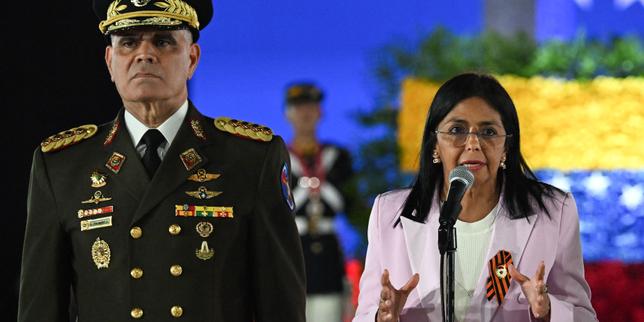
Venezuela's political chessboard just saw its most aggressive move in years. Delcy Rodriguez, acting in her capacity as interim president, has officially removed Vladimir Padrino Lopez from his long-standing position as Minister of Defense. If you've followed Venezuelan politics even casually over the last decade, you know this isn't just a routine cabinet shuffle. It's a seismic shift that signals a massive internal recalibration within the Chavismo movement. Padrino wasn't just a minister; he was the bridge between the political elite and the armed forces. Now, that bridge is gone.
This move comes at a time when the administration is clearly looking to tighten its grip. By placing someone new at the helm of the Bolivarian National Armed Forces (FANB), Rodriguez is doing more than filling a vacancy. She's sending a message to every general in the country. The old guard's job security is officially a thing of the past.
Why Padrino Lopez was the untouchable man of Caracas
For years, Vladimir Padrino Lopez seemed bulletproof. He survived coup attempts, international sanctions, and endless rumors of internal betrayal. He was the longest-serving defense minister in the country's modern history. His staying power came from a unique ability to project total loyalty to the Miraflores Palace while maintaining enough respect within the barracks to prevent a full-scale mutiny.
Most analysts thought he was too big to fail. They were wrong. The reality of Venezuelan power dynamics is that loyalty has a shelf life. When an interim leader like Delcy Rodriguez steps in and makes a move this bold, it suggests that the perceived "stability" Padrino provided was actually starting to look like a threat. In a system built on revolutionary fervor, being "too stable" can sometimes look a lot like being "too powerful."
The military is the only institution that truly matters for survival in Caracas. It controls the borders, the food distribution, and, most importantly, the weapons. By removing the man who knew where every single body was buried, Rodriguez is effectively resetting the military’s relationship with the executive branch. It’s a high-stakes gamble. If the transition isn't perfect, she risks alienating the mid-level officers who looked at Padrino as their protector.
Delcy Rodriguez and the consolidation of internal control
Delcy Rodriguez has always been a formidable strategist. She’s navigated the highest levels of the Venezuelan government for years, moving from Foreign Minister to Vice President and now into this interim role. Her decision to axe Padrino is a masterclass in asserting dominance. It tells the world—and her colleagues—that she isn't just a seat-warmer. She’s an architect of the new order.
You have to look at the timing here. Global energy markets are shifting, and internal pressure for reform is bubbling under the surface. A defense minister who has been in power for nearly a decade develops their own network of patronage. They have "their" guys in the ports and "their" guys in the oil fields. By removing Padrino, Rodriguez can dismantle those networks and install people whose loyalty is 100% tied to the current moment, not to a decade of history.
It's a classic power play. When you want to ensure your commands are followed without hesitation, you don't keep the veteran who remembers the "old way" of doing things. You bring in a fresh face who owes their entire career to your signature on a decree.
The ripple effect on the FANB
The Bolivarian National Armed Forces aren't a monolith. There are deep divisions between the top brass, who have benefited immensely from the status quo, and the lower-ranking soldiers who feel the same economic pinch as the rest of the population. Padrino was the "glue." Without him, the FANB enters a period of profound uncertainty.
The replacement of a defense minister usually triggers a wave of secondary retirements and promotions. We're likely to see a massive "cleansing" of the command structure over the next few weeks. Anyone seen as a "Padrino loyalist" is probably looking over their shoulder right now. This kind of churn creates an environment of fear, which is exactly what a centralized government needs to prevent organized dissent.
International reactions and the regional impact
The world is watching this closely, especially neighbors like Colombia and Brazil. A stable Venezuelan military is a predictable one. An unstable military, or one in the middle of a messy leadership transition, is a wild card. If the command structure becomes fractured, the ability to control the borders or manage the ongoing migration crisis could weaken.
Washington is undoubtedly crunching the data on this. Padrino was often seen as the primary point of contact for any back-channel negotiations regarding a "peaceful transition." With him out of the picture, those channels might have just gone dark. It forces the international community to deal directly with Rodriguez’s circle, which has historically been much more ideologically rigid and less prone to compromise.
What this means for the average citizen
Does this change the price of bread in Caracas? Probably not today. But it changes the long-term outlook for the country's governance. When the military leadership is reshuffled so drastically, it usually precedes a shift in how the state handles internal security. You can expect to see a more aggressive stance toward any form of protest. The new leadership will want to prove their worth immediately.
The military's role in the economy is also likely to expand or be "reorganized." Since the FANB manages so much of the country's infrastructure, a change at the top means new hands on the levers of the economy. For the average person, this just means a different set of uniforms overseeing the same systemic issues.
Understanding the mechanics of a military dismissal
In Venezuela, a dismissal of this scale isn't just a letter from the human resources department. It’s a televised event, a symbolic stripping of power. It usually involves a public ceremony where the outgoing official pledges their "undying loyalty" to the revolution, even as they're being pushed out the door. It’s a theater of unity designed to mask the very real cracks in the foundation.
Padrino’s departure marks the end of an era. He was the face of the military during the country's most turbulent years. His removal suggests that the government believes the "defense" phase of the revolution is over and the "consolidation" phase has begun. They don't need a defender anymore; they need an enforcer who doesn't have a legacy to protect.
The road ahead for the Venezuelan executive
If you're looking for what happens next, watch the promotion lists. The names that fill the vacancies left by Padrino’s exit will tell you everything you need to know about the government's direction. Are they hardliners? Are they younger officers with no ties to the pre-2014 era? The answers to those questions will define the next five years of Venezuelan history.
Rodriguez has taken a massive leap. If the military accepts this change without a murmur, her power is absolute. If there is friction, we might be looking at the beginning of a very different kind of story. Power in Caracas has always been a balancing act between three pillars: the party, the people, and the guns. Right now, Delcy Rodriguez just tried to seize the guns for herself.
Keep an eye on the official gazette. The true story isn't in the speeches; it's in the fine print of the appointments that follow. The chess game is far from over, but the most important piece on the board has just been swapped out. For anyone trying to understand where the country is headed, start by looking at who is now standing behind the podium at the Ministry of Defense. Their background, their training, and their specific branch of service will dictate the tone of the "new" Venezuela. Don't expect a softening of the state's stance. If anything, this move suggests the circle is closing, and those inside it are tighter than ever.