The fluorescent lights in an Ohio diner buzz at a frequency that rattles your teeth if you sit there long enough, especially at six in the morning when the coffee tastes like burnt toast and the news anchors on the corner television are already shouting.
Wait. If you liked this post, you might want to check out: this related article.
Listen to the silence between the shouting.
For months, the political class has stared at spreadsheets, obsessively refreshing polling averages and arguing over razor-thin margins in suburban districts. They treat the American midterm elections like a sporting event with colorful maps and horse-race commentary. Yet if the pollsters actually get it right this time—if the historical pendulum swings the way decades of data suggest it almost always does against the party holding the White House—the real story will not unfold on a television studio floor in Manhattan. It will happen at kitchen tables, in hospital billing offices, and on factory floors across the country. For another angle on this development, see the latest coverage from Al Jazeera.
To understand what a divided government actually means when the dust settles, picture a hypothetical family living just outside Columbus. Let’s call them Elena and Marcus. Elena manages logistics for a mid-sized medical supply distributor; Marcus teaches high school history. They do not spend their weekends attending rallies or donating to super PACs. They care about whether their mortgage rate will ever drop enough to refinance, whether the prescription drugs for Elena’s aging father will bankrupt their savings, and whether the local school district will have the federal funding it promised for special education next autumn.
When pollsters predict a shift in control of Congress—specifically, the opposing party capturing the House of Representatives while the Senate remains locked in a trench war—political analysts call it "gridlock." That word sounds sterile, almost boring, like traffic moving slowly on a rainy Tuesday. In reality, gridlock is a sudden, violent braking of the entire machinery of federal governance.
The Architecture of a Sudden Stop
In nearly every midterm election since the Civil War, the president’s party has lost seats in the House. The exceptions—1934, 1998, 2002—are remembered precisely because they required extraordinary historical anomalies, like the Great Depression or the immediate aftermath of September 11. Standard political gravity pulls hard against incumbent power. Voters use the midterms not as an endorsement of the opposition, but as a collective slap on the wrist to whoever currently holds the microphone.
Suppose the numbers hold and the opposition takes the gavel in the lower chamber. Overnight, the legislative pipeline freezes solid.
Think of the federal government as an old, sprawling house with two separate circuit breakers in the basement. For the first two years of a presidency, one party usually controls both switches, allowing them to push through sweeping tax overhauls, healthcare adjustments, or infrastructure spending. The moment the House flips, someone walks into the basement and snaps one of those switches off. Nothing major passes without a compromise that neither side’s base will allow them to make.
For Elena and Marcus, this is not an abstract constitutional theory. If Congress deadlocks on expiring tax provisions or healthcare subsidies, the uncertainty ripples directly into their monthly budget. Businesses, sensing that regulatory rules and corporate tax rates are frozen in amber—or worse, about to become hostages in budget negotiations—pull back on hiring and capital investment. I have sat in boardrooms during past midterm transitions where chief financial officers literally closed their laptops mid-presentation, waiting to see which way the legislative wind would blow before approving a new warehouse or a round of raises.
Wall Street, paradoxically, often cheers this paralysis. Investors tend to prefer a government that cannot pass new regulations or raise taxes. The S&P 500 has historically performed remarkably well in the twelve months following a midterm election, largely because uncertainty gives way to predictable inaction. Yet what comforts a hedge fund manager in Greenwich can feel like slow suffocation to a family waiting on federal action for childcare costs or prescription drug caps.
Subpoenas Replace Statutes
When lawmakers can no longer pass bills, they do not simply go home and tend their gardens. They turn into investigators.
If the polling projections hold, the immediate aftermath of the election will usher in an era of relentless congressional oversight. Committee chairs who spent the last two years in the minority suddenly gain subpoena power. The legislative calendar gives way to televised hearings, document demands, and investigations into executive branch agencies, supply chain failures, border enforcement, or pandemic spending.
This shift changes the daily oxygen of Washington. Cabinet secretaries spend less time managing departments and more time sitting behind green felt tables, flanked by lawyers, answering rapid-fire questions designed to produce thirty-second viral clips.
Consider what happens next: because the White House cannot move its agenda through Congress, the president almost inevitably turns to the executive pen. We saw this playbook perfected during the Obama, Trump, and Biden administrations alike. When Capitol Hill locks its doors, the Oval Office governs through executive orders, regulatory rule changes, and agency directives.
Here is the catch, and it is a painful one for anyone trying to plan a life or a business around government policy. Laws passed by Congress are etched in stone; undoing them requires another act of Congress. Executive actions are written in wet sand. They are immediately challenged in federal courts, frozen by injunctions from sympathetic judges in Texas or California, and wiped away the moment a new administration takes office. For Elena’s medical supply company, trying to comply with federal environmental or labor standards under a divided government feels like trying to hit a moving target in the dark.
The Debt Ceiling Brinkmanship
There is one area where gridlock stops being merely frustrating and becomes genuinely dangerous.
Every so often, the United States government must raise its statutory borrowing limit—the debt ceiling—to pay for spending that Congress has already approved. Under a unified government, raising that limit is usually a quiet, procedural vote. Under a divided government, it becomes a game of high-stakes chicken played on the edge of a cliff.
History offers stark reminders of what this looks like. During the 2011 standoff between a Democratic president and a newly elected Republican House majority, negotiations dragged so close to the deadline of default that Standard & Poor’s downgraded the credit rating of the United States for the very first time. Mortgage rates jumped. Consumer confidence plunged to levels not seen since the depths of the 2008 financial crisis. Retirement accounts lost trillions of dollars in paper value within weeks.
If pollsters are right about the upcoming congressional map, the newly empowered House majority will almost certainly use the debt ceiling and annual government funding bills as leverage to force spending cuts. The White House will refuse to negotiate under threat of default. Markets will jitter. Federal workers—from air traffic controllers to park rangers—will begin calculating how many weeks of groceries they can afford if a government shutdown furloughs them without immediate pay.
I remember walking past the closed gates of a national monument during a previous shutdown, watching a family from Germany stare in confusion at a laminated paper sign taped to a chain-link fence. They had saved for three years for that trip. To Washington insiders, a shutdown is a tactical maneuver in a messaging war. To everyone else, it is a broken promise.
What Happens to the Senate and the Courts?
Even if the House flips, the Senate remains the great wildcard of midterm math. Because only a third of Senate seats are up for election in any given cycle, the map rarely mirrors the House wave.
If the president’s party manages to hold the Senate—even by a single vote—the administration retains one vital lifeline: judicial confirmations. Federal judges serve lifetime appointments. A sympathetic Senate can continue confirming district and appellate judges, quietly reshaping the legal architecture of the country for the next thirty years on issues ranging from reproductive rights to corporate liability and environmental law.
Conversely, if the opposition captures both chambers, even that door slams shut. Judicial nominations stall. Ambassadorial posts sit vacant. Cabinet vacancies become nearly impossible to fill with permanent appointees, forcing the administration to rely on temporary "acting" officials whose authority is constantly questioned in court.
And what about foreign policy? Adversaries abroad read American polling data just as carefully as campaign strategists in Washington. When a sitting president loses control of Congress, foreign leaders often conclude that the administration has become a lame duck—weakened at home and unable to guarantee long-term financial or military commitments abroad. Trade agreements stall because foreign governments refuse to make painful concessions for a treaty that the Senate will never ratify. Funding for foreign allies becomes a bargaining chip in domestic budget fights.
The Illusion of the Polling Map
We have to be honest about one unsettling truth, though. Talking about what happens if the pollsters get it right carries a quiet, nagging asterisk: pollsters have struggled mightily to measure the modern American electorate.
Traditional polling relies on modeling who will actually show up to vote. In presidential years, turnout is massive and somewhat predictable. In midterms, turnout drops sharply, transforming the electorate into an older, wealthier, and more ideologically motivated group. A two-percent miss in turnout modeling—failing to capture a surge of angry suburban voters or an unexpected wave of rural enthusiasm—can turn a predicted red wave into a ripple, or turn a narrow blue hold into a rout.
That uncertainty is precisely why the days immediately following the election feel so disorienting. Even when the results are clear, the interpretation begins before the final ballots are counted in California or Arizona. Both sides claim a mandate. Both sides insist the voters sent an unmistakable message, even when the actual margin of victory across dozens of swing districts comes down to a few thousand votes—fewer people than fill a minor league baseball stadium.
Yet once the speeches fade and the yard signs are pulled from damp lawns, the mechanics of power take over.
The Quiet Shift at Home
Return for a moment to Elena and Marcus in Ohio.
If the polls prove accurate, their lives will not change overnight with a dramatic headline. Instead, the change will arrive slowly, like winter creeping under a doorframe.
It will show up when Marcus’s school board delays hiring a new counselor because federal grant renewals are stuck in a House appropriations committee. It will appear when Elena’s company freezes its expansion into a neighboring state because no one knows whether federal healthcare reimbursement rules will survive the next round of budget negotiations. It will linger in the background every evening when the news turns into an endless loop of committee subpoenas and debt ceiling countdown clocks.
This is the true nature of a midterm shift. Voters go to the polls hoping to break a fever, to punish excesses, or to restore balance to a system that feels out of control. What they actually purchase is a two-year truce enforced by mutual paralysis—a system designed by the founders to prevent tyranny, yet one that often feels indistinguishable from neglect when real problems demand urgent answers.
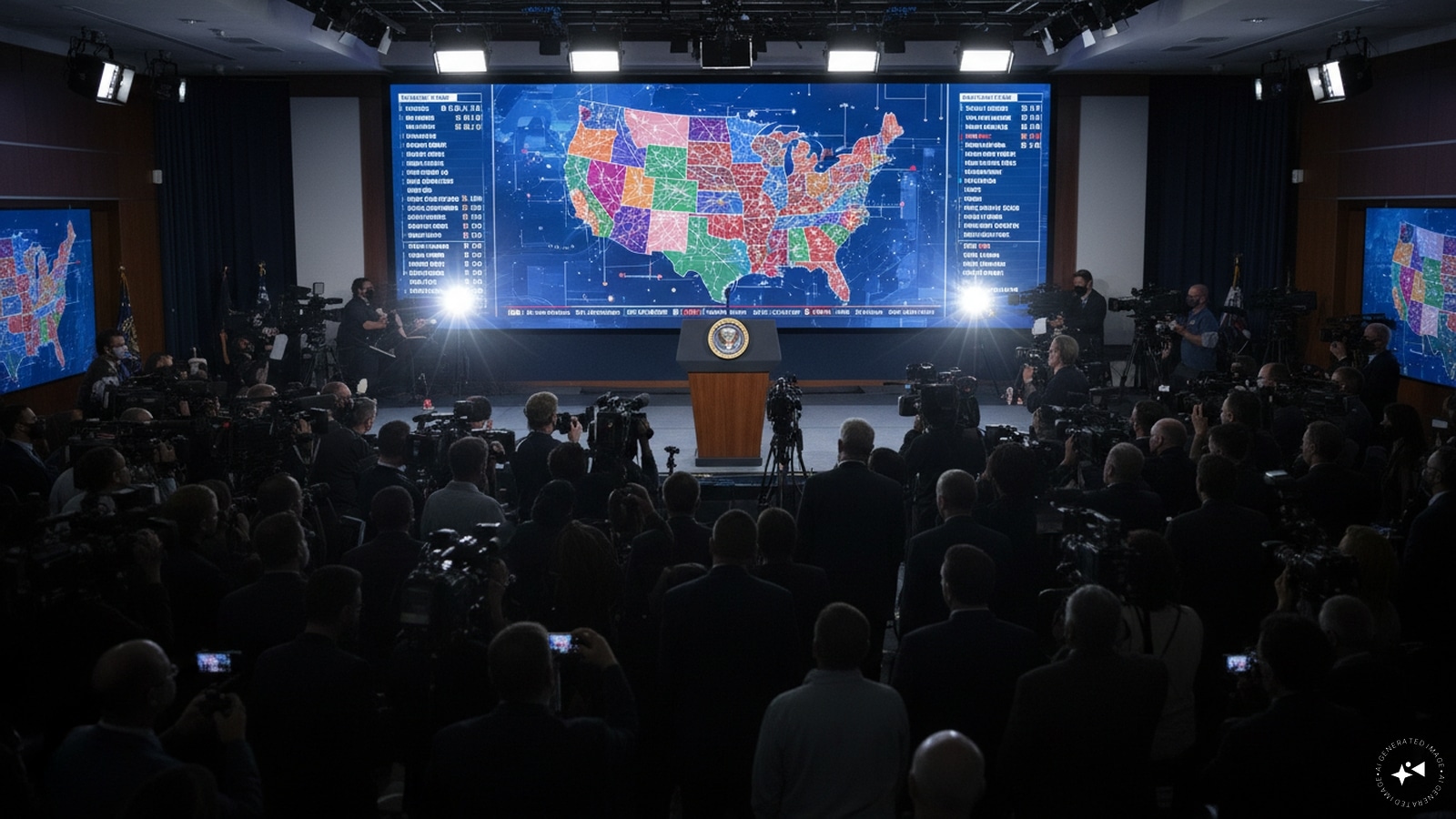
Outside that Ohio diner, the morning rush picks up. Cars pull onto the highway, headlights cutting through the gray mist, drivers already thinking about traffic, deadlines, and bills due at the end of the month. Inside, the television anchor moves on to the next segment, pointing at a glowing map of red and blue districts as if the colors themselves were the story, never once noticing the coffee growing cold on the counter below.