When Donald Trump signed the Countering America's Adversaries Through Sanctions Act into law, official Washington framed it as a decisive blow against the Kremlin. That was the public line. Behind closed doors on Capitol Hill and inside the State Department, the mood was remarkably different. Lawmakers had backed the executive branch into a corner, drafting a legislative package so airtight that the White House could not issue a veto without inviting immediate political suicide.
Months earlier, reports broke that Donald Trump signed Russia sanctions legislation under intense bipartisan pressure, effectively transforming a tool of foreign policy into a domestic political hostage. But the statute itself told a far more complex story about how economic statecraft actually functions when the legislative and executive branches are locked in a structural war of attrition.
The Legislative Trap That Left No Escape
Congress did not arrive at the sanctions package by accident. Intelligence reports detailing interference in domestic elections had created an atmosphere where opposing the legislation meant opening oneself up to immediate accusations of leniency toward Moscow. When a bill passes the Senate 98 to 2 and clears the House by an overwhelming 419 to 3 margin, it ceases to be a normal piece of legislation. It becomes a veto-proof freight train.
The administration understood the trap. To reject the measure would trigger a guaranteed override, advertising internal divisions to foreign adversaries and feeding a constant drip of unfavorable headlines. Yet signing it meant accepting a statutory handcuffs arrangement. The law stripped away significant executive flexibility, dictating mandatory penalties on energy pipelines, defense sectors, and sovereign debt holdings while establishing strict congressional notification requirements before any sanctions could be waived or eased.
This dynamic exposed a fundamental tension in the American constitutional framework. Foreign policy is historically the domain of the executive branch, driven by diplomats who prefer the freedom to bargain, adjust, and calibrate pressure based on shifting geopolitical leverage. Congress, conversely, prefers blunt instruments. Lawmakers write rules designed to tie future hands precisely because they distrust the current administration's diplomatic instincts.
Mechanics of Economic Coercion
The statute targeted specific veins of the Russian economy, focusing heavily on energy infrastructure and defense exports. These sectors represented the primary hard currency earners for the Russian state. Cutting off access to Western financial markets and penalizing international corporations collaborating on pipeline projects like Nord Stream 2 was designed to force a strategic reevaluation in Moscow.
Yet economic coercion rarely operates in a vacuum. The unintended consequences rippled quickly through European capitals. Continental energy security was tightly wound around Russian natural gas supplies. European firms heavily invested in joint ventures suddenly found themselves facing American secondary sanctions, forcing corporate boardrooms to choose between abandoning multi-billion-dollar infrastructure investments or risking total exclusion from the US banking system.
Diplomats in Berlin and Brussels were furious. They viewed the legislation as an exercise of extraterritorial overreach, a classic case of Washington writing domestic laws that dictated commercial terms for foreign allies. The resulting friction demonstrated the limits of unilateral economic warfare in a globally integrated market. When you penalize an adversary, you frequently end up collateral-damaging your closest trading partners, creating diplomatic fractures that the Kremlin could exploit.
The Reality of Enforcement Discretion
Passing a law and enforcing it are two entirely different administrative realities. Once the ink dried, the hard work shifted from Capitol Hill drafting desks to the quiet offices of the Treasury Department’s Office of Foreign Assets Control. Bureaucrats and career analysts were tasked with turning sweeping statutory mandates into practical, legally defensible enforcement actions.
Enforcement discretion became the primary battleground. The executive branch retained immense leeway in how aggressively to pursue targets, how to define threshold violations, and when to grant temporary waivers for national security interests. Consequently, many of the most severe potential penalties were applied selectively. Certain entities faced immediate designation, while others lingered in bureaucratic review purgatory.
This gap between legislative rhetoric and administrative reality revealed the enduring truth of bureaucratic governance. Laws can mandate goals, but they cannot manufacture institutional enthusiasm. When an administration is fundamentally skeptical of a policy tool handed to it by Congress, implementation tends to mimic compliance rather than zealous execution.
The Broader Lessons for Global Statecraft
Years removed from that legislative showdown, the episode serves as a case study in the limits of legislative coercion. Sanctions can disrupt transactions, freeze assets, and signal serious displeasure, but they rarely alter core strategic calculations of nuclear-armed adversaries on their own. Instead, they institutionalize economic warfare, turning trade networks into permanent battlefields where every transaction requires legal clearance.
The reliance on financial penalties as the primary instrument of foreign policy also carries a long-term systemic risk. When the US dollar and Western financial clearing houses are weaponized too frequently, target nations accelerate efforts to build alternative settlement systems, reduce dollar dependency, and decouple their economies from Western oversight.
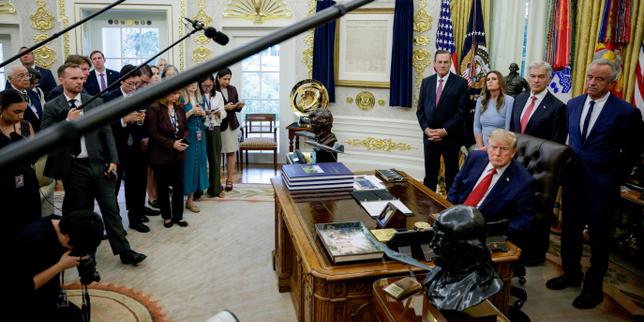
History will record that Donald Trump signed Russia sanctions into law during a moment of acute domestic political friction. But the deeper legacy of that afternoon in the Oval Office is not about partisan gamesmanship. It stands as a stark reminder of what happens when lawmakers attempt to legislate geopolitics through the barrel of a financial penalty, leaving the executive branch to navigate the messy reality of global markets, angry allies, and unintended economic fallout.