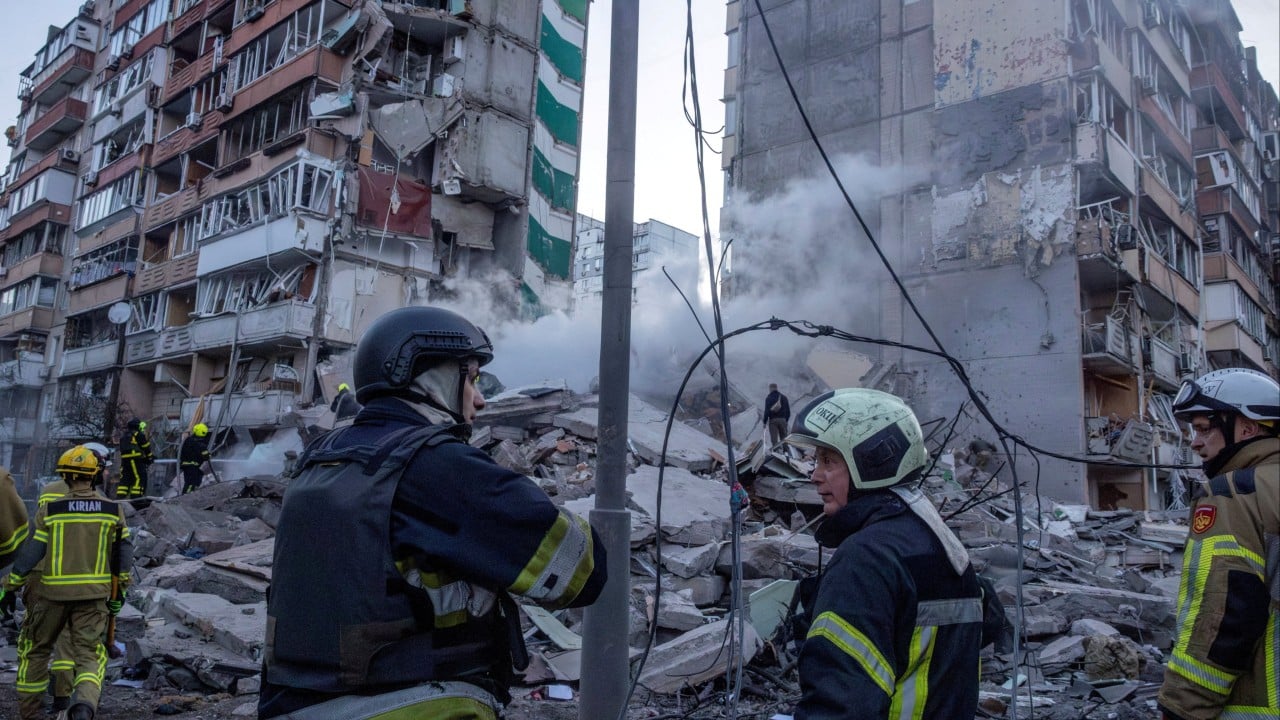
The Russian Federation’s shift toward a high-frequency, wide-area bombardment strategy represents a pivot from tactical front-line support to the systematic degradation of Ukraine’s national sustainability. By striking targets in Western and Central Ukraine—regions geographically removed from the kinetic contact zone—Moscow is executing a multi-domain pressure campaign designed to overwhelm air defense saturation points, disrupt the logistics of Western materiel, and collapse the civilian psychological threshold. This is not a series of isolated incidents but a calculated application of "Strategic Depth Attrition," where the target is the structural integrity of the state itself rather than specific military formations.
The Calculus of Volumetric Saturation
Russia’s current aerial doctrine relies on the principle of asymmetric cost imposition. The deployment of low-cost loitering munitions, such as the Geran-2, alongside high-velocity cruise and ballistic missiles creates a "Target Saturation Dilemma" for Ukrainian defenders.
The Interceptor Economics Gap
The cost-exchange ratio is the primary metric of this campaign. When a $20,000 Shahed-class drone forces the expenditure of a $2 million to $4 million MIM-104 Patriot interceptor, the Russian strategic goal is achieved regardless of whether the drone hits its physical target.
- Primary Effect: The depletion of finite interceptor stockpiles.
- Secondary Effect: The forced relocation of air defense assets from the front lines to protect urban centers, leaving ground troops vulnerable to Russian Close Air Support (CAS) and glide bombs.
- Tertiary Effect: Financial exhaustion of Western donor states tasked with replenishing high-tech munitions.
Layered Strike Vectors
Moscow utilizes a "Mixed-Load" approach to penetrate Ukrainian airspace. A typical strike package involves three distinct tiers of technology:
- Decoys and EW: Older missiles with removed warheads or drones equipped with Lüneburg lenses to mimic larger aircraft, forcing radar systems to stay active and reveal their positions.
- Saturation Drones: High volumes of slow-moving targets that distract automated defense systems.
- High-Value Projectiles: Kh-101 cruise missiles, Kalibr variants, and Kinzhal hypersonic missiles that exploit the gaps created by the first two tiers.
Disruption of the Logistic Rear
Striking regions like Lviv, Lutsk, and Ivano-Frankivsk serves an operational purpose: the interdiction of the "Western Pipeline." Ukraine’s ability to sustain a prolonged war of attrition depends on the unimpeded flow of equipment across the Polish and Romanian borders.
The Trans-Shipment Bottleneck
Most Western aid enters through a handful of terrestrial hubs. By targeting rail infrastructure and power substations in Western Ukraine, Russia attempts to create "Logistical Friction." This does not necessarily stop the flow of arms but increases the lead time between a shipment arriving at the border and its deployment at the Donbas front.
Kinetic Energy vs. Infrastructure Resilience
The targeting of the electrical grid is a forced multiplier. Modern military logistics—including the repair of damaged Western tanks and the coordination of troop movements—require stable power and communications. The "Energy-Logistics Nexus" means that a strike on a transformer in the far west has a direct, measurable impact on the combat readiness of a brigade in the east within 72 to 96 hours.
The Psychological War of Attrition
The expansion of the strike zone to include previously "safe" cities in the west is a form of socio-economic destabilization. The Russian command is betting on the erosion of the "Internal Refugee Buffer."
The Displacement Feedback Loop
Early in the conflict, Western Ukraine served as a massive internal displacement hub, allowing the workforce to remain within the country while staying out of the immediate line of fire. By removing the safety of the rear, Moscow aims to:
- Trigger new waves of external migration to the EU, increasing political pressure on Western governments.
- Hinder the domestic production of drones and munitions, which has been increasingly localized in Western Ukraine.
- Degrade the "Normalization Bias"—the ability of the civilian population to maintain a functioning wartime economy.
Strategic Constraints and Failure Points
Despite the scale of these strikes, the Russian campaign faces significant structural limitations. The "Precision Munition Burn Rate" is the most critical constraint. Russia has transitioned to using missiles produced within weeks of their launch, indicating that they are operating at the edge of their industrial capacity.
Intelligence Gaps and Accuracy
Long-range strikes are only as effective as the intelligence driving them. The reliance on satellite imagery with varying refresh rates and human intelligence (HUMINT) in hostile territory leads to a high "Miss-to-Kill" ratio. Many strikes hit residential areas not by intent, but due to GPS jamming, electronic warfare interference, or the failure of aging inertial navigation systems.
Adaptation of Ukrainian Integrated Air Defense Systems (IADS)
Ukraine has moved toward a "Network-Centric Defense" model. By integrating disparate systems—Soviet S-300s, German IRIS-T, American Patriots, and NASAMS—into a single data-sharing environment, they have increased their "Probability of Kill" (Pk). This integration allows for:
- Sensor Fusion: Using civilian smartphone apps and acoustic sensors to track low-flying drones that bypass traditional radar.
- Energy Management: Keeping high-end radars cold until the last possible second to avoid anti-radiation missiles.
Technical Analysis of Strike Evolution
The shift from 2023 to 2026 patterns shows a move toward "Terminal Maneuvering." Newer iterations of the Kh-101 missiles have been observed deploying flares and chaff during their final approach. This evolution suggests that the Russian military-industrial complex is actively iterating based on battlefield data, treating the Ukrainian theater as a live-fire laboratory for bypassing NATO-standard defense systems.
The second critical evolution is the "Time-on-Target" synchronization. Russia is increasingly hitting targets with multiple vectors (drones, cruise, and ballistic) simultaneously. This "Convergence Strike" ensures that even if 90% of the projectiles are intercepted, the 10% that break through are concentrated on a single high-value node, ensuring its destruction.
Strategic Play: The Counter-Saturation Mandate
The current defensive posture is reactive and unsustainable in a multi-year timeframe. To break the logic of Strategic Depth Attrition, the defensive strategy must shift toward "Proactive Interdiction."
- Neutralization of the Launch Platform: The only way to restore the cost-exchange ratio is to destroy the Tu-95 and Tu-160 bombers and the ground-based Iskander launchers before they fire. This requires long-range kinetic capabilities that can reach airfields deep inside Russian territory.
- Hardening of the Energy Spine: Transitioning from centralized power hubs to a "Distributed Microgrid" model. By modularizing the power supply, the impact of a single cruise missile strike is localized, preventing regional blackouts.
- Low-Cost Interception Scale: The mass production of "Counter-Drone Drones"—cheap, FPV-style interceptors that can down Shaheds using physical impact or small explosive charges—to preserve the $4 million Patriot missiles for hypersonic threats.
The conflict has entered a phase where the "Rear" is a misnomer. The geographical distance from the front is no longer a proxy for safety; instead, safety is a function of electronic warfare density and interceptor inventory. The side that first solves the "Volume vs. Precision" economic puzzle will dictate the terms of the war’s next phase. Moscow is betting on Ukraine’s exhaustion; Ukraine’s counter must be the total automation and commoditization of its defense.