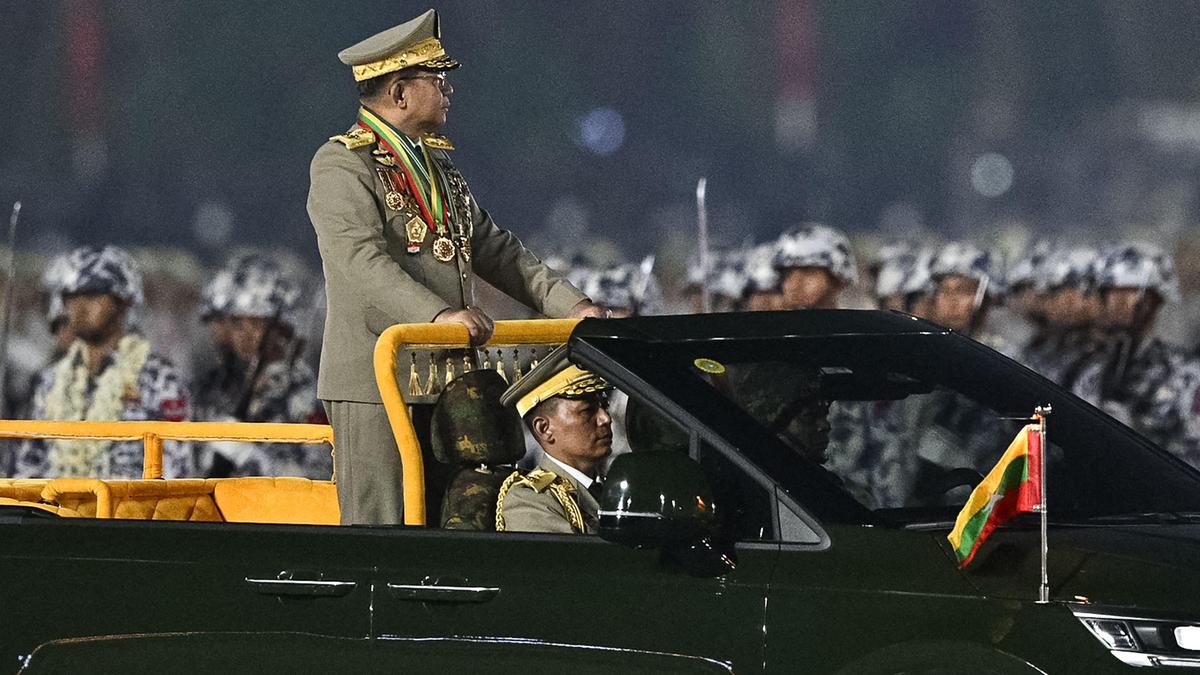
The annual Armed Forces Day parade in Naypyidaw serves as a primary signaling mechanism for the State Administration Council (SAC), functioning less as a display of martial strength and more as a theater of internal hierarchical recalibration. While international observers often focus on the hardware—missiles and tanks—the true data lies in the physical positioning of the officer corps and the rhetorical shifts in the Commander-in-Chief’s address. Current indicators suggest the SAC is initiating a phase of "controlled transition," a strategic attempt to solve the looming crisis of leadership stagnation while maintaining the institutional integrity of the Tatmadaw.
The Institutional Dilemma of Seniority
The Myanmar military operates under a rigid seniority-based promotion system that has historically created a bottleneck at the top. Senior General Min Aung Hlaing and his immediate subordinates face a "Exit Strategy Paradox": they cannot retire without risking legal or physical retaliation from internal rivals or external resistance forces, yet they cannot remain indefinitely without stifling the upward mobility of the younger Brigadier Generals and Major Generals who command active combat operations.
The current signals of leadership change are not an admission of weakness, but a calculated redistribution of risk. By elevating a new tier of officers into administrative and decorative roles, the senior leadership achieves three specific objectives:
- Proximal Insulation: Placing "next-generation" loyalists in key ministerial or regional command positions creates a buffer between the core junta leadership and the operational failures on the peripheries.
- Incentive Alignment: It signals to the mid-career officer corps—those currently bearing the brunt of the conflict against People’s Defense Forces (PDFs) and Ethnic Armed Organizations (EAOs)—ories that the path to the "Golden Tier" of the SAC remains open.
- Diplomatic Optionality: New faces allow for a theoretical "reset" in back-channel negotiations with regional powers like ASEAN or China, offering the appearance of reform without altering the underlying power structure.
The Logistics of the Parade as a Power Metric
Analysis of the 2026 parade formation reveals a significant deviation from traditional staging. The attendance of foreign military attaches, or the lack thereof, provides a quantifiable metric of the SAC’s international isolation. However, the internal "Distance from the Center" metric is more telling.
In military juntas, physical proximity to the Commander-in-Chief during the review of troops correlates directly with political capital. The presence of specific retired generals or the sudden elevation of previously sidelined officers into the "Reviewing Stand" indicates a shift in the internal coalition. We are observing a transition from a "War Cabinet" footing toward a "Bureaucratic Survival" footing. The military is attempting to transition its identity from an active combatant force—which is currently struggling to maintain territorial control—back to its preferred role as the "Permanent Overseer" of the state.
The Strategic Failure of Territorial Consolidation
The primary variable driving these leadership changes is the failure of the "Four Cuts" strategy in the borderlands. The loss of key trade hubs along the Chinese border and the sustained resistance in the Dry Zone have broken the military's monopoly on violence. This loss of territory has a direct impact on the military’s internal economy.
The Tatmadaw is not just a military; it is a conglomerate. The leadership changes are inextricably linked to the management of the Myanma Economic Holdings Limited (MEHL) and Myanmar Economic Corporation (MEC). When a regional commander loses a border crossing, they lose a revenue stream. Leadership changes in Naypyidaw are often the result of this "Economic Performance Review." An officer who cannot protect the extraction of jade, timber, or the transit of goods is an institutional liability.
The structural logic follows a predictable cycle:
- Territorial Loss: Leads to decreased revenue for the central command.
- Institutional Friction: Discontent grows among the lower ranks who face resource shortages.
- Leadership Purge: The SAC replaces the commander to signal accountability while centralizing remaining assets.
The Mechanism of the "Sham Election" Pivot
The parade rhetoric regarding "returning to a path of democracy" is a structural necessity for the military’s long-term survival. This is the "Constitutional Off-Ramp." The military requires a civilian or semi-civilian veneer to facilitate international investment and reduce the efficacy of sanctions.
The leadership changes signaled at the parade are the first stage of vetting the candidates for this future civilianized administration. The SAC is looking for "Technocratic Loyalists"—officers who can trade their uniforms for suits without threatening the military’s veto power over national security and budget. This process requires a delicate balance; if the transition is too fast, the military loses control; if it is too slow, the economy collapses under the weight of its own isolation.
The Resistance Variable and Intelligence Gaps
A critical limitation in any analysis of Myanmar’s internal military dynamics is the "Opacity of the Barracks." The SAC maintains a high level of compartmentalization, meaning that leadership changes often appear abrupt to external observers. However, the cause-and-effect relationship between resistance successes and Naypyidaw’s reshuffling is undeniable.
The military's reliance on airpower and heavy artillery, as showcased in the parade, masks a deepening crisis in human intelligence and infantry morale. When the leadership signals "change," it is often a defensive reaction to an intelligence breach or a localized mutiny that has not yet reached international news cycles.
The Tactical Utility of Modernized Weaponry
The hardware displayed in the parade—unmanned aerial vehicles (UAVs) and precision-guided munitions—reflects a shift in the military's cost function. Infantry-based pacification is expensive in terms of both political capital (casually counts) and actual capital. The SAC is pivoting toward a "Technological Deterrence" model. By showcasing advanced systems, they are attempting to convince the resistance that the cost of an urban offensive is prohibitively high.
This is a psychological operation directed at the urban populations of Yangon and Mandalay. The message is simple: regardless of territorial losses in the mountains, the heartland remains under a technological canopy that can be deployed at will.
The Geopolitical Anchor
The presence of Russian or Chinese hardware and personnel serves as a geopolitical signaling tool. For the SAC, these relationships are the "Stability Floor." As long as at least one permanent member of the UN Security Council provides a diplomatic shield and a weapons pipeline, the military believes it can outlast the resistance through a war of attrition. The leadership changes are often calibrated to satisfy these patrons—ensuring that the officers in charge are those most capable of managing these high-value bilateral relationships.
The Failure of the "Centralized Command" Model
The most significant structural risk to the SAC is the breakdown of the centralized command-and-control (C2) architecture. Historically, the Tatmadaw was a monolithic entity where orders from Naypyidaw were executed without question. The current conflict has forced a decentralization of authority to regional commanders out of necessity.
This decentralization creates "Warlordism." A regional commander with his own revenue stream and a loyal local force is a potential threat to the Senior General. The leadership changes signaled during the parade are a mechanism to re-centralize power. By rotating commanders frequently, the SAC prevents any single officer from building a power base sufficient to launch a coup or negotiate a separate peace with the resistance.
Strategic Recommendation for External Stakeholders
The military’s leadership changes should be viewed as an internal inventory management process, not a genuine shift in political philosophy. The SAC is optimizing for "Institutional Longevity" in an environment of diminishing resources.
The most effective counter-strategy involves targeting the "Friction Points" identified in this analysis:
- Revenue Interdiction: Focus sanctions on the specific entities managed by the newly promoted officers to disrupt the "Incentive Alignment" within the upper ranks.
- Information Operations: Highlight the disparity between the "Golden Tier" officer class in Naypyidaw and the "Expendable Tier" on the front lines to accelerate the erosion of morale.
- Diplomatic Non-Recognition: Refuse to validate the "Technocratic Loyalist" transition by maintaining that any "civilianized" government led by former SAC members is merely a functional extension of the junta.
The military is currently at its most vulnerable when its internal hierarchy is in flux. The window between a leadership reshuffle and the consolidation of the new hierarchy is the period of maximum institutional fragility. This is the moment to apply systemic pressure.
The SAC’s current trajectory suggests a move toward a "Garrison State" model—a smaller, more technologically advanced, and highly insular force that abandons the periphery to hold the center. The leadership changes observed today are the foundational steps of this contraction. The strategic priority for the resistance and the international community must be to prevent this contraction from stabilizing into a permanent political reality.