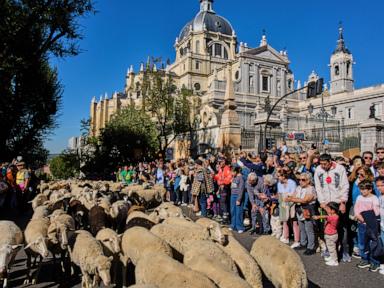
Every media outlet covering Madrid’s decision to reroute thousands of migrating sheep around a housing protest camp in Plaza de Callao fell for the exact same lazy framing. They treated it like a charming logistical hiccup. A quirky collision between centuries-old pastoral tradition and modern urban activism.
That narrative is completely backwards.
What happened during the Fiesta de la Trashumancia wasn't a cute scheduling conflict between shepherds and students. It was a live-action demonstration of how major European cities weaponize sterilized heritage to distract from systemic economic failure. When municipal authorities calmly redirect livestock away from citizens demanding affordable shelter, they aren't preserving culture. They are curating a theme park while the actual city burns down around the perimeter.
The Lazy Consensus of "Quirky Heritage"
Read the standard wire reports on this incident and you will find the exact same formula. First, a paragraph marveling at the medieval roots of trashumancia—the ancient right of herders to move livestock along traditional droving routes, known as cañadas reales, right through the heart of Spain’s capital. Second, a brief mention that thousands of Merino sheep had to detour around tents pitched by housing activists in central Madrid. Third, a warm, fuzzy wrap-up about how tradition always finds a way.
This framing misses the entire structural reality of what a cañada real actually represents.
Historically, transhumance was never a tourist spectacle. Under the Honored Council of the Mesta, established by King Alfonso X in 1273, those migratory corridors were hard-nosed economic infrastructure. Wool was Spain’s primary export engine. The state protected those routes with ruthless legal authority because the survival of the Castilian economy depended on moving livestock between summer mountain pastures and winter lowland grazing grounds.
Today, the Fiesta de la Trashumancia is pure municipal theater. The city pays symbolic tolls—literally handing over medieval maravedí coins to officials at City Hall—while tourists snap photos of sheep blocking traffic on Calle de Alcalá. Meanwhile, the activists camped out just blocks away in Plaza de Callao represent the actual economic crisis choking Madrid: a housing market where median rents have surged far beyond local wage growth, driven by short-term tourist rentals, speculative institutional buying, and chronic underbuilding.
By rerouting the sheep to avoid the tents, Madrid’s City Hall revealed its exact hierarchy of values. Heritage is welcome, provided it stays inside its designated velvet ropes and generates positive press. Dissent—especially dissent that highlights the failure of urban housing policy—is treated as an unsightly obstacle to be navigated around like a broken water main.
Why Everyone Is Asking the Wrong Question
If you look at public reaction online, people are debating the wrong things entirely. They ask whether protesters had the right to block a historic route, or whether the festival should have been canceled out of solidarity. Both questions completely miss the mechanics of modern urban governance.
Did the housing protesters block a legitimate ancient right-of-way?
No. The modern Fiesta de la Trashumancia is a ceremonial reenactment revived in 1994 by conservationists and pastoral advocates, not an active commercial supply chain. More importantly, Spain’s actual, living cañadas reales—particularly the Cañada Real Galiana on the southeastern outskirts of Madrid—are currently home to tens of thousands of marginalized residents living in informal settlements, many of whom have endured years without reliable electricity.
Think about the sheer absurdity of that contrast. While city officials bend over backward to ensure ceremonial sheep enjoy an unobstructed stroll past luxury flagship stores in central Madrid, thousands of human beings living on an actual historic droving route miles away are left in the dark.
Should municipal governments prioritize cultural festivals over public protests?
Asking which event deserves priority assumes they exist on a level playing field. They don't. Festivals are state-sanctioned commercial assets. Protests are friction.
I have spent fifteen years advising municipalities, real estate developers, and cultural boards across Europe and North America on urban placemaking and civic activation. I have watched city councils blow millions of euros on "heritage branding" and weekend street spectacles while quietly gutting zoning reforms that would actually lower housing costs. When a city treats a protest camp as a mere traffic detour for a photo-op parade, it is practicing institutional gaslighting. It signals to residents that their material survival is less important than maintaining an uninterrupted backdrop for weekend tourism.
The Economics of Performative Nostalgia
To understand why Madrid handled the detour so effortlessly, you have to understand how modern cities monetize history.
In urban economics, there is a well-documented phenomenon where post-industrial cities replace productive economic activity with curated cultural consumption. Sociologist Sharon Zukin nailed this decades ago when she analyzed how cities use culture and historic preservation to drive real estate values and attract global capital. You take a gritty, functional reality—like moving livestock for meat and wool—strip away the mud, the labor, and the economic necessity, and turn it into a family-friendly Sunday morning attraction.
Here is how that playbook operates in practice:
- Sanitize the history: Remove any mention of the brutal class conflicts, land enclosures, and ecological disputes that defined historical pastoralism.
- Monetize the foot traffic: Route the spectacle directly past high-end retail corridors and hospitality zones to maximize tourist spending.
- Isolate modern political friction: Keep genuine civic anger—like youth unemployment and housing unaffordability—quarantined away from the cameras.
When those housing activists pitched their tents in Plaza de Callao, they accidentally broke the fourth wall of Madrid’s urban branding. You cannot sell the romantic myth of traditional Spanish life while dozens of young workers are publicly declaring they cannot afford a studio apartment in the city where they were born.
So the city did what every image-obsessed bureaucracy does. It quietly altered the parade route. No dramatic police crackdown during the broadcast window. No viral footage of riot shields clashing with sheepdogs. Just a clean, administrative sidestep that kept the cameras focused on the wool and away from the picket signs.
The Uncomfortable Truth About Housing Activism and Optics
Before anyone mistakes this for a blanket endorsement of the protest camp’s tactics, let’s look at the other side of the ledger. Because if municipal leaders are guilty of performative nostalgia, modern housing activists are frequently guilty of strategic naivete.
I have watched dozens of urban occupation movements—from Madrid’s 15-M movement in 2011 to tenant unions in Berlin, London, and New York—win the news cycle and lose the policy war. Pitching tents in a central plaza creates immediate visibility, sure. It forces city officials to acknowledge your existence, even if only by routing livestock around you.
But visibility is not leverage.
When activists occupy symbolic public squares without pairing that disruption with relentless pressure on zoning boards, municipal licensing agencies, and institutional tax loopholes, they hand city officials an easy win. Look at how smoothly Madrid neutralized the optics:
- The city absorbed the disruption without conceding a single policy point. Rerouting the sheep cost the municipal government virtually nothing in political capital.
- The media framed the story around the detour, not the demands. The headline became about the sheep avoiding the camp, reducing a structural housing crisis to a subordinate clause in a human-interest story.
- Public sympathy fractures when daily rituals are interrupted. Working-class families who brought their kids downtown to see the sheep didn't leave angry at real estate investment trusts; many left annoyed at the people blocking the square.
This is the fatal flaw of purely symbolic protest. When you stage a static occupation in a tourist zone, you are playing on the municipality’s home turf. City officials know how to manage crowds, reroute parades, and wait out the weather. They have entire departments dedicated to pedestrian flow and event logistics. What they do not know how to handle is organized, sustained disruption of the actual financial mechanisms driving housing inflation.
How Cities and Activists Should Actually Fix This Mess
If you want to move past performative festivals and performative protests, both sides have to stop treating the city center like a theater stage.
For Urban Planners and City Officials
Stop hiding behind heritage tourism to mask housing failures. If Madrid—or any major European capital—wants to celebrate its agricultural past, it needs to confront the land-use realities of its present.
- Audit municipal event budgets against housing enforcement. If a city can deploy dozens of police officers, sanitation crews, and traffic engineers to escort 1,500 sheep through downtown on a Sunday morning, it has zero excuse for failing to inspect and shut down illegal short-term tourist apartments operating without licenses.
- Connect historical preservation to living infrastructure. Protect actual rural-urban ecological corridors rather than treating them as once-a-year parade routes. Support working pastoralists with real subsidies and land access instead of ceremonial maravedí coins.
- De-escalate through structural reform, not spatial rerouting. When protesters camp in a public square, don't just redraw the map around them. Publish transparent, real-time data on vacant corporate-owned residential units and expedite permitting for high-density social housing.
For Housing Movements and Tenant Unions
Stop camping in squares and start targeting bottlenecks. If your goal is to force housing reform, your tactics have to create financial friction for the actors profiting from scarcity, not minor detours for a sheep parade.
- Follow the capital, not the foot traffic. Protesting in front of flagship retail stores annoys shoppers. Protesting outside municipal zoning hearings, private equity real estate conferences, and short-term rental permitting offices forces decision-makers into direct accountability.
- Weaponize regulatory compliance. In cities like Madrid, tens of thousands of tourist flats operate in legal gray zones. Organized citizen audits that flood municipal code-enforcement portals with documented violations do infinitely more damage to speculative landlords than sleeping in a tent for a week.
- Build coalitions with rural producers. Instead of letting the city pit urban housing activists against rural shepherds, connect the dots. The exact same speculative land dynamics pricing workers out of Madrid are consolidating agricultural land and destroying traditional pastoralism across rural Spain.
The Real Lesson of the Detour
Imagine a scenario where Madrid’s City Hall hadn't rerouted the sheep. Imagine the flock walking straight through Plaza de Callao, flanked by herders in traditional dress on one side and young workers holding signs about skyrocketing rents on the other.
That image would have been honest. It would have captured the exact tension defining modern Europe: a continent rich in history, obsessed with preserving its aesthetic past, yet increasingly incapable of providing basic shelter for the people who keep its cities running today.
Instead, officials drew a neat little detour on a map. They kept the tradition clean, kept the tourists happy, and kept the protest contained.
A city that has to reroute its history so it doesn't collide with its citizens' basic needs isn't preserving its culture—it's admitting it can no longer house the people who live there.



