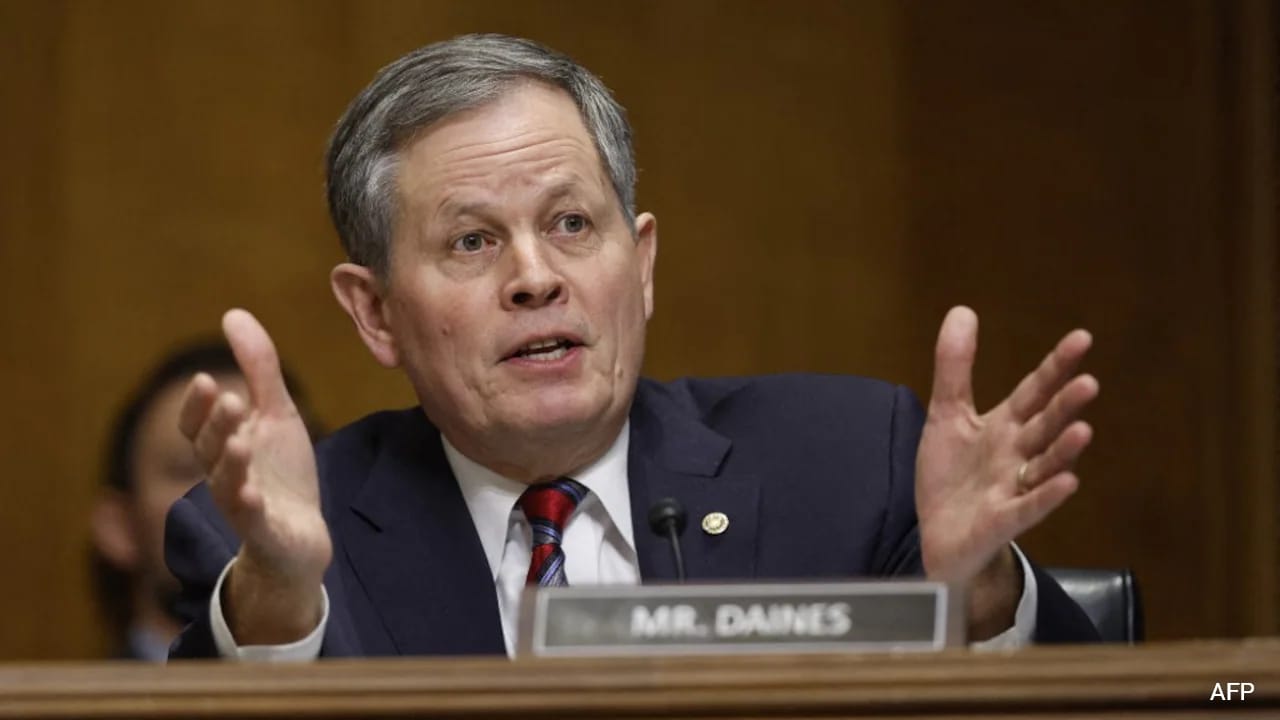
Wall Street spends millions trying to find the perfect market timing, but sometimes the best trade is staring everyone right in the face. When senior US Republican Senator Steve Daines sat down with NDTV, he didn't rely on diplomatic fluff. Instead, he framed the geopolitical shift in pure financial terms. If countries were listed on the stock market, he said, he would put his money on India without hesitation.
It is a bold claim, but it isn't empty political praise. The global financial system is undergoing an aggressive realignment. Washington and New Delhi are closing in on a massive trade deal. Supply chains are fleeing Beijing. Capital is looking for a predictable, high-growth home. If you look closely at the numbers, India fits the bill perfectly.
The Trade Deal That Changes Everything
For years, talk of an India-US trade pact felt like an endless loop of bureaucratic stalling. Not anymore. US Envoy Sergio Gor recently confirmed that the long-awaited trade agreement is in its final steps. This isn't a minor regulatory update. It represents a fundamental rewrite of how the world's largest democracy and the world's largest economy do business together.
Former US Ambassador to India Kenneth Juster pointed out that this upcoming pact will elevate the partnership to heights we haven't seen before. The framework is locked in. The focus has moved from abstract policy to real market access and duty reductions.
Why does this matter to someone managing a portfolio? It removes the political risk that usually scares big money away from emerging economies. When governments sign these agreements, corporations follow with hard cash. US companies are already ramping up their capital expenditure on Indian soil. They aren't doing it out of kindness. They are doing it because the local market offers something rare: massive scale combined with political stability.
Replacing the China Production Engine
The old thesis of relying entirely on Chinese manufacturing is dead. It has been dying for a decade, but the current geopolitical climate buried it. Global corporations cannot afford to keep all their eggs in a single, increasingly hostile basket.
India has stepped into this vacuum with remarkable aggression. The country isn't just offering cheap labor. It is building out infrastructure at a breakneck pace. Look at electronics manufacturing. A few years ago, the latest smartphones were made almost exclusively in Chinese hubs. Today, giant manufacturing facilities in southern India are rolling out top-tier global hardware for export.
This isn't a temporary trend. It is a permanent migration of industrial capacity. Senator Daines highlighted this shift by calling India America's trusted partner. Trust is the ultimate currency in modern supply chains. When a company builds a multi-billion-dollar factory, they need to know the host government won't weaponize regulations overnight. New Delhi has proven it plays by predictable rules, making it the natural successor to the old East Asian manufacturing model.
The Artificial Intelligence Battlefront
The competition between global superpowers is no longer just about shipping containers and steel tonnage. It is about computational power. It is about data.
US Under Secretary Jacob Helberg recently pointed out that India possesses a distinct advantage over China in the field of artificial intelligence. That sounds counterintuitive to people who only look at China's massive state-funded tech giants. But AI requires human ingenuity, open collaboration, and an environment that doesn't censor raw data.
China's closed internet ecosystem limits its AI models. Their systems are forced to operate within strict political boundaries. India, on the other hand, operates an open, vibrant digital infrastructure. The country built the India Stack, a digital identity and payment architecture that processes billions of transactions every single month. This system creates an incredibly deep pool of clean, real-world data. Tech companies need that data to train the next generation of software algorithms.
Combine this data wealth with an army of software engineers. India produces hundreds of thousands of engineering graduates every year. Historically, the best talent left for Silicon Valley. Now, a massive chunk of that talent stays home to build local tech giants or works in high-end research centers set up by global multinationals.
The Undervalued Asset of the Diaspora
You cannot understand the economic momentum between the US and India without looking at the human bridge connecting them. The Indian-American diaspora is one of the most successful immigrant groups in American history. Senator Daines specifically credited this community for driving innovation in critical sectors.
- Healthcare Systems: From top surgeons to hospital executives, the diaspora holds major sway over American medical infrastructure.
- Scientific Research: Elite American universities and private laboratories rely heavily on researchers of Indian origin.
- Corporate Leadership: A staggering number of Silicon Valley giants are led by executives who grew up and studied in India.
This community creates a natural feedback loop. When a tech executive in California needs to open a new research facility, their first instinct is to look at Bangalore, Hyderabad, or Pune. They understand the culture, they know the talent pool, and they have the local networks to get things done. This organic connection does more for bilateral economic growth than a hundred government summits ever could.
Real Risks That Investors Must Watch
It would be foolish to pretend India is a perfect, risk-free bet. No market is. If you're going to put your money here, you need to understand the structural friction that still exists.
First, let's talk about energy costs. India imports the vast majority of its crude oil. When global energy prices spike due to Middle Eastern conflicts or shifting Western foreign policies, the Indian economy takes a direct hit. For instance, aggressive US policies targeting oil-producing nations like Iran routinely force India to seek more expensive alternative energy sources, putting pressure on its fiscal deficit.
Second, bureaucracy can still be a bureaucratic nightmare. Even though Prime Minister Narendra Modi's administration has cut immense amounts of red tape, local state-level regulations can still surprise foreign companies. Land acquisition can take months longer than planned. Environmental clearances sometimes get tangled in local courts. It is a messy democracy, and doing business there requires patience.
Finally, stock valuations aren't cheap. Because everyone is realizing India's potential, the domestic stock indices have been trading at premium multiples. If you buy indiscriminately, you risk overpaying for growth that might take five years to materialize.
Moving Beyond the Hype
How do you actually act on this trend? Sitting on the sidelines and watching the news won't grow your wealth. If you want to follow the money, you need a systematic approach.
Don't buy individual small-cap Indian stocks unless you have a deep, localized understanding of their corporate governance. Instead, look at liquid exchange-traded funds that hold the dominant players in the Indian economy. Look for funds that track the Nifty 50 or the Sensex. These vehicles give you direct exposure to massive private banks, infrastructure conglomerates, and global IT service firms that form the backbone of the country's growth.
Focus heavily on the banking sector. As an economy transitions from developing to developed, credit growth explodes. Indian private banks have exceptionally clean balance sheets right now, and they are funding the factories, highways, and consumer loans driving this boom.
Keep a close eye on the upcoming G20 summit, where PM Modi is scheduled to travel to the US. Watch the announcements that come out of that meeting. If the final signatures land on the trade deal as Sergio Gor predicted, the market will likely re-rate upwards again. The window to buy in before the mainstream global capital completely crowds out the market is closing fast. Get your capital positioned before the paperwork is finalized.