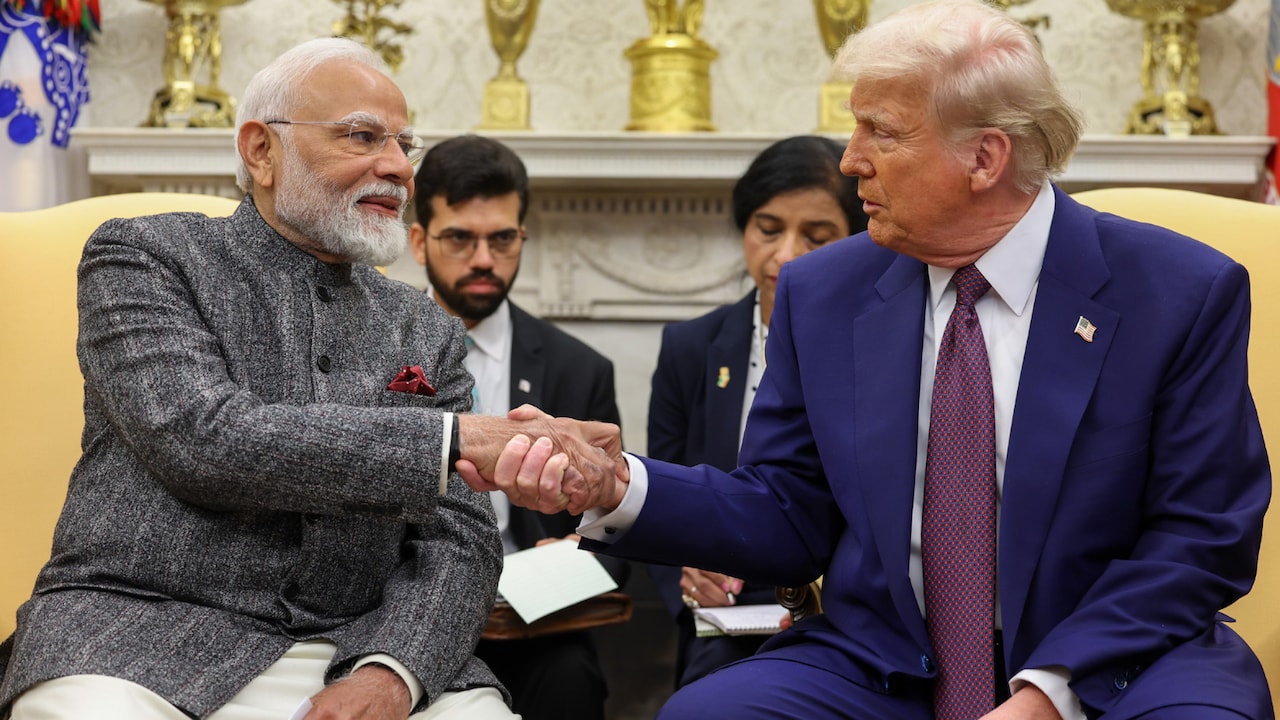
Mainstream financial media loves a "final stretch" narrative. It builds anticipation. It clicks well. For years, headlines have blared that Washington and New Delhi are on the cusp of a historic trade breakthrough. They point to bilateral summits, smiling press conferences, and joint statements about shared democratic values.
They are selling you a fantasy.
The idea that India and the United States are about to sign a sweeping, comprehensive trade agreement misunderstands the fundamental economic DNAs of both nations. I have spent nearly two decades analyzing trade flows and supply chain architectures. I have watched trade negotiators from both sides retreat to their corners after hours of circular debates. The reality is stark: there is no final stretch. There is a structural deadlock masquerading as a temporary delay.
The Fatal Flaw of Shared Democratic Values
The lazy consensus among commentators is that because the US and India share geopolitical alignment—specifically as a counterweight to China—a trade deal is an inevitable byproduct. This is a massive analytical error. Geopolitical alignment does not automatically translate into commercial concession.
Trade negotiations are not emotional exercises. They are cold, transactional calculus driven by domestic political survival.
The United States operates under a trade policy framework increasingly dominated by worker-centric protectionism and stringent environmental mandates. India operates under the banner of Atmanirbhar Bharat (Self-Reliant India), a policy explicitly designed to substitute imports with domestic manufacturing through tariff walls and production-linked incentives.
To expect these two diametrically opposed philosophies to merge into a free trade agreement is like expecting a magnet's north poles to attract. It defies the physics of global economics.
The Tariff Myth and the Real Stumbling Blocks
Let us look at the actual mechanics of the disagreement. The media often reduces the friction to simple commodities: Harley-Davidson motorcycles, Washington apples, or Alphonso mangoes. These are trivialities used for public relations victories. The real battlegrounds are structural and systemic.
- Data Localization and E-commerce: The US demands the unrestricted cross-border flow of data, championing the interests of Silicon Valley titans. India’s Reserve Bank and Ministry of Electronics and Information Technology demand that data generated within India stay within India. New Delhi views data as a national sovereign asset, not a commodity to be exported for free extraction by American tech monopolies.
- Intellectual Property and Pharmaceuticals: Washington fights relentlessly for the extension of pharmaceutical patents (evergreening). India is the pharmacy of the developing world. Its generic drug industry relies on a legal framework that prioritizes affordable public health over corporate profit margins. India will not dismantle its patent laws to please Western pharmaceutical lobbies.
- Agriculture and Subsidies: This is the ultimate deal-breaker. India has hundreds of millions of subsistence farmers. Agricultural policy there is not a matter of corporate balance sheets; it is a matter of food security and social stability. The US demands market access for its heavily subsidized dairy and poultry products. For any Indian government, opening the floodgates to American agricultural imports is political suicide.
Market Access Is the Wrong Question Entirely
When people ask, "When will India lower tariffs for US companies?" they are asking the wrong question. The real question is: "Why do American companies think tariffs are their biggest problem in India?"
If you look closely at companies that succeeded in India, they did not wait for a trade deal. They adapted to the existing ecosystem. They localized their supply chains, navigated the bureaucracy, and accepted lower margins for massive scale.
Conversely, companies waiting for a trade deal to hand them market access on a silver platter are fundamentally lazy. A trade agreement will not fix a flawed product-market fit or an inflexible global corporate structure.
+------------------------------------+------------------------------------+
| The Mainstream Media Narrative     | The Insider Reality                |
+------------------------------------+------------------------------------+
| Negotiations are 90% complete.     | The remaining 10% contains 100% of |
|                                    | the fundamental disagreements.     |
+------------------------------------+------------------------------------+
| Geopolitical alignment drives      | Domestic political survival overrides|
| trade deals.                       | foreign policy alignment.         |
+------------------------------------+------------------------------------+
| Tariffs are the primary barrier    | Regulatory friction and compliance |
| to entry.                          | are the true operational hurdles.  |
+------------------------------------+------------------------------------+
The Hypocrisy of the Generalized System of Preferences
Consider the obsession with India’s reinstatement into the US Generalized System of Preferences (GSP). When the US revoked India's GSP status years ago, pundits predicted disaster for Indian exporters.
What actually happened? Indian exports to the US climbed to record highs anyway.
The removal of GSP benefits amounted to a minor tax on specific sectors, which smart enterprises absorbed through operational efficiencies or currency fluctuations. The hyper-fixation on GSP reinstatement is a distraction. It is a minor negotiating chip treated like a crown jewel.
The Danger of a "Mini-Deal"
Desperate for a political win, negotiators occasionally float the idea of a "mini-deal"—a limited agreement covering a handful of sectors like electronics, agricultural products, or specific medical devices.
This is a trap.
A limited deal creates artificial distortions. It rewards specific interest groups while kicking the structural reforms down the road. It provides the illusion of progress while exhausting the political capital required to address the real economic frictions. If you settle for a patchwork agreement, you guarantee that a comprehensive partnership never materializes.
I have seen corporate boards allocate billions of dollars in capital expenditure based on the promise of these mini-deals, only to watch the regulatory goalposts move six months later. It is a dangerous game.
Stop Waiting for Washington and New Delhi
For businesses operating in this corridor, the strategy is clear: operate as if a trade deal will never happen.
If your business model depends on a bilateral treaty to become profitable, your business model is dead on arrival. Build your operational resilience around the current tariff structures. Factor in data localization compliance as a fixed cost of doing business. Optimize your supply chain to leverage mini-lateral alignments like the Quad or specific critical technology partnerships (iCT) which actually move the needle on a corporate level.
The true integration of the US and Indian economies is happening from the bottom up, driven by private capital, technology transfers, and human talent. It is completely decoupled from the bureaucratic theater in Washington and New Delhi. The negotiators will keep meeting. The press releases will keep flowing. The "final stretch" will remain perpetually out of reach.
Stop watching the politicians. Watch the capital flows. That is where the real deal is being struck every single day.