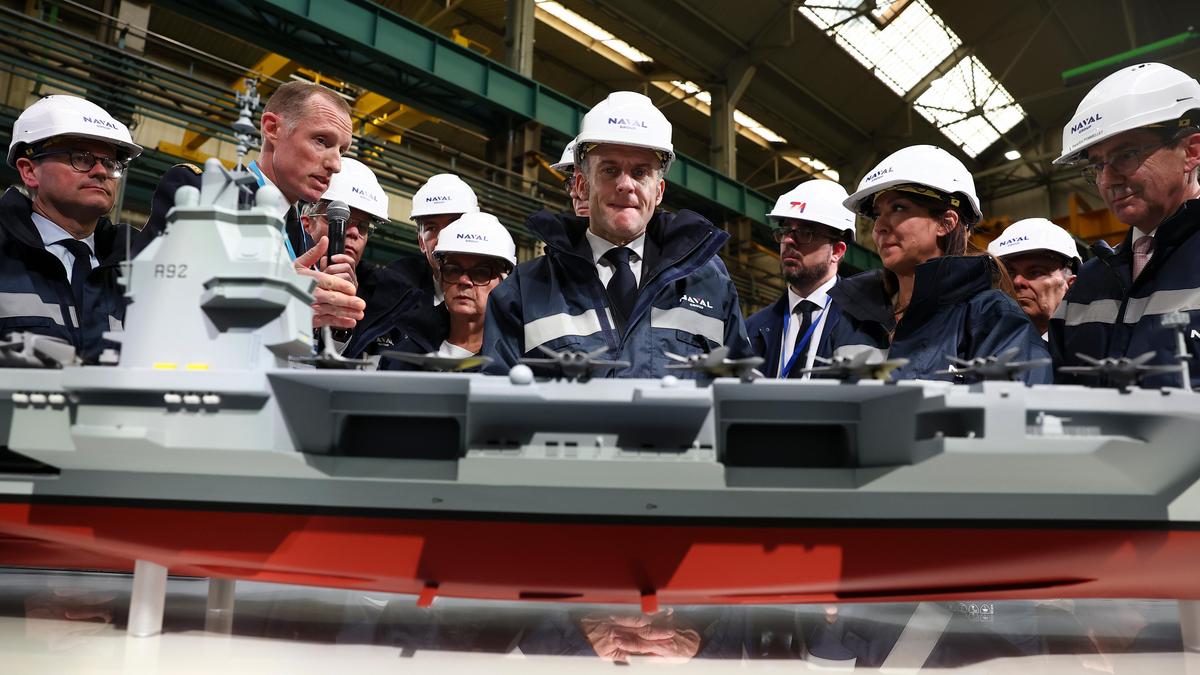
Emmanuel Macron has officially christened the successor to the Charles de Gaulle. By naming the PANG (Porte-Avions de Nouvelle Génération) the France Libre, the Élysée is not just picking a name from the Gaullist history books. It is signaling a hard break from European dependency. This 75,000-ton behemoth is designed to be the centerpiece of French power projection for the next half-century. However, the steel and uranium heart of this vessel conceals a complex web of industrial risk, skyrocketing budgets, and a lonely pursuit of naval supremacy that few other European nations are willing to fund.
The decision to go nuclear-powered for the France Libre is a calculated move to ensure the French Navy remains in a different league than its continental neighbors. While the UK’s Queen Elizabeth-class carriers rely on marine gas turbines and diesel, France is doubling down on the endurance that only an onboard reactor provides. This isn't just about prestige. It is about the ability to sit off a coastline for months without a tanker in sight.
The Nuclear Necessity
France remains the only nation besides the United States to operate a nuclear-powered aircraft carrier. That distinction comes with a staggering price tag. Current estimates place the cost of the France Libre at upwards of 10 billion Euros. To justify this to a skeptical parliament, the administration is framing the carrier as a mobile piece of French soil, independent of foreign bases or fuel lines.
The engineering hurdles are massive. The ship will house two K22 pressurized water reactors, providing the massive electrical output needed not just for propulsion, but for the new Electromagnetic Aircraft Launch System (EMALS). This is a significant shift. For decades, steam catapults were the standard, but the France Libre is jumping straight into the digital age of flight deck operations.
This transition is fraught with technical traps. The U.S. Navy struggled for years to iron out the kinks in the EMALS on the USS Gerald R. Ford. France is betting that by the time the France Libre hits the water in 2038, these systems will be mature. If they aren't, Paris will have spent billions on a very expensive floating airfield that cannot launch its own planes.
Sovereignty Versus the Supply Chain
The name France Libre evokes a time of total independence, but the reality of modern defense procurement is far more intertwined. While the hull will be built in Saint-Nazaire and the reactors by TechnicAtome, the catapult system is an American export. General Atomics holds the keys to the EMALS technology. This creates a fascinating contradiction in Macron’s "Strategic Autonomy" doctrine. To build a symbol of French independence, Paris must write a massive check to San Diego.
The Rafale M Successor
A carrier is only as effective as its air wing. The France Libre is being built specifically to house the FCAS (Future Combat Air System), the next-generation fighter intended to replace the Rafale. This is where the geopolitical friction gets heated. The FCAS is a joint project between France, Germany, and Spain.
Germany has no interest in carrier-based operations. This mismatch in requirements has already led to friction in the design phase. France needs a ruggedized, hook-equipped version of the jet for the France Libre; Germany wants a high-altitude interceptor for the plains of Europe. If the FCAS project collapses under the weight of these diverging needs, France might find itself with a massive carrier and no modern jet to fly from it.
The Maintenance Trap
The Charles de Gaulle famously spends a significant portion of its life in dry dock for refueling and complex overhauls. Critics argue that having only one carrier is a strategic blunder. When the ship is down, France has zero carrier capability.
Building a second hull to ensure constant availability was discussed but ultimately shelved due to cost. Instead, the French Navy is banking on the increased reliability of the K22 reactors to shorten maintenance cycles. It is a high-stakes gamble. If the France Libre suffers a mechanical failure during a crisis, the "Symbol of Independence" becomes a static monument in Toulon.
Industrial Warfare in the Shipyards
The construction of the France Libre is a lifeline for the French naval industry. Naval Group and Chantiers de l'Atlantique are the primary beneficiaries. This project isn't just about defense; it is about maintaining the specialized workforce required to build nuclear-capable vessels. Once those skills are lost, they are nearly impossible to regain.
The workforce in Saint-Nazaire must manage a vessel that is significantly larger than the Charles de Gaulle. We are talking about a flight deck the size of three football fields. The logistics of moving 75,000 tons of steel through a harbor is one thing; integrating a nuclear power plant and a digital launch system is another entirely.
- Displacement: 75,000 tons (compared to 42,500 for the current carrier).
- Length: 310 meters.
- Speed: 30 knots.
- Crew: Approximately 2,000 sailors and aviators.
The Mediterranean and Beyond
Why does France need this? The answer lies in the shifting dynamics of the Mediterranean and the Indo-Pacific. With the rise of blue-water navies in Asia and the increased presence of Russian and Turkish assets in the Mediterranean, Paris feels the need to maintain a "First Entry" capability. This means being able to strike anywhere without asking for permission or overflight rights from neighboring countries.
The France Libre is intended to carry a mix of manned fighters and autonomous loyal wingman drones. The integration of these drones is the true "hard-hitting" aspect of the ship’s design. By using the carrier as a command-and-control hub for a swarm of unmanned aircraft, the French Navy hopes to overcome the numerical advantages of larger rival fleets.
The Budgetary Ghost
The elephant in the room is the French national debt. Financing a 10-billion-euro ship while the country faces strict EU deficit rules is a political nightmare. Every euro spent on the France Libre is a euro not spent on the Army’s armored vehicle programs or the Air Force’s transport fleet.
The defense ministry argues that the carrier pays for itself through industrial exports and diplomatic leverage. When a French carrier group arrives off a coast, it changes the conversation. It is "Gunboat Diplomacy" updated for the 21st century. Whether that leverage is worth the potential for a massive cost overrun remains the subject of intense debate in the National Assembly.
The technical specifications of the K22 reactors are classified, but we know they are designed to go longer between refueling than the current K15 models. This is critical. Every day spent refueling is a day the ship is not "Free."
The American Influence
Despite the rhetoric of independence, the France Libre will likely operate in close coordination with the U.S. Navy. Interoperability is a requirement, not an option. The deck must be capable of recovering U.S. F/A-18s or F-35s in an emergency, and vice versa. This technical alignment means that while the name on the stern says France, the software and systems underneath are increasingly standardized with NATO protocols.
This standardization is a double-edged sword. It makes France a more capable ally, but it also tethers their most prestigious asset to a technological ecosystem they do not fully control. The "Independence" of the France Libre is, in many ways, a managed independence.
The steel for the France Libre has yet to be cut, but the political and economic battle lines are already drawn. This ship will be the ultimate test of whether a medium-sized power can still play the great-power game in an era of hyper-expensive technology.
You should track the upcoming 2027 defense budget reviews to see if the initial funding for the K22 reactors holds steady or if the first signs of "scope creep" begin to emerge.