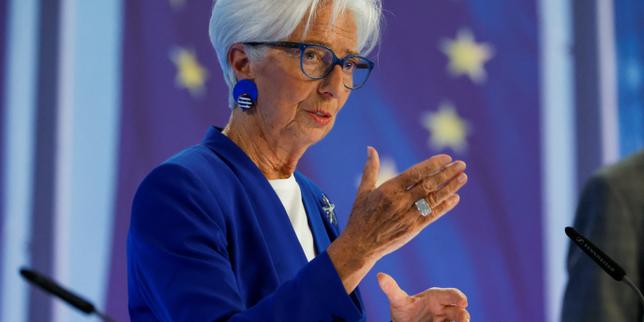
The financial press is suffering from collective amnesia.
Every major outlet is running the exact same headline: "ECB raises rates despite slowing economic growth." They wring their hands over the Eurozone’s stuttering GDP. They weep for the manufacturing sectors in Germany and France. They paint Christine Lagarde as a rigid bureaucrat blindly stepping on the brakes of a car that is already running out of gas.
This narrative is completely wrong. It is built on a fundamental misunderstanding of what causes economic stagnation and what central banks are actually responsible for fixing.
The conventional wisdom says that when growth slows, you cut rates to pump money into the economy. That is the playbook we have chewed on since 2008. But we are no longer in that world. Keeping interest rates artificially low to manufacture fake growth is precisely how Europe ended up in this trap.
The European Central Bank isn't killing the economy by raising rates. It is finally trying to cure it.
The Lazy Myth of 'Growth vs. Inflation'
Commentators love to frame monetary policy as a simple scale. On one side you have growth; on the other, you have inflation. If you tip the scale toward crushing inflation, you must sacrifice growth.
This is a childish view of economics.
Inflation is not a temporary annoyance that you tolerate to keep factories running. It is a corrosive acid that destroys the pricing mechanism of the entire market. When inflation runs rampant, businesses cannot plan for next quarter, let alone next decade. Consumers do not just spend less; they lose all purchasing power stability.
I spent years advising institutional funds on European debt allocations. Let me tell you what happens when a central bank hesitates in this scenario. Investors do not look at low interest rates and think, "Great, let's build a new factory." They look at the negative real yields, realize their capital is evaporating, and move their money out of the Eurozone entirely.
Slowing growth is a structural problem. High inflation is a monetary problem. You cannot fix structural rot by printing cheap money. Trying to stimulate your way out of supply-side inflation is like drinking saltwater to quench your thirst.
Europe’s Zombie Economy is Finally Facing Reality
For over a decade, the Eurozone operated under the delusion of negative interest rates. Think about how absurd that is. Lenders were effectively paying borrowers to take money.
This twisted environment created a massive army of zombie companies. These are businesses that do not generate enough profit to cover their debt servicing costs. They only survive by constantly refinancing their debt at rock-bottom rates.
According to data analyzed during my time in capital markets, nearly 10% of corporate entities in major European economies fell into this zombie category by 2021. They hoard labor. They lock up capital that could be used by productive, innovative startups. They drag down overall productivity.
By raising interest rates into a economic slowdown, the ECB is doing something uncomfortable but entirely necessary: it is letting the weak links break.
Yes, bankruptcies will rise. Yes, marginal businesses will fail. But that is called creative destruction. It is a vital feature of capitalism, not a bug. If a company cannot survive when the cost of money is at 3% or 4%, it shouldn't exist in a healthy economy. Keeping rates at zero to save these zombies is what doomed Japan to multiple lost decades. Europe is finally refusing to follow that exact path.
Dismantling the 'People Also Ask' Delusions
Look at the questions people ask online about this topic. The premises are completely flawed.
'Won't higher interest rates cause a recession?'
This question assumes that preventing a recession at all costs is always the correct move. It isn't. A mild recession that cleanses the system of bad debt and stabilizes prices is infinitely better than stagflation. Stagflation—zero growth combined with high inflation—is the ultimate economic nightmare. It destroys societies from the inside out. If the ECB has to trigger a temporary downturn to prevent long-term currency debasement, that is a bargain worth making.
'Why can't governments just use price controls instead?'
Because price controls have a 100% failure rate over a four-thousand-year historical timeline. From ancient Rome to 1970s America, capping prices by decree simply causes shortages, black markets, and economic collapse. If you mandate that bread cannot cost more than two euros, but the bakery's costs for energy and flour double, the bakery closes. The problem disappears from the price index only because the product disappears from the shelves. Price stability requires monetary discipline, not government clipboards.
The Real Risk Nobody Wants to Talk About
To be absolutely fair, this contrarian approach does carry a massive, terrifying downside. It isn't the risk of a corporate recession. It is the sovereign debt trap.
When the ECB raises rates, it doesn't just raise them for corporations; it raises them for governments. Heavily indebted nations like Italy and Greece suddenly face soaring borrowing costs on their new bond issuances.
Imagine a scenario where Italy's debt-to-GDP ratio sits comfortably above 130%, and the yield on its 10-year bonds climbs past 5%. The math becomes brutal very quickly. A massive chunk of the national budget starts going toward paying interest rather than public services or infrastructure.
This is the true tightrope Lagarde is walking. The risk isn't that she hurts the average consumer; the risk is that she triggers a sequel to the Eurozone sovereign debt crisis of 2011.
But hiding from this reality by keeping rates low is cowardice. It simply transfers the burden from profligate governments to everyday citizens through the hidden tax of inflation. If a European nation cannot manage its budget without relying on the central bank to manipulate the bond market indefinitely, that government needs to reform its fiscal policy. It is not the ECB’s job to monetize national debt at the expense of currency stability.
Stop Asking the Wrong Questions
The media will continue to panic over every quarter of negative growth. They will continue to treat central banks like central planners who can fine-tune human behavior to the decimal point.
Stop buying into the illusion.
The ECB is not making a mistake. It is executing the only rational play left on the board. It is choosing to protect the value of the currency used by over 340 million people, rather than propping up inefficient corporations and over-leveraged states.
The next time you read a headline screaming about rates hurting growth, remember this: growth without price stability is an illusion. The slowdown isn't the disaster. It is the cleanup crew.