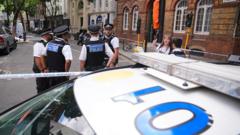
A frantic midday attack on Endell Street left four men hospitalized and a central London community questioning its safety after 47-year-old Stella Gollovena was charged with multiple counts of wounding with intent. The incident, which unfolded in the bustling Covent Garden district near the Shaftesbury Theatre, quickly transformed from a local emergency into a broader examination of urban vulnerability. Metropolitan Police confirmed that Gollovena, of no fixed address, faces four counts of wounding with intent to cause grievous bodily harm and one count of possessing an offensive weapon—specifically, a pair of scissors—following the sequence of chaotic events on Wednesday afternoon.
Emergency services rushed to the scene at approximately 12:30 BST, deploying fast-response units, ambulances, and an air ambulance that touched down nearby. Four victims, aged 34, 39, 42, and 52, sustained slash and stab wounds before being transported as priorities to a major trauma center. While two victims were discharged shortly after treatment, the remaining two spent days under medical care with injuries officials confirmed were not life-threatening.
The Anatomy of a Midday Assault
Street-level violence in prime tourist corridors carries a distinct psychological weight. Covent Garden on a Wednesday afternoon is packed with theatergoers, diners, and office workers moving freely through narrow arteries like Endell Street. When an individual begins lashing out randomly, standard urban assumptions about public safety shatter instantly.
Eyewitness accounts from local business operators paint a picture of sudden confusion. Workers near the Shaftesbury Theatre watched as the assault began before spilling down the block. One victim managed to stagger into a nearby grooming room, shedding his shirt to reveal a severe gash across his back. Nearby restaurant managers reported recognizing the suspect as an unhoused individual who had frequently exhibited erratic behavior in the neighborhood prior to the incident.
Police response times proved critical. Officers arrived within minutes, containing the threat and securing the perimeter before a crowd could swell further. Yet the speed of the police intervention does little to quiet the lingering unease of those who work and live in the shadow of London's premier entertainment district.
Unraveling the Mental Health Failure Points
Authorities were quick to classify the attack as an isolated, mental health-related event. Chief Superintendent Jason Stewart moved swiftly to calm community nerves, emphasizing that investigators found no indication of a broader ideological or coordinated conspiracy.
However, labeling an incident as mental health-related often shifts the public discourse away from institutional accountability. When a vulnerable person with a history of unstable behavior falls completely through the social safety net to the point of wielding a weapon against strangers in a crowded tourist hub, the system has failed at multiple junctures.
Street outreach teams, local psychiatric care networks, and emergency housing systems are chronically overstretched across major British metropolitan areas. Street-level traders and local shopkeepers noted that the suspect's instability was a known quantity long before the attack occurred. When early interventions fail, society routinely relies on the criminal justice system to pick up the pieces after physical harm has already been inflicted.
The Broader Context of Urban Weapon Use
The choice of weapon in this case—a pair of everyday cutting tools rather than a firearm or a combat knife—highlights the inherent difficulty of policing public spaces. While the United Kingdom maintains some of the strictest firearms regulations globally, and aggressive knife crime legislation remains a staple of political manifestos, regulating every potential household implement capable of causing grievous bodily harm is an impossibility.
National statistics place the reality of urban crime into sharp relief. In the twelve months leading up to March 2026, police recorded nearly 49,000 knife-related offenses across England and Wales. While this represented an 8% decrease compared to the preceding year, high-profile incidents in densely populated commercial zones puncture public confidence far more than macro-level percentage drops can repair.
Tourists walking past the Royal Opera House or grabbing lunch near the Covent Garden piazza expect a baseline environment of security. When that environment is breached by an individual in the throes of an untreated psychiatric crisis, the shockwaves extend far beyond the immediate circle of the four injured men.
Navigating the Legal Path Ahead
Stella Gollovena's appearance at Highbury Corner Magistrates' Court marks the beginning of a legal process that will ultimately scrutinize not only her actions on Endell Street, but the state of her mental faculties at the time of the offense. Defense counsel will inevitably focus on psychological evaluations, while prosecutors build their case around the explicit intent required for four counts of grievous bodily harm.
Meanwhile, the street sweepers have cleared Endell Street, the police cordons have dissolved, and outdoor dining tables are once again filled with customers. Yet the structural gaps that allowed a distressed individual to roam a world-famous cultural center armed and desperate remain entirely unaddressed.