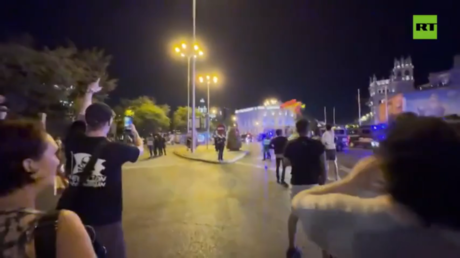
The air smells of burnt rubber, tear gas, and salt water. It is a specific kind of morning air along the southern edge of Europe, thick with anticipation and the kind of quiet that precedes a breaking point.
To understand what happened at the fence in Ceuta, you have to look past the flashing blue lights of the Guardia Civil and the wire—loops of concertina steel designed not just to stop bodies, but to sever hope. You have to imagine standing on a hillside in northern Morocco, watching the lights of a continent that feels impossibly close and infinitely distant at the same time.
That distance is measured in meters, yet it spans worlds.
On this particular morning, the friction boiled over. A mass rally, born from desperation and organized through encrypted chat groups and whispered rumors, converged on the border zone. Protesters clashed with police. Sirens wailed, rocks met shields, and clouds of white smoke bloomed against the Mediterranean blue. The headlines would call it a crisis rally. They would tally the injured officers, count the rocks thrown, and quantify the arrests in a neat, clinical bullet point for the evening news.
Numbers. Statistics. Decibels.
They miss the human weight entirely.
Let us be clear about the mechanics of the pressure cooker. Ceuta is not just a city; it is an anomaly of geography. A tiny Spanish enclave physically grafted onto the northern coast of Africa, it functions as a geopolitical seam. For thousands of young men and women staring down structural unemployment and exhausted futures across the Maghreb, Ceuta is the nearest open door to the European Union. Or at least, it used to be.
Over the years, that door has been reinforced, bolted, and electrified.
When people ask why crowds gather, why young men charge shields with bare hands and improvised stones, they are usually looking for a simple political conspiracy. They want a mastermind to blame. But hunger and systemic inertia do not need a mastermind. They need only a spark.
Consider what happens when desperation meets an immovable object. The mass rally in Ceuta was not an isolated event; it was the audible cracking of a foundation that has been groaning under pressure for years. The protesters who clashed with police were reacting to a reality where the waiting has become longer than life itself. Day after day of limbo turns patience into rage.
The police officers standing behind those riot shields are caught in their own version of the same trap. They are sons, brothers, and fathers wearing heavy gear under a brutal sun, holding a line drawn by politicians sitting thousands of miles away in Madrid and Brussels. They do not hate the faces staring back at them from the dust. They are simply the physical manifestation of a boundary line that refuses to yield.
When the first stone flew, the fragile social contract of the border shattered.
Chaos is loud. It drowns out nuance. In the immediate aftermath of the clashes, the blame game began instantly, ricocheting across social media feeds and parliamentary microphones. One side pointed to a complete breakdown of security and public order, demanding harder lines and faster deportations. The other pointed to systemic neglect, accusing authorities of turning a blind eye to the humanitarian emergency brewing at Europe’s forgotten back door.
Both are describing symptoms while ignoring the disease.
The invisible stake in Ceuta is not merely about immigration quotas or border enforcement protocols. It is about what happens to human dignity when geography becomes a life sentence. When you treat a human migration crisis solely as a law enforcement problem, you ensure that you will only ever manage the explosions, never extinguish the fire.
Think about the psychological toll of the double life led by those who live in these borderlands. The teachers, the shopkeepers, the commuters who cross legal checkpoints every morning while watching desperate others try to scale walls of razor wire. The normalization of suffering is a slow poison. It turns compassion into fatigue, and fatigue into hostility.
As the smoke cleared from the streets of Ceuta, leaving behind shattered glass, spent tear gas canisters, and the acrid smell of confrontation, the physical damage was cataloged and swept away. Streets were washed. Traffic slowly resumed a semblance of normality.
Yet, nothing was resolved.
The crowd dispersed, but they did not vanish. They retreated into the alleys, back across the border hills, back into the waiting rooms of unwritten futures. The wire remains. The guards remain. And across the narrow strait, the tide of young lives searching for a place where their existence matters continues to rise against the stone.
The most haunting part of the Ceuta crisis is not the violence of the clash itself. It is the quiet certainty that it will happen again.