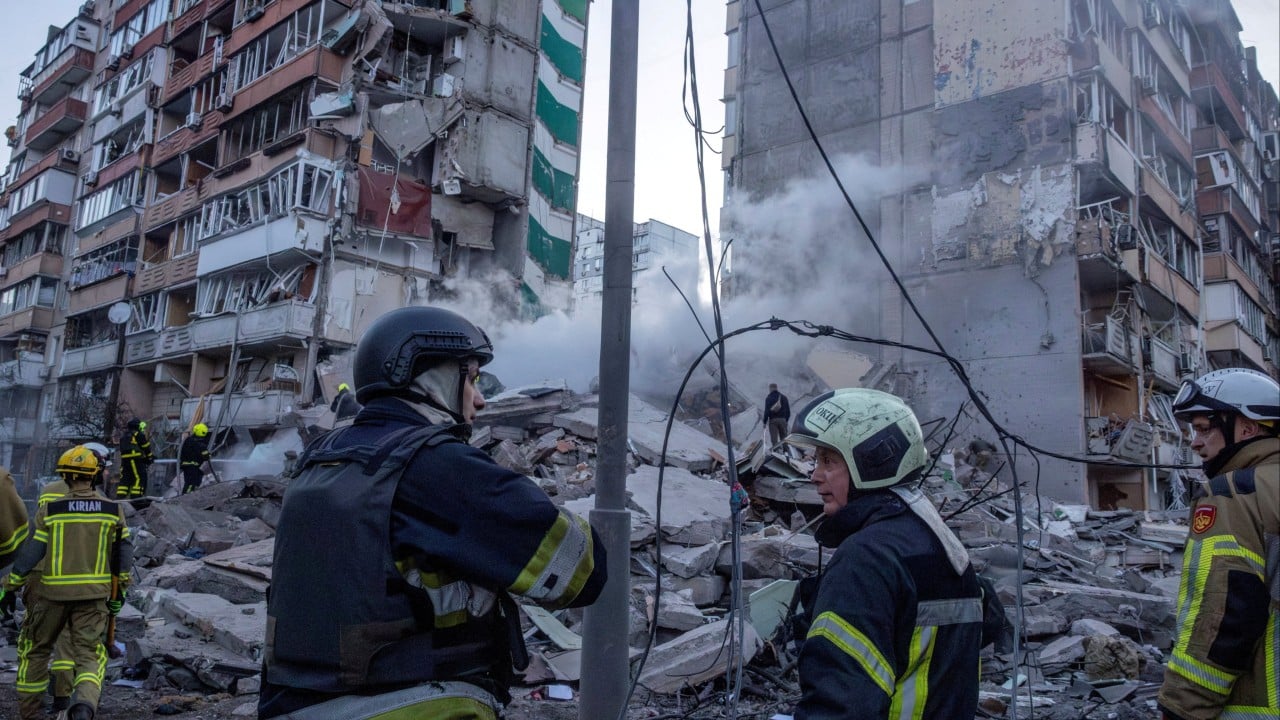
The deployment of 800 unmanned aerial vehicles (UAVs) within a single 24-hour window marks a transition from tactical harassment to industrial-scale atmospheric saturation. This volume suggests that the Russian Federation has moved beyond the "harassment phase" of drone warfare into a "systemic exhaustion phase." The objective of such a massive daytime barrage is not necessarily the destruction of high-value kinetic targets, but rather the forced depletion of a sophisticated, finite, and expensive air defense architecture. By analyzing the mechanics of this surge, we can identify a three-pillar strategy: sensory overload, economic asymmetry, and the mapping of active defense nodes.
The Triad of Saturation Tactics
To understand why 800 drones are more dangerous than 80 drones launched ten times, one must evaluate the concept of Intercept Capacity. Every air defense system, from the IRIS-T to the NASAMS, has a hard limit on the number of simultaneous tracks it can engage.
1. Sensory Overload and Radar Masking
Radars function on the principle of detecting and tracking objects within a specific electromagnetic field. When 800 units enter a designated airspace, they create a "clutter environment." This volume of low-radar-cross-section (RCS) targets forces automated systems and human operators to prioritize threats in real-time. If a defense battery is designed to track 50 targets simultaneously, 750 targets effectively become "noise" that can mask the trajectory of higher-velocity cruise missiles or more sophisticated loitering munitions.
2. The Economic Asymmetry Function
The primary friction point in this conflict is the Cost-to-Kill Ratio. A single Shahed-136 or Geran-2 variant costs between $20,000 and $50,000 to produce. Conversely, the interceptor missiles used to down them—such as the AIM-120 AMRAAM or the Patriot PAC-3—cost between $1 million and $4 million per unit.
- Attacker's Investment: $40,000,000 (800 units at $50k)
- Defender’s Expenditure: $800,000,000 (Assuming 1:1 intercept ratio at $1M per missile)
This 1:20 cost ratio creates a fiscal bottleneck for the defender. Even with high intercept success rates, the defender "loses" the engagement economically. The 800-drone barrage is an exercise in bankrupting the defender’s inventory of precision-guided munitions (PGMs).
3. Kinetic Mapping and Node Identification
A massive daytime barrage serves a secondary reconnaissance function. As Ukrainian air defense units engage the drones, they emit electronic signatures. Russian electronic intelligence (ELINT) platforms, positioned at standoff distances or in orbit, map these emissions. This allows the aggressor to identify the exact coordinates of previously hidden radar batteries, mobile launch platforms, and command-and-control hubs. The drones act as "electronic bait," sacrificing themselves to reveal the architecture of the defense grid for subsequent strikes.
Mechanical Evolution of the Daytime Surge
Historically, long-range drone strikes occurred under the cover of darkness to minimize visual detection. The shift to a massive daytime barrage indicates two significant technical developments.
Optical Navigation and AI Integration
Daytime operations allow for the use of low-cost optical sensors that assist in navigation when GPS/GLONASS signals are jammed. By using "terrain contour matching" (TERCOM) or basic visual odometry, drones can maintain flight paths without relying on satellite signals. A daytime launch provides the lighting conditions necessary for these cheaper, non-inertial navigation systems to function.
The Decoy Variable
A significant percentage of the 800 units are likely "Gerbera" or similar foam-core decoys. These lack warheads and complex engines, consisting of little more than a wooden or plastic frame and a signal reflector designed to mimic the radar signature of a lethal drone. By mixing 200 lethal munitions with 600 decoys, the attacker further dilutes the effectiveness of the defense response while keeping production costs floor-low.
The Logistics of Industrialized Attrition
Launching 800 drones in 24 hours is a logistical feat that suggests the decentralization of launch platforms. A centralized airfield would be too vulnerable to a counter-strike. Instead, this operation likely utilized "Distributed Launch Containers"—small, mobile units mounted on civilian-grade trucks that can be deployed from any paved surface.
Supply Chain Resiliency
The ability to expend 800 units in a single day implies a monthly production or acquisition rate exceeding 5,000 units. This points to a streamlined manufacturing process that bypasses high-end aerospace components in favor of dual-use technology:
- Commercial Grade Engines: Utilizing two-stroke engines typically found in lawnmowers or small motorcycles.
- Off-the-shelf Electronics: Using flight controllers derived from the hobbyist FPV market.
- Simplified Airframes: Shifting from carbon fiber to pressed fiberglass or expanded polystyrene.
Structural Weaknesses in the Current Defense Paradigm
Current Western-supplied air defense is built on the philosophy of "Precision Interception." This philosophy is failing against "Mass Attrition." The reliance on multi-million dollar missiles to hit $20,000 drones is a strategic dead end.
The Interceptor Scarcity Problem
Global production of interceptor missiles is measured in hundreds per year, not thousands. If Russia can launch 800 drones in a day, they can theoretically exhaust the annual production of Western interceptors in a single week. This "inventory depletion" is the true objective of the 800-drone barrage.
Transitioning to Directed Energy and Kinetic Volume
To counter this, the defense must shift toward:
- Electronic Warfare (EW): Expanding localized "domes" of GPS and radio frequency interference to drop drones before they reach target proximity.
- C-UAS Cannons: Returning to high-volume, rapid-fire anti-aircraft guns (like the Gepard) which use $500 programmable airburst rounds instead of $1M missiles.
- Directed Energy Weapons (DEW): High-energy lasers that have a "near-zero" cost per shot, limited only by power supply.
Strategic Forecast and Immediate Counter-Moves
The 800-drone barrage is a precursor to a new phase of the conflict where volume is the primary weapon. The data suggests that Russia has achieved "Drone-Launch Parity" with its manufacturing output, meaning it can sustain high-volume strikes indefinitely.
For Ukraine and its allies, the strategic priority must shift from "Increasing Interceptor Supply" to "Disrupting the Production Loop." This requires:
- Deep Strike Kinetic Operations: Targeting the assembly plants and regional distribution hubs where these 800 units are staged before a launch.
- Sanctioning Dual-Use Microelectronics: Hardening the export controls on the specific microcontrollers and small-scale engines that power these low-cost fleets.
- Automated Close-In Weapon Systems (CIWS): Massive deployment of localized, autonomous turret systems at every critical infrastructure point to preserve high-end missiles for cruise and ballistic threats.
The 800-drone barrage was not a show of force; it was a stress test of the West's industrial capacity. The results of that test indicate that the current defense model is mathematically unsustainable. Survival in this environment depends on breaking the cost-to-kill ratio before the interceptor inventory reaches zero.