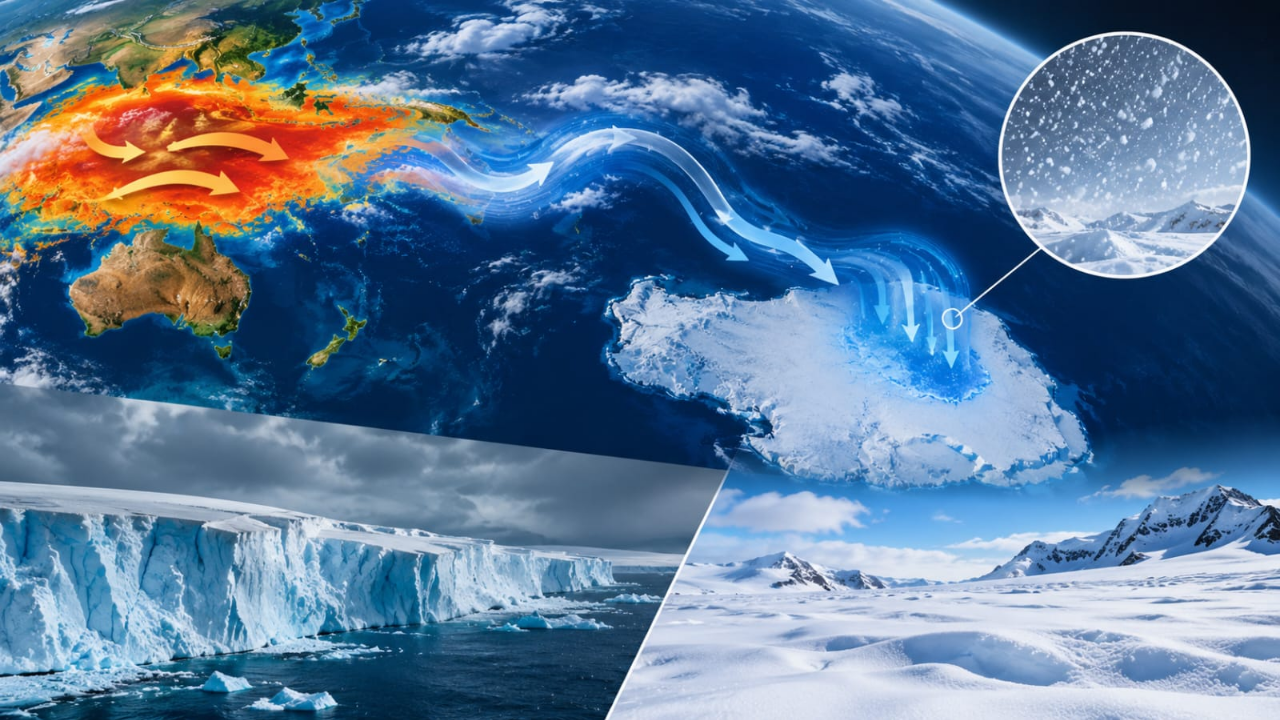
Mass accumulation events across the Antarctic ice sheet are frequently misinterpreted as indicators of ice sheet stabilization or reversal of long-term mass loss. When regional precipitation anomalies deliver hundreds of billions of tons of snow over brief multi-year windows, public discourse often frames this precipitation as a direct counterweight to accelerated basal melting and dynamic ice discharge. This framing collapses under basic glaciological scrutiny. Mass gain via surface accumulation operates through entirely different spatial scales, temporal horizons, and physical mechanisms than mass loss via oceanic thermal forcing and outlet glacier acceleration. Evaluating the state of the Antarctic ice sheet requires disaggregating total mass balance into its constituent fluxes: surface mass balance, basal melting, and dynamic ice discharge. When tropical sea surface temperature anomalies drive atmospheric moisture transport southward, the resulting snowfall accumulation does not negate the structural mass deficits occurring at the grounding lines of major marine-terminating glaciers.
The primary driver of short-term accumulation spikes lies in atmospheric teleconnections that amplify meridional moisture transport. Elevated sea surface temperatures in tropical ocean basins alter Hadley and Walker circulation cells, generating atmospheric rivers and blocking patterns that funnel moisture-laden air masses deep into the continental interior and onto peripheral ice shelves. As these air masses encounter the steep topographical gradients of the Antarctic margin, orographic uplift forces adiabatic cooling and heavy precipitation. This dynamic explains how multi-year periods can yield net positive surface mass balance anomalies running into hundreds of billions of tons. However, surface accumulation is fundamentally a meteorological phenomenon governed by precipitation minus sublimation and runoff, whereas ice sheet stability is governed by dynamics. Meanwhile, you can read similar events here: The Smithsonian Wars And The Fight To Rewrite American History.
Dissecting the mechanics of Antarctic ice loss reveals a distinct spatial decoupling from surface accumulation zones. The vast interior plateaus where the bulk of anomalous snowfall occurs are characterized by slow ice velocities and thick, cold firn columns. Snow deposited in these high-altitude regions takes millennia to transit toward the coast, meaning that a transient spike in precipitation provides negligible near-term mitigation against coastal mass deficits. Conversely, the sectors experiencing rapid mass loss are concentrated in the Amundsen Sea Emigration and the Antarctic Peninsula, where warm circumpolar deep water intrudes onto the continental shelf. This oceanic forcing attacks the ice shelves from below, thinning their pinning points, reducing buttressing capacity, and unleashing higher ice velocities across upstream grounding lines.
The mechanical disconnect between surface mass inputs and marine ice outputs creates a structural asymmetry in the ice sheet's response function. Surface accumulation adds mass uniformly across vast, elevated drainage basins, while mass loss concentrates intensely at localized outlet gateways. When warm tropical waters fuel heavy snowfall, they simultaneously drive thermal energy anomalies through oceanic channels that accelerate basal melting of ice shelves. Evaluating the net mass balance of Antarctica by balancing total accumulation against total discharge masks this regional polarization. An ice sheet can register a net positive anomaly across a two-year interval due to an exceptional precipitation event while simultaneously experiencing structural destabilization in its primary marine sectors that commits the system to centuries of irreversible retreat. To explore the complete picture, we recommend the recent article by BBC News.
Quantifying the limits of surface accumulation requires examining the capacity of the snow column to retain and consolidate mass. Freshly fallen snow has a low density, forming a porous layer known as firn that densifies over decades into glacial ice. Under extreme accumulation events, the influx of snow can exceed the densification rate, altering local albedo and thermodynamic profiles. More critically, surface melting remains minimal across most of the continental interior, though localized surface melt on peripheral ice shelves can trigger hydrofracturing when standing meltwater wedges open preexisting crevasses. Thus, increased tropical warmth driving snowfall can simultaneously introduce localized surface melt risks on vulnerable ice shelves, compounding the structural vulnerability caused by basal ocean melting.
The thermodynamic linkage between tropical warmth and Antarctic precipitation operates via Clausius-Clapeyron scaling relationships, which dictate that warmer air holds exponentially more moisture. As tropical sea surface temperatures rise, the global hydrological cycle intensifies, increasing the precipitable water available for poleward atmospheric rivers. This establishes a paradoxical feedback loop: warming that destabilizes global ice sheets through thermal expansion and ocean heat content also supercharges the atmospheric conveyor belts that dump snow onto those exact ice sheets. Recognizing this coupling prevents simplistic assumptions that climate warming is uniformly detrimental to ice mass; rather, warming acts as an engine of extremes, accelerating both the moisture supply for precipitation and the thermal drivers of oceanic melting.
Addressing the long-term trajectory of Antarctic ice dynamics demands shifting analytical focus away from aggregate mass anomalies and toward grounding line stability metrics. Grounding line retreat is irreversible on decadal timescales because the bedrock topography of West Antarctica slopes downward toward the interior, creating an unstable retrograde bed configuration. Once warm water breaches the bathymetric sills and initiates ungrounding, the rate of ice discharge is dictated by internal ice rheology and fracture mechanics rather than surface snowfall rates. Surface accumulation cannot plug a widening breach at the marine terminus; it merely adds weight to an already destabilized floating tongue, potentially increasing driving stresses if accumulation rates outpace basal thinning rates on unbuttressed ice fronts.
To project ice sheet contributions to global sea level rise with operational accuracy, modeling frameworks must integrate high-resolution oceanographic data with localized ice-shelf cavity circulation models. Global climate models frequently struggle to resolve the narrow bathymetric troughs that channel circumpolar deep water toward ice shelf bases. Without accurate representation of these sub-shelf melting rates, projections that rely on surface mass balance anomalies alone produce distorted risk assessments. Analysts must treat surface accumulation and dynamic ice discharge as distinct variables governed by independent physical equations, avoiding the analytical trap of netting them out into a single misleading aggregate figure.
The strategic priority for polar monitoring lies in high-frequency altimetry and gravimetry calibrated against in-situ oceanographic profiling at critical marine gateways. Satellites measure changes in surface elevation and Earth's gravity field, capturing the net result of competing mass fluxes. Distinguishing whether a mass change stems from a localized meteorological anomaly or a systemic structural failure requires continuous observation of ice shelf thickness, grounding line position, and sub-shelf melt rates. Capital allocation for climate risk assessment should prioritize instrumentation in the Amundsen and Dronning Maud sectors rather than broad-scale precipitation tracking, as the former dictates the physical tipping points of the marine ice sheet.
Deploy computational resources toward coupled ice-ocean models that resolve sub-shelf cavity thermodynamics and grounding line migration at kilometer-scale resolution, anchoring regional risk assessments in dynamic physical constraints rather than aggregate surface mass balance metrics.