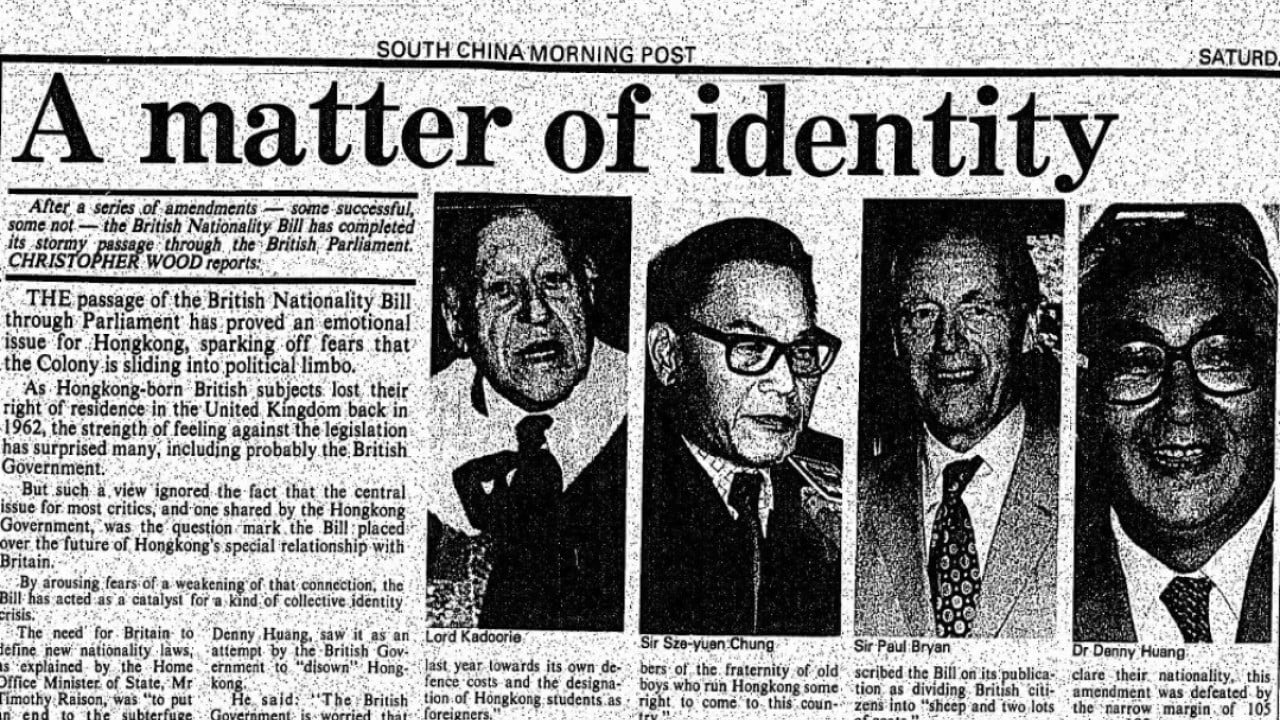
In October 1981, the British Parliament passed legislation that legally erased the right of millions of colonial subjects to call the United Kingdom home. The British Nationality Act 1981 shattered the post-war concept of a unified Commonwealth citizenship, replacing it with a strict hierarchy that tied the right of abode directly to ancestral bloodlines in the British Isles. For roughly 2.6 million residents of Hong Kong, the law instantly downgraded their status from Citizens of the United Kingdom and Colonies to British Dependent Territories Citizens—a title that carried a passport, a colonial crest, and zero automatic right to live or work in Britain.
The move was deliberate. Facing economic stagnation, racial tensions at home, and looming diplomatic negotiations with Beijing over the future of Hong Kong, Margaret Thatcher’s Conservative government sought a permanent legal firewall against large-scale immigration from the remnants of the empire. While contemporary headlines framed the bill as a bureaucratic tidying-up of outdated imperial laws, cabinet records and parliamentary debates reveal a far more calculated objective. Westminster wanted to lock the doors before the lease on Hong Kong’s New Territories expired in 1997. Building on this theme, you can find more in: Inside the Sudden Guilty Plea That Fractured the Abby Choi Murder Defense.
The Architecture of Exclusion
Before 1981, British nationality law operated on the expansive principle of jus soli—the right of the soil—combined with a broad imperial umbrella. Under the British Nationality Act 1948, anyone born within the United Kingdom or its remaining colonies held the shared status of Citizen of the United Kingdom and Colonies (CUKC). In theory, a dockworker in Kowloon, a civil servant in Nairobi, and a shopkeeper in Manchester held the exact same citizenship.
That theoretical equality survived only as long as people did not actually use it to move to Britain. Throughout the 1960s and 1970s, successive Labour and Conservative governments passed emergency immigration acts to restrict entry from newly independent Commonwealth nations in Asia, Africa, and the Caribbean. The 1962, 1968, and 1971 immigration bills gradually separated citizenship from the right of abode. By the late 1970s, holding a British passport no longer guaranteed entry into Britain. Observers at Al Jazeera have shared their thoughts on this situation.
Thatcher’s government decided to end the contradiction by rewriting nationality law itself. Home Secretary William Whitelaw introduced the bill in January 1981 with the stated goal of bringing citizenship laws into alignment with immigration controls. The legislation abolished CUKC status entirely and fractured it into three distinct tiers.
- British Citizenship, reserved almost exclusively for those with close personal or ancestral ties to the United Kingdom itself, carrying the unrestricted right of abode.
- British Dependent Territories Citizenship (BDTC), assigned to people connected to remaining colonies like Hong Kong, Gibraltar, and the Falkland Islands, granting no right to enter or settle in Britain.
- British Overseas Citizenship (BOC), a residual category handed to roughly 1.5 million people—primarily ethnic Indians in Malaysia and East Africa—who held CUKC status without ties to either the UK or an existing dependent territory.
The third tier was widely condemned by legal scholars and human rights advocates as a form of institutionalized statelessness. A BOC passport offered no right of abode anywhere in the world, not even in the countries where its holders lived.
Hong Kong Caught in the Crossfire
Nowhere did the 1981 act land with greater geopolitical force than in Hong Kong. By 1981, the British colony had transformed from a war-torn entrepôt into one of Asia’s wealthiest financial centers. Its population had swelled to over five million, roughly half of whom were locally born and held CUKC status.
The timing of the bill was anything but coincidental. Under the 1898 Convention for the Extension of Hong Kong Territory, Britain’s 99-year lease on the New Territories—comprising nearly 90 percent of Hong Kong’s landmass—was set to expire on July 1, 1997. Hong Kong’s Governor, Sir Murray MacLehose, had traveled to Beijing in 1979 to sound out Chinese leader Deng Xiaoping on the possibility of extending British administration past 1997. Deng made it unmistakably clear that China intended to recover sovereignty over the entire territory.
Whitehall knew a handover was inevitable. Officials in the Home Office and the Foreign and Commonwealth Office also recognized the obvious risk: if negotiations with Beijing collapsed or triggered political panic in Hong Kong, millions of British passport holders might attempt to flee to the United Kingdom.
"The primary purpose of the bill was to ensure that Britain could never again be legally obliged to accept large numbers of people from its remaining dependencies." — Contemporary analysis by the Joint Council for the Welfare of Immigrants, 1981
When the bill’s text became public in Hong Kong, the reaction was immediate outrage. Unofficial members of Hong Kong’s Executive and Legislative Councils—normally loyal allies of the colonial administration—flew to London to lobby Parliament against the measure. They argued that stripping Hong Kong residents of their shared British citizenship status on the eve of sensitive negotiations with Beijing would destroy local morale and signal that Britain was preparing to abandon the city.
Westminster refused to budge. Aside from minor cosmetic adjustments—such as changing the wording on passports so they did not explicitly state the holder was subject to immigration control—the government pushed the bill through the House of Commons and the House of Lords. The message to Hong Kong was blunt: the British Empire was winding down, and its remaining subjects would not be invited to the metropole.
The End of Birthright Citizenship
While the geopolitical fallout centered on Hong Kong, the 1981 act also carried profound domestic consequences inside the United Kingdom. For over seven centuries, English common law had recognized that anyone born on British soil was automatically a subject of the Crown.
The British Nationality Act 1981 terminated unconditional birthright citizenship. Starting on January 1, 1983, when the act took effect, a child born in the United Kingdom only acquired British citizenship if at least one parent was already a British citizen or was legally "settled" in the country with permanent residency.
Critics inside Britain, including the Labour opposition, civil rights groups, and the British Council of Churches, argued that the legislation introduced racial discrimination into nationality law under the guise of technical reform. Because the vast majority of people with ancestral ties to the United Kingdom were white, while the millions relegated to BDTC and BOC status were overwhelmingly people of color from Asia, Africa, and the Caribbean, the bill drew a sharp racial boundary around British identity.
Supporters of the legislation countered that Britain was simply adopting the standard European model of citizenship. Countries like France, West Germany, and the Netherlands already tied nationality closely to parentage rather than place of birth, and none maintained open-ended citizenship obligations to former colonial populations. From the perspective of the Thatcher government, an overcrowded island with three million unemployed workers could not sustain an open door to the remnants of a global empire.
The Long Shadow of 1981
The legal architecture constructed in 1981 did not stay static, nor did it permanently insulate Britain from its colonial obligations. Instead, it created decades of diplomatic friction and piecemeal legislative patches whenever imperial history collided with modern crises.
| Legislative Patch | Year | Target Population | Core Provision |
|---|---|---|---|
| British Nationality (Falkland Islands) Act | 1983 | Falkland Islanders | Restored full British citizenship following the 1982 war with Argentina. |
| Hong Kong Act & BNO Order | 1985–1986 | Hong Kong BDTCs | Created British National (Overseas) status; valid for life, no right of abode. |
| British Nationality (Hong Kong) Act | 1990 | Key Hong Kong personnel | Granted full British citizenship to 50,000 heads of household and families after Tiananmen Square. |
| British Overseas Territories Act | 2002 | Remaining Overseas Territories | Restored full British citizenship to BDTCs in Gibraltar, Bermuda, Cayman Islands, etc., excluding Hong Kong. |
| UK BN(O) Visa Route | 2021 | Hong Kong BN(O) holders | Allowed BN(O) holders and dependents to live, work, and apply for citizenship in the UK after Beijing's National Security Law. |
The double standards embedded in these subsequent revisions exposed the political calculations behind the 1981 law. Less than two years after downgrading Falkland Islanders to BDTC status alongside Hong Kong residents, Argentina invaded the South Atlantic archipelago. Following Britain’s military victory in 1982, Parliament swiftly passed the British Nationality (Falkland Islands) Act 1983, restoring full British citizenship to the islands' roughly 1,800 predominantly white residents. Hong Kong’s 2.6 million BDTCs received no such restoration.
When London and Beijing signed the Sino-British Joint Declaration in 1984, formally agreeing to transfer Hong Kong to Chinese sovereignty in 1997, Britain had to invent yet another nationality category. Because BDTC status was tied to a territory that would cease to be British in 1997, Parliament created British National (Overseas), or BN(O), status. Hong Kong residents could register for a BN(O) passport before the handover, allowing them to retain a lifelong consular link to the United Kingdom—still without the right to live there.
The cracks in that settlement widened dramatically after the June 1989 Tiananmen Square crackdown in Beijing. Panic swept through Hong Kong, triggering massive capital flight and emigration. Fearful that the city’s civil service and business elite would abandon Hong Kong before 1997, London passed the British Nationality (Hong Kong) Act 1990, granting full British citizenship to 50,000 selected households—roughly 225,000 people—in a controversial points-based scheme designed to keep key professionals in the territory rather than bring them to Britain immediately.
Even after the 1997 handover, the 1981 act continued to generate anomalies. In 2002, Tony Blair’s government passed the British Overseas Territories Act, restoring full British citizenship to citizens of all remaining British territories—from Bermuda to St Helena—while explicitly excluding Hong Kong’s former BDTCs. Nearly two decades later, when Beijing imposed a sweeping National Security Law on Hong Kong in 2020, Boris Johnson’s government finally opened a dedicated visa pathway allowing BN(O) status holders to settle in the UK and eventually acquire the full citizenship stripped from their parents four decades earlier. Over 140,000 Hongkongers relocated to Britain under the scheme within its first three years.
A Defining Break with Empire
The British Nationality Act 1981 achieved precisely what its architects intended. It severed the legal fiction that Britain remained the center of a unified global commonwealth where subjects shared a common civic bond. By prioritizing domestic immigration control over imperial obligation, Westminster drew a hard border around the British Isles and forced millions of people across Asia and Africa to confront the reality that their British passports were travel documents, not guarantees of belonging.
When the law came into force on New Year's Day in 1983, there were no ceremonies in London or Hong Kong to mark the occasion—only a quiet administrative reclassification in government ledgers that permanently altered the meaning of being British.