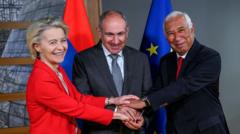
Walk through the streets of Yerevan today and you'll feel a tension that has nothing to do with the summer heat. On May 4, 2026, the city isn't just the capital of a small, landlocked nation; it's the center of a massive geopolitical tug-of-war. For the first time, Armenia is hosting the European Political Community (EPC) summit, followed immediately by an inaugural EU-Armenia bilateral summit. It’s a bold move that basically tells the Kremlin the old rules don't apply anymore.
You've got dozens of European heads of state—including heavy hitters like Emmanuel Macron—descending on a country that, for decades, was seen as Russia's "backyard." Moscow is watching, and they aren't happy. But for Prime Minister Nikol Pashinyan, this isn't just about photo ops. It’s about survival. After years of feeling abandoned by Russian security guarantees, Armenia is sprinting toward the West, and this week’s events are the clearest signal yet that there’s no turning back.
Breaking the security myth
The biggest reason for this shift is simple: Russia didn't show up when it mattered. For years, Armenians were told that being part of the Collective Security Treaty Organization (CSTO) was their only shield. That myth shattered during the recent conflicts with Azerbaijan. While Armenia was being attacked, the "peacekeepers" in Moscow basically sat on their hands.
I’ve talked to people here who feel a deep sense of betrayal. It’s not just a political disagreement; it’s personal. That’s why Armenia took the massive risk of "freezing" its CSTO membership in 2024. They’re looking for new friends because the old ones proved useless. The presence of European leaders in Yerevan today provides a kind of "diplomatic shield" that the country has lacked for a long time.
- The EU Mission (EUMA): There are now over 200 European personnel on the ground, monitoring the border with Azerbaijan.
- Defense Deals: Armenia has started buying hardware from France and India, moving away from a 100% reliance on Russian kits.
- The 2025 Pivot: Last year, the Armenian parliament even passed legislation to start the formal process of applying for EU membership.
The Kremlin’s shrinking shadow
Don’t think for a second that Vladimir Putin is just letting this happen without a fight. Russia still controls a huge chunk of Armenia’s economy. They own the gas pipelines, they have a massive say in the rail network, and the Armenian energy grid is deeply tied to Russian interests.
The Kremlin has already issued warnings. Putin himself said earlier this year that Armenia can't sit in "two chairs" forever. They've used trade bans on Armenian cognac and apricots in the past to show their teeth. But here’s the thing: those threats aren't working like they used to. Armenia is diversifying. They’re looking at the "Crossroads of Peace" project to link up with Georgia, Turkey, and Iran, trying to find any exit ramp they can from the Russian economic orbit.
Why this summit is different
Usually, these big international meetings are all about vague statements and "shared values." This one feels different because the stakes are so visible. Hosting the 8th EPC summit in Yerevan is a massive logistical and security undertaking. It's a statement of intent.
The EU is putting real money on the table too. We’re talking about a €270 million Resilience and Growth Plan and promises of up to €2.5 billion in investments through the Global Gateway strategy. This isn't just "aid"; it’s infrastructure. They’re talking about building roads and digital networks that physically connect Armenia to the West.
- Visa Liberalization: Dialogue is finally moving forward, which is a huge deal for regular Armenians who want to travel and work in Europe.
- Energy Security: Efforts are underway to decouple Armenia from the Russian gas monopoly.
- Democratic Resilience: The EU just passed a resolution on April 30, 2026, specifically to support Armenia's democratic institutions against outside interference.
Dealing with the "Georgia Ghost"
There’s a shadow hanging over these meetings, and it’s the situation in Georgia. Everyone in Yerevan is looking at Tbilisi and seeing a cautionary tale. In 2024, Georgia saw a massive democratic backsliding that basically killed its EU dreams.
The European leaders in Yerevan aren't just here to support Armenia; they’re here to make sure the same thing doesn't happen here. They want to prove that a former Soviet republic can actually make the jump to the West without collapsing or being pulled back into the Russian sphere. It’s a high-stakes experiment in real-time.
The June elections are the real test
While the summits are great for the headlines, the real battle happens in June 2026. That’s when Armenia goes to the polls for parliamentary elections. This is where Russia will likely make its move. We’re already seeing signs of heavy disinformation campaigns designed to paint Pashinyan as a Western puppet who’s going to lead the country into another war.
Polls show Pashinyan’s Civil Contract party has the lead—around 47% approval recently—but there’s a huge chunk of the population, maybe 30%, that’s still undecided. These people are scared. They want the Western lifestyle and the security, but they’re terrified of what Russia will do if the "divorce" becomes final.
If you want to understand where this is going, stop looking at the official communiqués and start looking at the energy prices and the border reports. The West is offering a path to a different future, but Russia still has its hand on the thermostat. The Yerevan summits prove that Armenia has chosen its side, but the hard part—actually living with that choice—is just beginning.
Keep a close eye on the "Yerevan Dialogue" forum happening alongside the summits. It’s where the actual nuts and bolts of these new security arrangements are being hammered out. If you're invested in the region, watch for new agreements on "cyber resilience" and "hybrid threat" management. That's the new frontline.