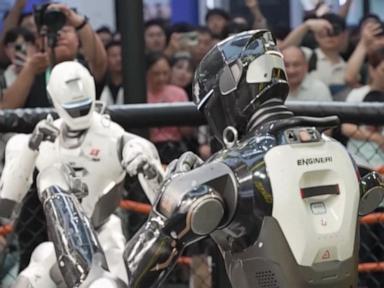
Forget everything you thought you knew about slow, clunky laboratory robots. At the National Speed Skating Oval in Beijing, over 2,000 humanoid robots just entered an arena to race, jump, and crash harder than anyone expected.
The second annual World Humanoid Robot Games kicked off with a massive spectacle. Machines are no longer just performing scripted routines for trade shows. They are running sprints, playing soccer, and testing limits that shock even veteran engineers. If you think this is just a glorified science fair, you are missing the entire industrial shift happening right now.
Smashing Human Records on the Track
The biggest headline from the opening days involves pure, raw speed. During the 100-meter preliminary heats, a machine called Tiangong Ultra—built by the Beijing Humanoid Robot Innovation Center—clocked an astonishing 9.39 seconds.
To put that in perspective, Usain Bolt holds the human world record at 9.58 seconds, set back in Berlin in 2009. Another competitor, Honor's Lightning, finished right behind at 9.47 seconds after hitting a blistering top speed during pre-tests.
Yet, the reality of hardware physics bit back immediately. Both robots crossed the finish line only to slam violently into the heavy protective safety mats. Tiangong stumbled wildly toward the stands while Lightning collapsed entirely, requiring a stretcher to carry it off the track.
Speed is easy to engineer in bursts. Surviving the momentum is the real challenge.
Beyond Athletics Real Tasks Take Center Stage
Sports make for great viral videos, but the 51 events featured at the Beijing games reveal a much deeper commercial ambition. The competition splits into two distinct tracks. Around 30 events are traditional competitive sports like soccer, dancing, and table tennis. The remaining 21 are scenario-based challenges.
These functional tests require machines to handle household chores, hotel services, industrial assembly, and emergency firefighting tasks.
Organizers note that events like the 400-meter and 1,500-meter races now require full autonomy. No remote controls are allowed. The onboard computers process sensory inputs in real-time, making split-second balance corrections on the fly.
The Economics Driving the Boom
Why are 666 teams from 16 countries pouring resources into these complex systems? Money and strategic national priority. China has labeled advanced robotics a core pillar of its industrial strategy, and private markets are reacting aggressively.
Look at Unitree, a prominent Chinese humanoid maker. Their recent market debut on the Shanghai exchange saw shares surge more than fivefold, pushing the company valuation to roughly $50 billion.
Meanwhile, global tension is rising. International regulators are watching closely. The United States recently introduced strict import blocks on foreign-made humanoid hardware, citing security concerns. The geopolitical landscape is fracturing right as the technology starts hitting functional maturity.
What This Means for the Immediate Future
We aren't looking at a distant sci-fi scenario anymore. When machines can run faster than elite humans and adapt to complex industrial environments, commercial deployment accelerates. Companies are no longer asking if humanoids will enter the workforce. They are figuring out how fast they can scale production to cut labor costs.
Keep a close eye on how these robots transition from stadium tracks to factory floors over the next twelve months. The era of practical humanoid labor is arriving much faster than the skeptics predicted.