The air inside a funeral home is different from anywhere else on earth. It carries a heavy, clinical stillness, underscored by the faint, sweet scent of chemical preservatives and wilted lilies. It is a place designed for finality. For the living, it is a room of closure; for the dead, it is the final corridor before the fire.
Imagine lying in that stillness. You cannot move your eyelids. You cannot draw enough breath to cry out. Your skin is cold to the touch, and your pulse has slowed to a microscopic flutter that eludes the frantic fingers of your loved ones. You are entirely aware of the weeping around you. You hear the rustle of the shroud. You feel the heavy, metal tray shifting as you are prepared for the furnace.
This is not a gothic ghost story. It is the terrifying reality of what happened to a woman in rural China, a woman whose name became a whisper of miracles across her province after she opened her eyes just moments before the flames could claim her.
Her name is Xiu, a quiet soul from a small town where life is measured by the harvest and the steady ticking of the generational clock. Before the silence took her, she was an ordinary thread in the fabric of her community. Then came the sudden medical catastrophe, a profound collapse that sent her spiraling into a coma so deep, so absolute, that the local medical equipment and exhausted eyes of her caretakers registered nothing but death.
In many traditional rural areas, burial or cremation happens quickly. The family gathers. The grief is immediate, loud, and consuming. Xiu’s body was washed, dressed in her finest clothes, and transported to the local crematorium. The paperwork was signed. The furnace was warming up.
Then, a tremor.
A single, involuntary twitch of a finger. A faint gasp that sounded less like a breath and more like a ghost escaping. The worker preparing her froze. He pressed his ear to her chest. Beneath the cold flesh, a stubborn, fragile heart was beating a rhythmic protest against the grave.
The Weight of the Return
Waking up from the threshold of death is not like it appears in the movies. There is no sudden, triumphant sitting up, no immediate burst of tears and joyful embraces. The human body does not return from a prolonged coma unscathed. When Xiu was brought back from the brink of the furnace, she did not return to her old life. She returned to a ruin.
The oxygen deprivation and the sheer trauma of the coma left her nervous system shattered. Her limbs were stiff, uncooperative statues. Her speech was reduced to a slow, agonizing mumble that frustrated both her and the family who had just celebrated her resurrection. The miracle of her survival quickly gave way to the crushing weight of chronic disability.
Consider the psychological horror of this transition. One day you are a functioning independent adult. The next, you are a medical anomaly, a person who was almost smoke, trapped inside a physical shell that refuses to obey your commands. The neighbors looked at her with a mix of awe and deep, superstitious discomfort. She was the woman who came back. But to Xiu, it felt like she had left a piece of her soul in that dark, silent space.
Depression after a near-death experience is a documented phenomenon. The world moves fast, yet the survivor is stuck in slow motion. Xiu found herself staring at the walls of her small home, watching the sunlight trace slow lines across the floorboards. The isolation was absolute. She could not speak her grief. She could not walk away from her terror.
But the human spirit possesses a strange, unpredictable resilience. When the mouth fails and the legs refuse to carry the weight of existence, the mind searches for another exit.
The Language of the Brush
The transformation began with a cheap box of watercolors and a handful of coarse brushes. They were brought to her by a relative who hoped the simple act of moving her hands might serve as a crude form of physical therapy.
At first, it was a disaster. Xiu’s hands shook with violent tremors. The brush would slip from her stiff fingers, splattering dark pools of ink across the table and the floor. It was frustrating. It was humiliating. Every dropped brush was a reminder of what the coma had stolen from her.
Yet, she did not stop.
She began by painting simple things. The shape of a leaf outside her window. The curve of a ceramic bowl. She discovered that if she held her breath and pressed her wrist firmly against the wooden table, the tremors would subside for a fraction of a second. In that tiny window of stability, she would strike the paper.
One stroke. Then another.
Art became her speech. The vibrant blues and deep, stormy grays that began to fill her small room were not just pretty pictures; they were the screams she couldn't utter when she was trapped inside her own body. She painted the darkness of the coma. She painted the blinding, terrifying light of the day she woke up. Through the pigment, she began to externalize the trauma that had been corroding her from the inside out.
The Anatomy of Recovery
Neuroscientists call this neuroplasticity. When a specific pathway in the brain is damaged by trauma or lack of oxygen, the brain can, under the right conditions, forge new trails. It bypasses the roadblocks. For Xiu, the intensive focus required to guide a brush across paper became a form of cognitive rewiring.
Her progress was agonizingly slow, measured not in weeks, but in years.
- Year One: The mastery of the straight line. Learning to control the tremor enough to keep the ink from pooling into chaotic blobs.
- Year Three: The introduction of complex perspective. Her brain was relearning how to translate the three-dimensional world onto a flat surface, reconstructing her spatial awareness.
- Year Five: A complete shift in physical capability. The stiff, claw-like grip had softened into the fluid, precise hold of an artist.
Her community began to notice a change. The woman who used to sit in the shadow of her doorway, staring blankly into the street, now had paint smudged across her cheekbones and ink permanently stained beneath her fingernails. Her eyes, which had been dull and haunted since her time on the metal tray, were sharp again. They were looking for color.
Her work evolved from simple, amateur sketches into sprawling, intricate landscapes that captured the raw, rugged beauty of her province. She painted mountains shrouded in mist, rivers cutting through stone, and trees clinging precariously to the edges of cliffs. The metaphor was obvious to anyone who looked closely: she was painting survival.
Beyond the Fire
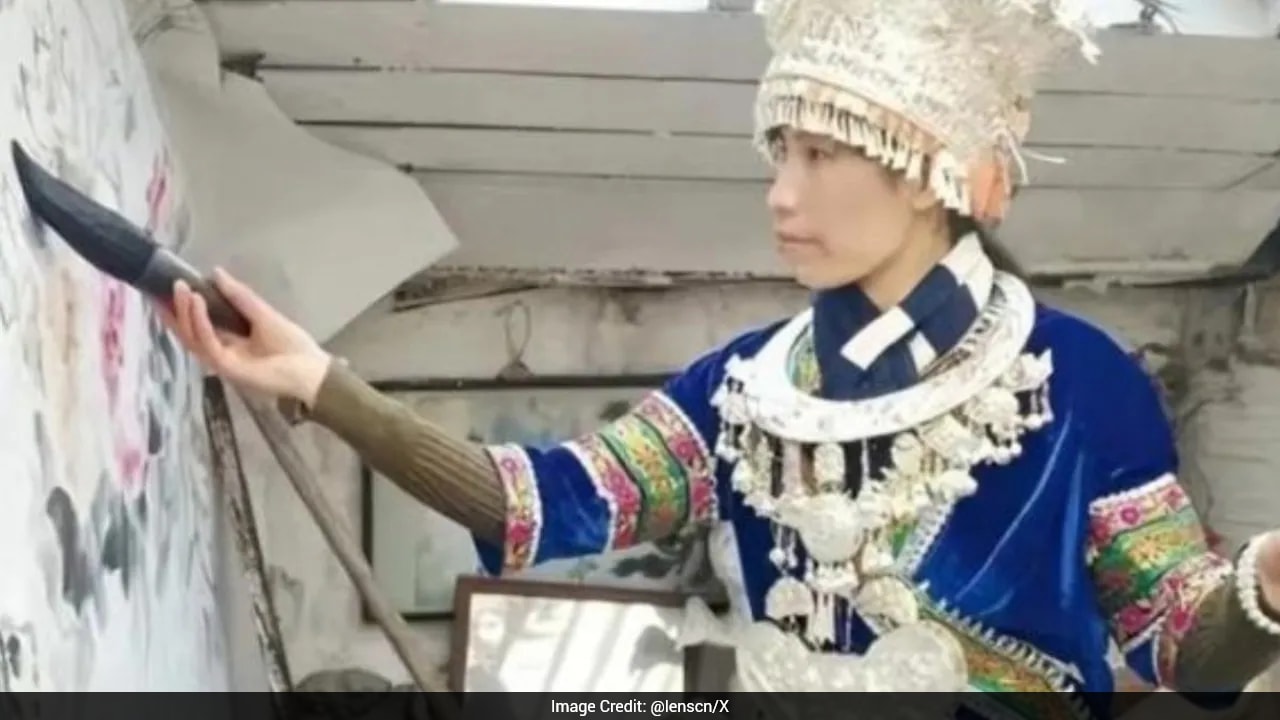
Today, Xiu’s paintings are no longer confined to the walls of her small home. They have found their way into local galleries, drawing collectors who are moved not just by the technical skill of the work, but by the staggering history behind every brushstroke. People stand in front of her canvases, looking at the rich textures and vibrant hues, trying to comprehend that the hand holding the brush was once cold enough to be sent to a crematorium.
She still speaks with a slight hesitation, a lingering echo of the night her body tried to shut down for good. But when she holds a brush, there is no hesitation.
Her story forces us to look at the boundaries of human potential through a different lens. It is easy to view a medical catastrophe as a definitive ending or a permanent reduction of life. We tend to treat survivors of profound trauma with a gentle, pitying condescension, assuming their best days are buried in the past.
Xiu shattered that assumption. She did not just rebuild her old life; she built an entirely new one from the ashes of her near-destruction. The coma stripped away her voice, her mobility, and her identity. In return, the struggle gave her a vision of the world that few human beings ever access—a view from the very edge of existence, where every color is brighter because it was almost lost forever.
The studio where she works now is quiet, but it is a vibrant, chaotic quiet, poles apart from the clinical silence of the funeral home. Jars of water, cloudy with emerald green and cobalt blue, sit on the windowsill. Scraps of paper cover the floor.
Xiu sits at her easel, her back straight, her hand steady. She dips her brush into a pool of deep crimson. She pauses for a second, looking at the blank white paper before her, a space waiting to be filled. Then she brings the brush down, leaving a bold, definitive mark that proves, beyond any shadow of a doubt, that she is still here.


