The air in Guatemala City during the rainy season smells of damp concrete, diesel exhaust, and cheap coffee. It is a heavy air, the kind that clings to your clothes and makes you feel like you are breathing underwater. For years, walking past the Ministry of Public Affairs on Gerona Street felt exactly like that. Heavy. Suffocating. You didn't look the guards in the eye. You walked a little faster, because everyone knew that inside that concrete fortress, justice wasn't blind. It was just counting its money.
At the center of that fortress sat Consuelo Porras.
To the outside world, she was the Attorney General, a bureaucrat in tailored suits with a pristine bun and a permanent, icy half-smile. But to the people who actually had to live under her jurisdiction, she was something far more formidable. She was the architect of a legal fortress built to protect the untouchables. When the history of Central America's struggle with corruption is written, her name will not be a footnote. It will be the title of the darkest chapter.
Now, that chapter is finally closing. But to understand the sheer relief vibrating through the streets of Guatemala today, you have to understand how deeply the rot had settled, and how one woman managed to hold an entire nation hostage with nothing more than a pen and a rubber stamp.
The Architecture of Impunity
Corruption in the abstract sounds like a victimless crime, a series of ledger entries and offshore bank accounts that only matter to economists. It isn't. In Guatemala, corruption is the bridge that collapses during a tropical storm because the contractor skimmed thirty percent off the concrete budget. It is the oncology ward where the medicine never arrives. It is the reason a young father packs a single backpack and risks his life walking north toward the US border, because staying home means watching his children starve in a system rigged against their survival.
For years, a unique experiment called CICIG—a UN-backed anti-corruption commission—had begun to tear down that system. They were actually winning. They put former presidents in handcuffs. They exposed rings of customs fraud that reached the absolute highest levels of power.
Then came Consuelo Porras.
When she took office, the machinery of justice didn't just slow down; it reversed. It was a masterclass in bureaucratic warfare. She didn't announce that she was protecting criminals. Instead, she used the law as a weapon against the lawmakers.
Consider the anatomy of a purge. It starts with a whisper, then a sudden administrative transfer. A prosecutor who spent five years building a airtight case against a corrupt minister would suddenly find themselves reassigned to a remote office in the highlands, tasked with investigating bicycle thefts. If they protested, internal affairs opened an investigation into them.
One by one, the country’s brightest legal minds realized the terrifying truth: the prosecutor's office was no longer hunting criminals. It was hunting the hunters.
The Flight of the Honest
Step into a small, sterile café in Mexico City or a cramped apartment in Washington, D.C., and you will find the human collateral of the Porras era. Dozens of Guatemalan judges, prosecutors, and journalists now live in exile.
Juan Francisco Sandoval was one of them. He was the head of FECI, the special anti-corruption prosecutorial unit, and a man who possessed a terrifyingly thorough knowledge of where the money was hidden. When he pushed too close to the financial secrets of the ruling elite, Porras didn't just fire him. She fabricated charges against him. Sandoval had to flee his own country in the dead of night, crossing the border into El Salvador in the back of a car, leaving behind his life, his career, and his home.
This wasn't just a political maneuver. It was a psychological campaign meant to send a message to every clerk, every low-level investigator, and every ordinary citizen: If we can destroy him, imagine what we can do to you.
Fear became the primary currency of the state. Under Porras, the Public Ministry turned into a black hole where cases against powerful politicians went to die, while files against indigenous activists, independent judges, and critical reporters were fast-tracked with terrifying efficiency. The international community noticed. The United States placed her on the Engel List for corrupt and undemocratic actors, revoking her visa and freezing her ability to interact with the global financial system. She wore the sanction like a badge of honor.
She felt untouchable because, for a long time, she was.
The Election That Broke the Script
Every authoritarian system has a flaw: it eventually begins to believe its own propaganda. The ruling class, a loose coalition of corrupt politicians, military elites, and organized crime figures known locally as el pacto de corruptos (the pact of the corrupt), assumed they had the country completely locked down. The 2023 presidential election was supposed to be a scripted affair, a transition of power from one safe establishment figure to another.
They forgot to account for the quiet fury of a population pushed to its absolute limit.
When Bernardo Arévalo, an academic and diplomat running on a fiercely anti-corruption platform, miraculously advanced to the second round of the presidential election, the fortress panicked. Porras mobilized her entire apparatus. Her office raided the electoral tribunal. They seized ballot boxes, physical paper votes cast by citizens, dragging them out in plastic bags like contraband. They attempted to suspend Arévalo’s political party entirely.
It was a slow-motion coup d'état carried out in broad daylight, using the legal code as a camouflage net.
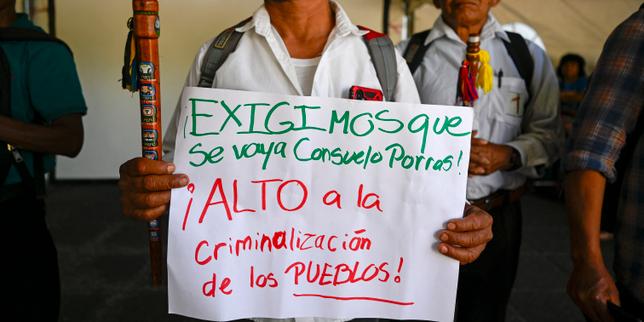
But then, something extraordinary happened. The strategy failed because it encountered an immovable object: the indigenous authorities and the ordinary people of Guatemala.
For weeks, the country stopped. Total paralysis. Indigenous communities blocked major highways, not with violence, but with chairs, blankets, and human bodies. They stood in the pouring rain, chanting for the resignation of Consuelo Porras. The elite expected the protests to fizzle out after a few days. They didn't understand that when you have already lost everything to corruption, you have nothing left to lose by standing in the street.
Arévalo took office. The script was broken.
The Ghost in the Machine
Yet, even with a new president in the national palace, Porras remained. The constitutional architecture of Guatemala made removing an Attorney General nearly impossible, a design flaw intentionally exploited to keep her in place as a shadow ruler. She sat in her office, a ghost in the machine of the new government, continuing to launch investigations against the new administration, trying to paralyze the presidency from within.
But power is a fragile illusion. It requires everyone to agree to be afraid. Once the fear evaporates, the concrete walls of the Ministry of Public Affairs begin to look less like a fortress and more like a cage.
The end of the Porras era is not marked by a dramatic arrest or a theatrical fall from grace. It is the slow, agonizing sound of a system running out of fuel. The alliances are fracturing. The politicians who once sought her protection are quietly looking for exit strategies. The international pressure has turned into a financial vice.
Guatemala is finally breathing out.
The damage she inflicted on the judicial system will take a generation to repair. The empty desks of the exiled prosecutors cannot be filled overnight. The trust that was shattered by years of weaponized law will have to be rebuilt brick by painful brick.
On a recent evening in Guatemala City, the rain stopped just as the sun was setting, leaving the pavement slick and reflecting the amber glow of the streetlights. Outside the Central Plaza, a small group of students was packing up a banner they had kept hung for months. It bore a simple slogan, scrawled in black paint.
Florecerás, Guatemala. You will flourish, Guatemala.
The banner is down now, not because they were forced to take it down, but because the message is no longer a protest. It is an instruction. The woman who locked the gates of the country is still sitting inside her office, watching the clock tick, but outside her window, the city is already moving on without her.