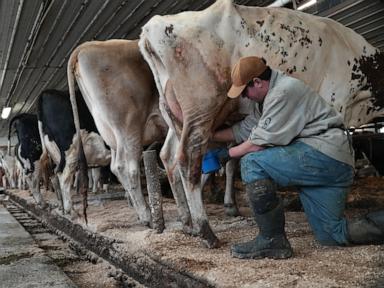
Sarah stands in a sun-drenched kitchen in Iowa, holding a glass of milk that looks different from anything you’ll find on a supermarket shelf. It is thick. It is creamy. A slight yellowish tint hints at the grass-fed diet of the cow it came from. To Sarah, this isn't just a beverage; it’s a protest against an industrial food system she no longer trusts. She believes she is giving her children the purest form of nutrition available, a direct link to the earth that bypasses the stainless-steel vats and high-heat processing of the modern dairy plant.
But three counties away, a public health official stares at a spreadsheet that tells a much darker story. A cluster of three children has just been admitted to the hospital with hemolytic uremic syndrome—a terrifying condition where the kidneys begin to shut down. The common denominator? A "herd share" agreement from a local farm.
This is the frontline of the raw milk war. It is a conflict defined by a profound disconnect between the desire for bodily autonomy and the unforgiving reality of microscopic biology. Across the United States, the movement to legalize and consume unpasteurized milk is gaining a fierce, almost religious momentum, even as the scientific community sounds an increasingly desperate alarm.
The Ghost of Louis Pasteur
We have forgotten why we started boiling our milk in the first place. In the late 19th century, milk was a leading cause of death for children in American cities. It was often produced in "swill dairies" attached to breweries, where cows were fed fermented grain mash and kept in filth. The milk was a cocktail of tuberculosis, typhoid fever, and scarlet fever.
Then came pasteurization. By heating milk to a specific temperature for a set amount of time, we effectively wiped out the pathogens that were killing our youth. It was one of the greatest public health triumphs in human history.
Today, that triumph has become a victim of its own success. Because we no longer see people dying of bovine tuberculosis, the threat feels theoretical. It feels like an old wives' tale told by overzealous government regulators. When a risk is invisible, it is easy to dismiss. Proponents of raw milk argue that modern sanitation has made pasteurization unnecessary. They speak of "dead milk" vs "live milk," claiming that the heat kills beneficial enzymes and probiotics that our bodies crave.
The science, however, remains stubborn.
The FDA and the CDC maintain that there is no meaningful nutritional difference between pasteurized and raw milk. What is different is the risk profile. Raw milk is roughly 150 times more likely to cause an outbreak than pasteurized dairy. It isn't just about the cleanliness of the barn. Even the healthiest cow can shed Campylobacter, Salmonella, or E. coli in its milk. One bad day, one missed heartbeat in the cleaning protocol, and the "pure" liquid becomes a delivery system for a life-altering pathogen.
The Psychology of the Pour
Why do people take the risk? To understand the raw milk drinker, you have to understand the modern sense of betrayal.
We live in an era where "processed" has become a dirty word. We have watched as ultra-processed diets contributed to a rise in metabolic disease, and in response, many have swung the pendulum to the furthest possible extreme. They want the "raw" truth. They want to know the name of the cow. There is a deeply human yearning for the "ancestral," a belief that if our great-grandparents drank it and survived, it must be superior to the plastic-wrapped reality of 2026.
This isn't just a trend for the rural fringe. It has become a political statement. In states like West Virginia and Louisiana, the push for raw milk has been framed as a battle for "food freedom." It’s the idea that a grown adult should have the right to choose what they put in their body, even if the state deems it dangerous.
Consider a hypothetical father named Mark. Mark is a libertarian-leaning software engineer who started buying raw milk because his son had chronic eczema. He read online that unpasteurized milk could cure it. When the eczema cleared up—likely due to a dozen different factors—the milk became his miracle cure. For Mark, every gallon he buys is a middle finger to a bureaucracy he views as captured by Big Dairy interests.
The problem is that "food freedom" rarely accounts for the collateral damage.
When a child drinks raw milk and develops a life-long disability due to an E. coli infection, they didn't choose that risk. The "freedom" was exercised by the parent, but the consequence is borne by the minor. This is the jagged edge where personal liberty meets public safety, and it is where the conversation usually turns into a shouting match.
The Bird Flu Variable
The stakes shifted dramatically in early 2024. The H5N1 avian influenza virus, which had been decimating bird populations for years, made a jump into US dairy cattle. Suddenly, the raw milk debate wasn't just about localized stomach bugs. It was about a potential pandemic.
Researchers discovered that the milk of infected cows was teeming with the virus. When that milk is pasteurized, the virus is neutralized. When it isn't, the virus remains active.
[Image of H5N1 virus structure]
This turned a private health choice into a national security concern. Public health experts aren't just worried about the person drinking the milk getting sick; they are worried about the milk acting as a bridge. Every time a human is exposed to a high viral load of H5N1, it is another "spin of the roulette wheel" for the virus to mutate into a form that spreads easily from person to person.
If you talk to raw milk advocates about bird flu, you often hear a wall of skepticism. They point out that the cows don't seem that sick. They claim the government is using the virus as a pretext to shut down small farmers. The tragedy is that viruses do not care about political narratives. They only care about finding a host.
The Invisible Toll
We often talk about these outbreaks in terms of numbers. "Thirty people sickened across four states." But the numbers hide the sensory reality of the hospital room.
It is the sound of a dialysis machine humming at 3:00 AM because a six-year-old’s kidneys can no longer filter her blood. It is the grey, ashen color of a teenager’s skin as he battles a systemic infection that has gone septic. It is the look on a mother’s face when she realizes that the "natural" product she bought to keep her family healthy is the very thing that might take them away.
These aren't just possibilities; they are the documented history of raw milk outbreaks over the last two decades. While many people drink raw milk for years and never get sick, the "lottery" is always running in the background.
The artisanal dairy movement is right about one thing: we should care about where our food comes from. We should support small farmers who treat their animals with dignity and steward the land with care. We should demand transparency in our food systems.
But there is a reason we don't build bridges out of wood anymore, and there is a reason we don't drink water straight from the city river. We learned. We evolved. We developed tools to keep the invisible predators at bay.
The milk in Sarah's kitchen remains cool and inviting. She pours a glass for her daughter, convinced she is doing the right thing. Outside, the world is full of complex, microscopic threats that don't respect her desire for a simpler time. The rebellion continues, one unpasteurized gallon at a time, fueled by a potent mix of distrust, hope, and the dangerous assumption that nature is always kind.
Nature is many things, but it is rarely kind to the unprotected.