The executive branch is quietly attempting to seize control of local election mechanics, using a combination of federal agency directives, law enforcement investigations, and postal tracking mandates to override state authority. This strategy bypasses the traditional legislative path, moving the battleground from state houses directly into the federal bureaucracy.
While public attention remains fixed on fiery cable news debates and slow-moving congressional bills, the true restructuring of American voting is happening through administrative decree. The issuance of the executive order titled Ensuring Citizenship Verification and Integrity in Federal Elections marked a fundamental shift in this campaign. By commanding the Department of Homeland Security, the Social Security Administration, and the United States Postal Service to build a federal layer of oversight above local county clerks, the administration is attempting a systemic rewrite of how ballots are distributed, verified, and tallied.
The objective is clear. Control the infrastructure of the vote, and the outcome takes care of itself.
The Federal Bureaucracy as an Enforcement Arm
For more than a century, the principle that states manage their own elections has remained a bedrock of American governance. That model is being systematically tested. Under new directives, the Department of Justice and the FBI have been instructed to prioritize investigations into local election administrators who distribute ballots to individuals deemed ineligible by federal databases.
This creates an immediate chilling effect for local officials. A county clerk in a rural precinct or a major metropolitan hub now faces the threat of a federal criminal inquiry for administrative discrepancies. If a state voter roll does not perfectly align with an error-prone federal citizenship database compiled by the Department of Homeland Security, the local official responsible for mailing that ballot could find themselves in the crosshairs of a Department of Justice probe.
The pressure is not applied uniformly. Investigative resources are visibly concentrating on swing states, specifically targeting counties with high volumes of mail-in registrations. By focusing federal law enforcement scrutiny on these administrative choke points, the administration introduces a powerful deterrent against expansive voting policies. Local workers, often operating on shoestring budgets, face a choice between restricting ballot access or risking federal indictment.
Database Discrepancies and the Purge Mandate
The reliance on federal databases to audit state voter rolls introduces massive administrative instability. State records rely on local data sources, such as birth certificates, local DMV records, and marriage licenses. Federal systems like the Systematic Alien Verification for Entitlements database were never engineered to serve as real-time voter eligibility checklists.
When a federal agency forces a state to reconcile these fundamentally different data sets, errors are inevitable. Naturalized citizens who obtained their citizenship recently frequently experience delays before federal databases reflect their updated status. Under the current federal pressure, states are being pushed to execute rapid voter roll purges based on these flawed comparisons, dropping eligible voters from active lists just weeks before major contests.
Weaponizing the Postal Service
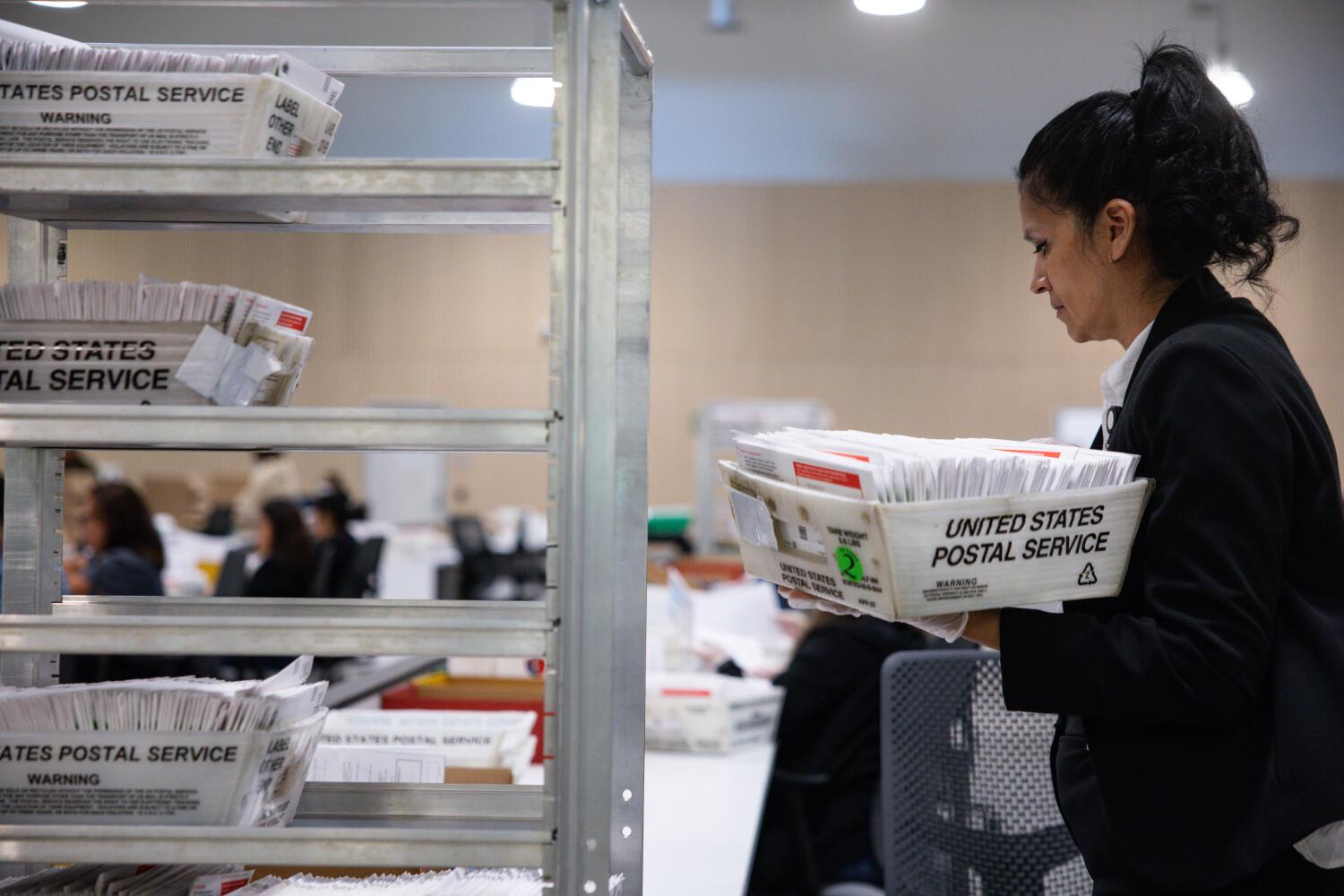
The most radical component of this administrative campaign involves the United States Postal Service. Historically treated as a neutral logistics pipeline, the postal system is being repositioned as an active filter for the electorate.
The March executive order instructs the postal service to draft nationwide regulations for handling election mail. This includes the development of highly specific, federally mandated envelopes equipped with unique tracking codes. Under the proposed framework, if a state does not provide its comprehensive voter registration lists to federal agencies for verification, the postal service could simply decline to distribute or return mail-in ballots for that region.
This is a profound expansion of executive power. By turning a mail carrier into an arbiter of whether a ballot is legally cleared for delivery, the administration circumvents the courts and state election boards entirely. A state might pass a law authorizing universal mail-in voting, but that law becomes meaningless if the federal mail system refuses to carry the pieces of paper.
The Logistics of Selective Delivery
Consider the operational reality of this system. In a hypothetical scenario where a state election board refuses to submit its voter rolls to the Department of Homeland Security, millions of mail-in envelopes could sit stalled in regional distribution facilities.
Postal workers would be put in the position of sorting compliant election mail from non-compliant mail based entirely on federal administrative guidelines. This creates an immediate logistical bottleneck. It turns the physical processing plants of the postal service into ideological gatekeepers, where the right to vote hinges on a barcode approved by Washington.
The Judicial Backstop and Strategic Losses
The strategy is not invulnerable, and it has sustained significant blows in the courts. The Supreme Court issued a major blow to this effort in a five-to-four decision, ruling that states retain the constitutional authority to count late-arriving mailed ballots, provided they are postmarked by Election Day.
This decision exposed a clear ideological fracture within the conservative judicial majority. The ruling established that federal laws setting a single uniform day for elections leave the specific receipt deadlines up to individual state capitals. It was a significant defensive victory for voting rights advocates, confirming that the executive branch cannot use federal litigation to instantly wipe out state-level ballot extension policies.
Supreme Court Vote Alignment on Late-Arriving Ballots:
Majority (5): Roberts, Kavanaugh, Barrett, Sotomayor, Kagan
Dissent (4): Thomas, Alito, Gorsuch, Jackson
Yet, viewing these courtroom defeats as total failures misinterprets the broader objective. The administration uses legal losses to build momentum for parallel tracks. When a court blocks an executive action, the administration immediately pivots to its allies in the House of Representatives, demanding emergency legislative interventions like the SAVE America Act or the MEGA Act.
The Legislative Echo Chamber
These legislative proposals are designed to formalize what the executive orders attempt to mandate through bureaucratic pressure. The MEGA Act explicitly targets universal mail voting systems, requiring citizens to actively request a mail ballot for every single election cycle while simultaneously outlawing community ballot collection.
Even when these bills stall in the Senate, they serve a vital narrative function. They establish a baseline of discontent, framing existing election systems as inherently compromised and justifying further unilateral executive interventions. The litigation creates the friction, the media exploitation creates the urgency, and the subsequent executive orders are framed as necessary national security measures.
The On the Ground Attrition
While the national media focuses on high-profile judicial rulings, a parallel campaign of attrition is unfolding inside local polling places. Financed by millions of dollars diverted into specialized political party legal funds, an army of trained observers and partisan lawyers has been deployed to monitor every phase of the voting process.
This is no longer a loose collection of volunteers holding clipboards. This is a highly organized, legally integrated network operating with corporate efficiency. In key battleground counties, partisan operatives use public records requests to demand immediate, rolling updates on the partisan breakdown of hired poll workers, filing lawsuits the moment an imbalance is detected.
The intent is to litigate the election in real time, long before the first vote is officially certified. By challenging signature verification standards, drop box locations, and the physical setup of polling stations on a county-by-county level, this network creates an environment of perpetual administrative chaos. Local election directors are forced to spend their limited time answering subpoenas and defending standard operating procedures in court, rather than focusing on the secure execution of the vote.
This multi-layered approach—combining top-down executive pressure with bottom-up operational harassment—has fundamentally altered the environment for election workers. The job has transformed from a routine civic duty into a high-stakes legal minefield. The long-term consequence is an exodus of experienced, non-partisan election officials, replaced by ideological actors willing to test the limits of statutory law. The system is changing, not through a grand constitutional convention, but through the steady, unyielding application of administrative force.