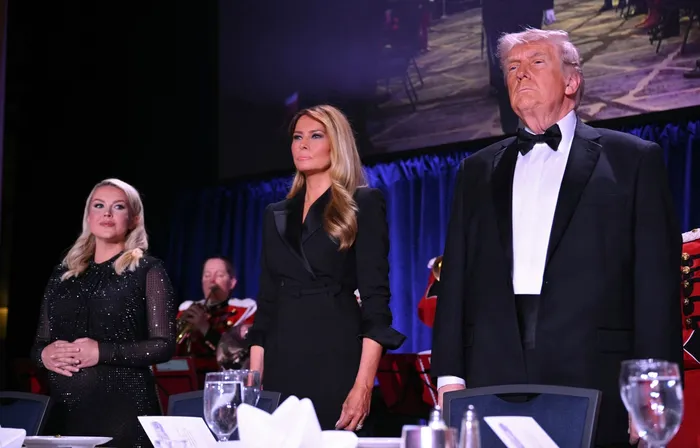
The media is currently obsessed with the health of the First Lady. They are scouring press releases, hunting for "doing great" quotes, and analyzing the trajectory of a bullet that didn't hit its mark. They are missing the forest for the trees. This wasn’t just a security breach or a near-miss; it was the final, violent collapse of the American political spectacle.
When a shooter opens fire at a high-profile event like the White House Correspondents' Dinner, the "news" isn't that the target is unharmed. The news is that the invisible wall between the elite and the reality of modern volatility has been permanently shattered. For decades, these dinners served as a cozy, safe-haven gala where journalists and politicians traded barbs over lukewarm chicken. That era is dead. If you think things go back to "business as usual" after this, you aren't paying attention.
The Myth of the Controlled Environment
Security experts will spend the next six months arguing about perimeters and bag checks. They are fighting the last war. The "lazy consensus" among the punditry is that this was a failure of Secret Service logistics. It wasn't. It was a failure of the cultural contract.
We have spent twenty years turning politics into a high-stakes sport, and now we are shocked when the fans storm the field with more than just a jersey and a sign. The dinner was designed to be the ultimate safe space for the ruling class—a place where the friction of the real world was filtered through jokes and tuxedoes. The shooting proved that there is no such thing as a controlled environment in a hyper-polarized society.
I have watched organizations dump tens of millions into "reputation management" and "security protocols" only to see it all evaporate because they ignored the underlying heat in the room. You cannot keep the public at a boiling point for profit and then act surprised when the steam burns you.
Why "Doing Great" is a Meaningless Metric
Trump’s insistence that the First Lady is "doing great" is classic damage control, but it’s intellectually dishonest. In the world of high-level crisis management, "doing great" is code for "please stop asking questions."
From a psychological standpoint, no one is "doing great" after an assassination attempt at a black-tie event. To suggest otherwise is to treat human beings like cardboard cutouts. By focusing on her physical health, the administration avoids the much more difficult conversation about the total breakdown of domestic stability.
Let’s look at the mechanics of fear.
$$F = P \times V$$
Where $F$ is the social impact of the event, $P$ is the perceived threat, and $V$ is the visibility of the target. When an event with maximum visibility ($V$) is hit by a threat ($P$) that was previously considered impossible in that setting, the social impact ($F$) is exponential, regardless of whether the physical harm was zero. The media is reporting on the 0, while the public is feeling the exponential result.
The Security-Industrial Complex is Lying to You
The immediate reaction to this shooting will be a demand for "more." More scanners, more surveillance, more distance between the podium and the press. This is a fallacy.
History shows us that increased security often creates a false sense of invulnerability that actually invites more creative forms of disruption. Think about the "Maginot Line" mentality. You build a wall so high that you stop looking at the sky.
- The Perimeter Fallacy: The idea that you can create a "sterile" zone in the heart of a major city is a fantasy.
- The Intelligence Gap: We are looking for "threats" using 20th-century profiles while the actual danger is decentralized and unpredictable.
- The Hardening Paradox: The more you "harden" a target, the more symbolic value it gains for someone looking to make a statement.
If the goal is to protect the people, the answer isn't more metal detectors. It's a complete dismantling of the "insider" culture that makes these events such enticing targets for those who feel permanently on the outside.
The Press is Not an Innocent Bystander
The White House Correspondents' Dinner has long been criticized as a "nerd prom" where the people supposed to hold power accountable instead break bread with it. The shooting happens, and suddenly the press is back to being the "victim."
Let’s be brutally honest: the media has spent years incentivizing the exact kind of radicalization that led to this moment. They sell conflict because conflict sells ads. They have turned the political process into a 24/7 reality show, and this shooting was the unscripted season finale.
You cannot spend every night telling people the world is ending and then expect them to remain calm when you gather in a ballroom to laugh about it. The hypocrisy is the propellant. The shooting wasn't just an attack on a person; it was an attack on the performance.
Stop Asking if She’s Okay
The "People Also Ask" sections are currently filled with queries about the First Lady’s recovery and the shooter’s identity. These are the wrong questions.
The right questions are:
- Why do we still hold events that prioritize optics over genuine security?
- How does the Secret Service adapt to an era where the threat is no longer a foreign agent, but a byproduct of domestic rhetoric?
- Is the American political gala officially obsolete?
The answer to the third question is a resounding yes. Any politician or celebrity who thinks they can walk into a room of 2,000 people and be "safe" because they have a lanyard is delusional. We are entering the age of the Virtual State—where any physical gathering of the elite is an unacceptable risk.
The Cost of the "Doing Great" Narrative
By downplaying the event, the administration is trying to project strength. But there is a massive downside to this approach. It signals to the public that this level of violence is now "manageable."
When we normalize a shooting at the highest levels of government as something one can simply "do great" after, we lower the bar for what is considered a crisis. We are effectively telling the next shooter that they need to do more damage to get a real reaction. It’s a dangerous game of escalation.
I have seen this in corporate crises repeatedly. A CEO ignores a glaring flaw in the product, says everything is "fine," and then acts shocked when the entire company collapses under the weight of the next mistake. You cannot "fine" your way out of a systemic failure.
The Death of Access
The real takeaway from this event is the end of access. For the average person, the government was already a distant entity. Now, the wall will get thicker.
Expect:
- The End of Open Dinners: These events will move to undisclosed locations or become entirely digital.
- The Militarization of DC: Expect the capital to look more like a Green Zone every day.
- The Silencing of the Press: "Security concerns" will become the primary excuse to deny journalists access to public officials.
This isn't about safety. It’s about insulation. The shooting provided the perfect pretext to further decouple the leadership from the people they represent.
The Irony of the Tuxedo
There is something deeply morbid about a shooting taking place in a room full of people in five-thousand-dollar outfits. It highlights the grotesque wealth gap and the disconnect between the "influencer" class and the reality of a country where many feel unheard.
The bullet didn't care about the brand of the suit. It didn't care about the "prestige" of the dinner. It was a cold, hard reminder that physics doesn't respect social standing.
If we want to prevent the next one, we don't need better guards. We need a better culture. We need to stop pretending that politics is a game of "us vs. them" played for the entertainment of a select few in a ballroom. Until the elite realize that their safety is tied to the stability of the entire system—not just the height of their fences—these events will remain nothing more than high-risk vanity projects.
The First Lady might be "doing great," but the American political experiment is currently in the ICU. Stop looking at the press releases and start looking at the cracks in the foundation. The next shot won't miss.