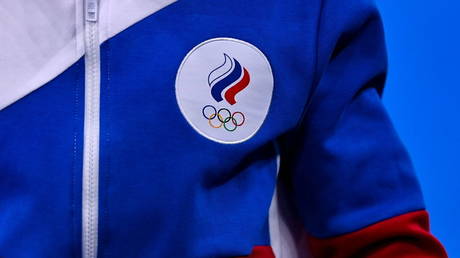
The floor of the gymnastics hall in a snowy training outpost outside Moscow smells of magnesium carbonate, sweat, and old mats. It is a universal smell, identical to gyms in Ohio, Kyiv, or Osaka. A young woman chalks her hands. She is nineteen. She has spent fourteen years bouncing her spine against fiberglass bars, sacrificing her ankles, her friendships, and any semblance of a normal childhood for a single three-week window in July.
But when she looks at her leotard, there is nothing there. No flag. No crest. No double-headed eagle. Meanwhile, you can read other events here: The Geopolitical Mechanics of Olympic Reintegration.
If she wins, a generic melody commissioned by a committee in Switzerland will play through the stadium speakers. She will stand on a podium while a pale green or white flag rises toward the rafters. To the world, she is an AIN—an Athlète Individuel Neutre. A ghost in a spandex suit.
Meanwhile, twelve hundred miles away in Kharkiv, a high jumper shelters in a subway station as air-raid sirens wail. His training track was pulverized by a missile six months ago. His coach is dead. He also dreams of the podium, but his dreams are heavy with the names of the fallen. When he looks at the nineteen-year-old Russian gymnast across the geopolitical divide, he does not see a neutral teenager. He sees the apparatus of the state that destroyed his life. To understand the full picture, check out the excellent report by ESPN.
This is the agonizing, fractured reality behind the International Olympic Committee’s quiet, relentless push to bring Russian athletes back into the global arena. What sounds like a dry policy update debated in wood-paneled rooms in Lausanne is actually a profound human experiment. Can you truly strip a human being of their country? Or is neutrality just a bureaucratic fiction we invent to keep the television cameras rolling?
The Executive Decision in the Silent Hills
The International Olympic Committee operates from a pristine glass building on the shores of Lake Geneva. It resembles a spaceship landed in a park. Inside, the language is civil, legalistic, and bloodless.
When the tanks rolled across the Ukrainian border, the IOC acted with uncharacteristic speed. They recommended a total ban. Russian and Belarusian athletes were cast into the wilderness. Stadium doors slammed shut from Paris to Los Angeles. It was a moment of moral clarity, or so it seemed at the time.
But institutions like the IOC do not like moral clarity. It is expensive. It fractures broadcasting markets. It alienates powerful oligarchs and sports ministers who have spent decades funding federations, building stadiums, and securing votes.
The shift happened incrementally. First came the quiet whispers about human rights. Is it fair, the lawyers asked, to punish a swimmer for a war they did not start? Does a passport make someone a criminal?
Then came the new framework. Russian athletes could return, but under a microscope. To earn the right to compete as a neutral, an athlete must pass a political background check that would make a cold-war spy blink. They cannot have spoken out in support of the war. They cannot be contracted to the military or national security agencies—a massive hurdle in a country where top-tier athletic clubs like CSKA are historically and financially tied to the armed forces. They cannot wear their country’s colors.
The IOC calls this a triumph of bridge-building.
The athletes call it something else. For the Ukrainians, it feels like a betrayal. For the Russians, it feels like a forced capitulation, a demand that they deny their homeland for the privilege of running in circles.
The Fiction of the Clean Slate
Consider the absurdity of the neutral uniform.
We are told that sports transcend politics. It is a beautiful lie, one we buy into every four years because we want to believe humanity can gather in peace. But the Olympics were built on nationalism. The entire spectacle relies on the tribal thrill of seeing your country’s flag ascend. Take away the flags, and the Olympic Games become just another expensive track meet.
An athlete is not an isolated entity grown in a laboratory. They are funded by state ministries. They train in facilities paid for by government rubles. They are escorted by coaches who answer to political appointees.
When a "neutral" athlete wins a gold medal, everyone back home knows exactly which flag they represent. The state-controlled newspapers still splash their faces across the front pages. The politicians still claim the victory as proof of national resilience against a hostile West. The neutrality exists only on the official scoreboard and in the minds of the executives who need to justify their data sheets.
I remember talking to a retired Olympic rower who competed during the boycotts of the 1980s. He told me that the political pressure inside the Olympic village is thick enough to choke on. You eat breakfast next to people whose governments are funding the destruction of your world. You walk past them in the hallways. You see them checking their phones for news from home, just like you do.
The tension does not disappear just because someone forced you to wear a gray tracksuit instead of a red one. It just simmers beneath the surface until the starter pistol fires.
The Unequal Scales of Preparation
The debate often centers on fairness to the individual. The argument goes that a career in elite sports is brief. Missing a single Olympic cycle can destroy a lifetime of work. To ban a clean athlete because of the geography of their birth is an injustice.
That argument possesses a certain philosophical weight. But it falls apart when you look at the conditions of the competitors.
Justice requires a level playing field. There is no level playing field here.
While the vetted Russian athletes continue to train in elite, heated facilities with sports psychologists, doctors, and state-of-the-art equipment, their Ukrainian counterparts are surviving in a war zone. More than four hundred Ukrainian athletes and coaches have been killed since the conflict began. Hundreds of sports complexes lie in ruins, their roofs caved in by artillery, their tracks littered with shrapnel.
Ukrainian competitors are training in exile, crammed into borrowed facilities across Europe, constantly checking their phones to see if their families in Kyiv or Odessa survived the night's drone strikes. They are exhausted. They are traumatized.
To suggest that a Russian athlete is facing an unfair hardship because they have to compete under a neutral flag is a profound distortion of perspective. One group is fighting for a medal; the other is fighting for the survival of their culture.
The Cracks in the Rings
What happens when the policy meets the pavement?
We have already seen the fractures. Handshakes refused at tennis tournaments. Fencers disqualified because they wouldn't touch blades with an opponent from a banned nation. The crowd booing, confused by the shifting rules of engagement.
The IOC’s new directives have not solved the problem; they have merely shifted the burden of enforcement onto the individual international federations. Some sports, like athletics, have held a firm line, refusing to allow Russian competitors back under any guise. Others, like tennis and swimming, have opened the doors wide.
This inconsistency has turned the international sporting world into a confusing patchwork of moral compromises. An athlete can be banned on a track in Monday but cleared to swim in a pool on Tuesday.
It exposes the fundamental weakness at the heart of modern sports governance. The rings are cracked. The myth of the Olympic truce—the ancient Greek tradition that all wars ceased during the games—has been exposed as an archaic fantasy.
The Sound of Silence
Imagine the podium ceremony.
The race is over. The neutral athlete has won. They stand on the highest block of wood. They look up at the flagpole.
There is no anthem. Just a sterile, synthesized melody that means nothing to anyone. The stadium is quiet, filled with an awkward, heavy stillness.
The athlete does not cry tears of national pride. They cannot salute. They must maintain a neutral expression, aware that every twitch of their facial muscles will be analyzed by commentators back home for signs of treason, and by critics abroad for signs of arrogance.
This is the prize the IOC has fought so hard to preserve. A moment stripped of joy, stripped of meaning, wrapped in legal disclaimers and political anxiety.
We are witnessing the slow death of the Olympic ideal, not because of the war itself, but because of the desperate, clumsy attempt to pretend the war isn't happening. By trying to please everyone—by attempting to balance the human rights of the individual against the collective guilt of the state—the authorities have created a system that satisfies no one.
The gymnast in Moscow continues to chalk her hands. The high jumper in Kharkiv continues to watch the sky. And the bureaucrats in Lausanne continue to adjust their parameters, oblivious to the fact that some divides are too deep for a white flag to bridge.