Silence in a stadium holds a distinct physical mass.
It is not merely the absence of noise. It is the sudden compression of forty thousand breaths, catching in collective throats, turning the bright, deafening summer air into something heavy and cold. You feel it in your teeth before you hear it in the stands. The sharp, metallic crack of a bat hitting a ball just right—and then, the sudden, awkward deceleration of a runner pulling up halfway down the line.
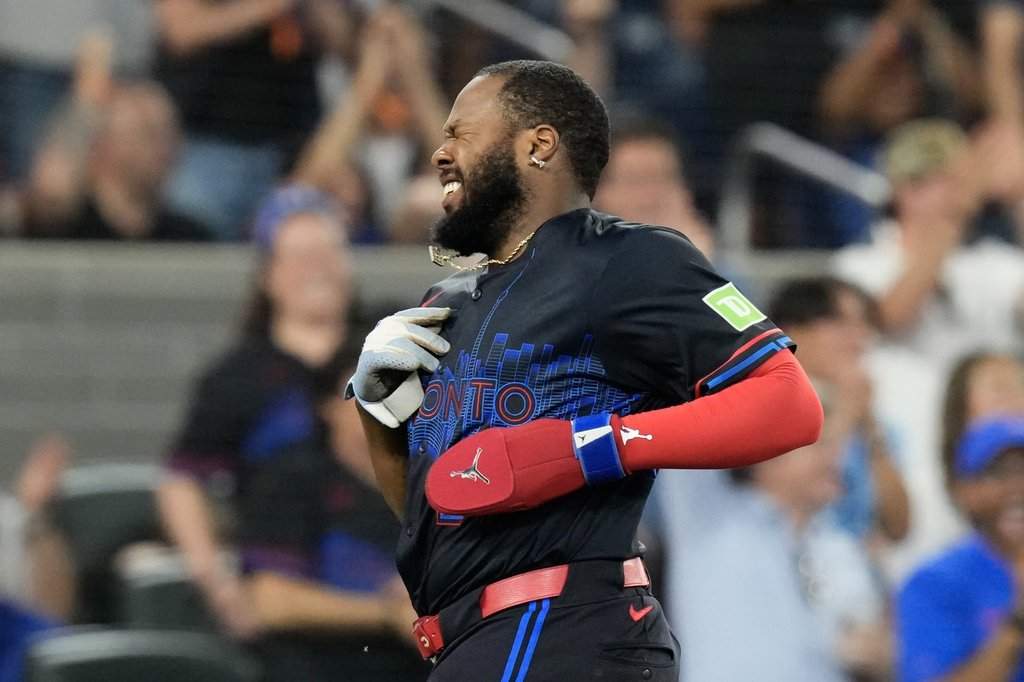
Vladimír Guerrero Jr. did not stumble dramatically. That is not how elite athletes break. They know their bodies with the terrifying precision of watchmakers; they feel the microscopic snap of tissue long before the television cameras catch the hitch in a stride. He simply slowed down. The heavy machinery of his swing, usually a masterclass in controlled violence and rotational torque, came to a grinding halt.
And just like that, the arithmetic of a season shifted.
Baseball is a sport obsessed with numbers, yet it is entirely governed by the fragile biology of human tendons and bone. When the Blue Jays officially announced that Guerrero was heading to the injured list, the news arrived on screens across North America as a neat, clinical transaction. Ten days. Retroactive. A roster spot open for a replacement.
Ink on a page. A blinking cursor on a website.
(Note: All historical references to team rosters and transaction dates reflect standard Major League Baseball protocols for handling acute soft-tissue strains.)
To understand what that transaction actually means, you have to step away from the glowing spreadsheets and walk down into the dugout, where the air smells of pine tar, stale bubblegum, and wintergreen liniment. You have to understand what it feels like to stand in the batter's box against a pitcher throwing ninety-six miles per hour with late movement, relying entirely on core stability, explosive hip rotation, and wrists that can whip through the zone like a cracking towel.
When your foundation fractures, even slightly, the entire structure wobbles.
The Anatomy of Absence
There is a specific kind of vertigo that hits a clubhouse when the best player in the room packs his spikes into a leather bag and walks out the tunnel.
Baseball is a daily grind. It is a war of attrition played out over one hundred and sixty-two afternoons and evenings. Teams do not survive this gauntlet on talent alone; they survive on rhythm. They survive on the quiet confidence that comes from looking down the lineup card and seeing a terrifying immovable object waiting in the cleanup spot.
Vladimír Guerrero Jr. is more than a slugger. He is the gravitational pull of the Toronto batting order. Pitchers approach him with a mixture of professional respect and sheer dread, often pitching completely backward—throwing sliders six inches off the plate just to see if he will chase, terrified of the consequences if they dare challenge him over the heart of the plate.
Remove that gravity, and the opposing pitchers suddenly stand a little taller. The strike zone expands for everyone else. The psychological safety net vanishes.
I remember watching an old minor league coach work with a rookie who had just torn his oblique. The kid was sitting on an overturned bucket in the corner of the medical room, staring blankly at a pair of unlaced cleats as if they were alien artifacts. The coach didn't offer a platitude. He didn't tell him everything happens for a reason. He just tapped the kid on the knee and said, "The hardest part isn't the healing. It's the watching."
That is the invisible tax of the injured list.
The physical rehab is methodical. It is ice packs, resistance bands, ultrasound machines, and agonizingly slow progress tracked on a physical therapist's clipboard. But the mental rehab—the silent, grinding hours spent sitting in the dugout in full uniform, watching your brothers fight a war you are legally forbidden to join—that is where careers stall.
You feel like a ghost. You are physically present, yet entirely irrelevant to the immediate outcome of the game. Every time the team strands runners in scoring position, every time a close call goes against the dugout, you feel a phantom twitch in the healing muscle, wishing you could step into the batter's box and absorb the pressure yourself.
The Domino Effect in the Lineup
Statistics tell us that a single replacement player rarely replicates the production of an elite superstar. But statistics fail to capture the human ripple effect.
When a cornerstone piece like Guerrero steps out of the lineup, manager John Schneider does not simply plug a new name into the third spot in the batting order and press print. He has to rearrange the delicate architecture of the entire team.
Consider what happens next.
The cleanup hitter must now shoulder the burden of protection, realizing that opposing pitchers no longer have to pitch around the following batter to get to him. The bench player thrust into regular duty must suddenly adjust to major league velocity every single night, stepping out of the comfortable rhythm of pinch-hitting and defensive substitution into the unforgiving spotlight of everyday survival.
It is like pulling a load-bearing column out of a house under construction. The remaining timbers creak. Everyone leans a little harder to compensate.
Fans look at the box score and see a zero-for-four night from a replacement infielder and feel anger. They see a missed opportunity with runners on base and scream at the television. What they do not see is the invisible exhaustion of a player trying desperately to be someone he is not—trying to hit home runs with his swing instead of his timing, pressing because he knows millions of people are evaluating his worth against the giant shadow of the man sitting on the bench.
Pressure in professional sports is a heavy cloak. When you are wearing it by choice, you build the neck muscles for it. When it is suddenly draped over your shoulders because an injury forced you into the spotlight, it can crush you.
The Long Road Back
Healing is rarely a straight line.
We live in a culture that loves deadlines. We want recovery timetables reduced to clean, predictable increments. Ten days. Fifteen days. Back in the middle of the order for the weekend series against the Yankees or the Orioles.
Biology refuses to read the press release.
Muscle tissue heals through a messy, microscopic process of tearing and rebuilding. It requires scar tissue to form, stretch, and soften under immense physical duress. A player can feel ninety percent for three days, take one vicious, full-effort hack during batting practice, and feel that terrifying, familiar pinch in his side that resets the entire clock.
That is the fear every athlete carries in the back of their mind. It is not the pain itself that scares them; it is the uncertainty. It is the lingering whisper that asks: Will I be the same when I come back? Will I trust my body to explode through the zone, or will I hesitate for a split second?
In baseball, a split second is the difference between a three-run home run into the second deck and a weak ground ball to the shortstop. Hesitation is fatal.
When Guerrero eventually returns to the lineup—when the training staff finally clears him, when the scar tissue yields, when he steps back into the batter's box and taps his cleats with his wooden bat—the stadium will erupt. Fans will cheer because they missed his bat. They will cheer because the team needs his wins.
But underneath that noise will be something simpler, something deeply human.
They will be cheering for a return to order. They will be cheering because the ghost has finally stepped back into the light, ready to pick up the heavy machinery of summer and swing again.