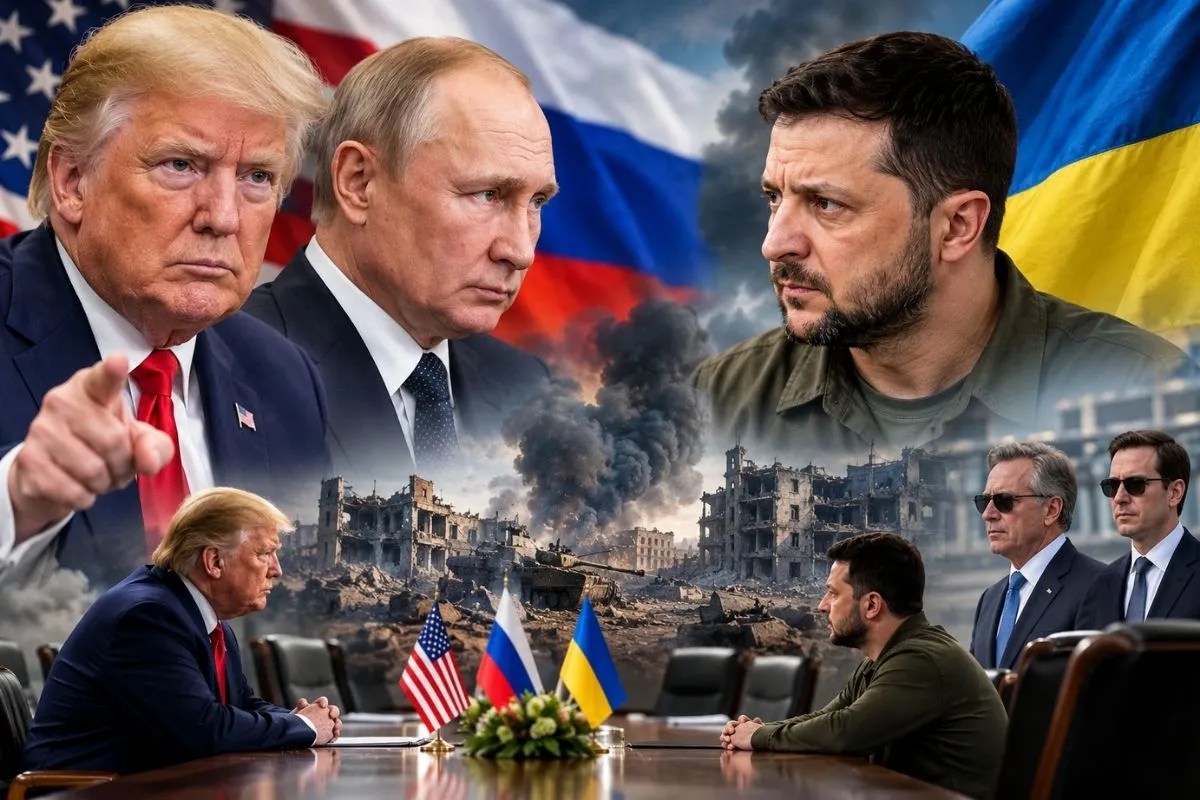
The map of Europe is folded on a mahogany table in Florida, stained with the ghost rings of cold coffee cups and creased along borders that millions of people bleed to protect. Outside, the sun beats down on manicured lawns, indifferent to the coordinates of grief. Inside, the air smells of old paper and ambition. Donald Trump leans forward, his hands resting flat against the wood, speaking about a war that has swallowed generations of young men in the freezing mud of the Donbas. He insists the end is closer than the world dares to hope. He hints at a trilateral room, a quiet space where Vladimir Putin and Volodymyr Zelenskyy might finally sit across from one another, not to shout through the barrels of artillery, but to negotiate the terms of a bruised survival.
Moscow denies it. Kyiv stiffens its spine. The artillery fire continues to roar across the eastern plains, turning brick houses into jagged teeth against a gray sky.
Yet, behind the diplomatic theater, the gravitational pull of exhaustion is beginning to bend the unbendable.
Consider what happens when a war lasts longer than the memories of the children born after it started. In a cramped kitchen in Kharkiv, a mother named Olena stares at a single flickering bulb, rationing the meager electricity left after another night of drone strikes. She does not care about geopolitical strategy or the shifting calculus of sanctions. She cares about the sound of sirens that wake her youngest daughter in the dead of night. When she hears that leaders thousands of miles away are talking about peace deals, about frozen lines of control, about trilateral summits, her heart does not soar with hope. It tightens with dread. Because she knows that peace dictated by the powerful is often just another name for a delayed catastrophe.
Putin wants a way out. This is the quiet truth whispered in the back channels of intelligence agencies and diplomatic cables. Not because the Russian leader has developed a sudden conscience, but because the ledger sheet of attrition is growing dangerously heavy. Steel factories in the Urals are working triple shifts to replace destroyed armor, but you cannot easily replace the hundreds of thousands of experienced soldiers buried beneath the snow. The economy is a balloon held together by heavy tape, pressurized by wartime spending that cannot go on forever without bursting. The desire to talk is real. But Putin’s terms remain a gilded cage for Ukraine: surrender the land, disarm the border, and accept a map drawn by force.
That is the wall Trump is circling.
The former U.S. president views diplomacy as a high-stakes real estate transaction. In his telling, every conflict has a price, and every adversary has a breaking point where a deal becomes more attractive than a protracted stalemate. By floating the prospect of a trilateral meeting, he is attempting to drag both sides out of their entrenched trenches and force them into the blinding light of compromise. But compromise requires leverage, and right now, the leverage is written in blood.
Zelenskyy knows this better than anyone. Imagine standing before a parliament of exhausted lawmakers, wearing the familiar olive-green fleece, knowing that every square mile of soil yielded at a negotiating table is a piece of your nation's soul carved away. To sit in the same room as the man who ordered the invasion is an act of psychological torture. Yet, the math of modern warfare dictates that no conflict ends on the battlefield alone. Every war that starts with a shot must eventually end with a signature.
The friction point is not whether talks will happen, but who dictates the reality on the ground when they do.
Trump argues that the current administration has prolonged the bloodshed by writing blank checks without a clear exit strategy. His supporters point to the staggering financial cost and the risk of escalation into a wider conflagration that could scorch the entire continent. There is a brutal pragmatism to this view. It strips away the moral poetry of the struggle and looks purely at the balance sheet. How much more destruction can the global economy absorb? How many more villages can be erased before the victory Ukraine seeks becomes an empty kingdom of ashes?
But the counter-argument echoes through the ruined streets of Bucha and the hospital wards of Lviv with equal fury. To offer Putin an off-ramp that rewards territorial aggression is to tear up the international playbook and rewrite it for an age of impunity. If a larger nation can simply march across an internationally recognized border, shell its neighbor into submission, and walk away with new provinces sanctioned by a weary world, then every small nation on earth is suddenly living on borrowed time.
This is the invisible stake of the trilateral summit that hasn't happened yet. It is not just about where the new border will be drawn on a map. It is about the future rules of human coexistence.
Look closely at the diplomatic choreography. Moscow leaks willingness to talk when military momentum stalls, then hardens its demands the moment a Western aid package faces political delay in Washington or Brussels. It is a pendulum swing designed to wear down the West's resolve. The Kremlin is playing a long, cold game, betting that democratic societies have notoriously short attention spans and that inflation and election cycles will eventually force Kyiv's allies to abandon them.
Trump’s intervention disrupts that rhythm. Whether one views him as a reckless disruptor or a necessary catalyst, his insistence on a negotiated settlement forces the issue into the open. He speaks of ending the war in twenty-four hours—an obvious rhetorical exaggeration, to be sure, but one that highlights the urgency missing from traditional diplomatic channels that treat time as an infinite resource.
Meanwhile, on the frozen frontlines, the soldiers do not talk about geopolitical frameworks. A twenty-two-year-old drone operator named Dmytro, sheltering in a damp basement outside of Kupiansk, watches a tiny screen as a quadcopter buzzes through the gray mist. His hands are raw from the cold, his eyes red from lack of sleep. When asked about Trump’s peace plans, he doesn't curse politicians; he just laughs bitterly.
"Let them come here," he says, wiping condensation off a cracked monitor. "Let them sit in this basement for twelve hours while the shells fall. Then we can talk about how easy it is to draw a line on a map."
That is the chasm between the boardroom and the bunker.
The proposed trilateral meeting remains a ghost story for now. A rumor whispered in newsrooms and debated on talk shows. Putin signals readiness, but on his own terms of capitulation. Trump promises a swift resolution, but lacks the magic wand to bridge the impossible gap between total conquest and absolute sovereignty. Zelenskyy holds the line, knowing that any deal made without absolute security guarantees is merely an intermission before the next act of violence.
The sun sinks lower over the Florida estate, and the papers on the table are gathered up. The conversation shifts to polls and strategy. But thousands of miles away, the generator hums in Olena’s kitchen, the drone motors whine in the eastern sky, and the map of Europe remains stained and unresolved, waiting for a courage that has not yet arrived.