The air in Kyiv smells of old rain and burnt metal, a familiar, heavy scent that clings to wool coats and stays at the back of your throat long after you have moved indoors.
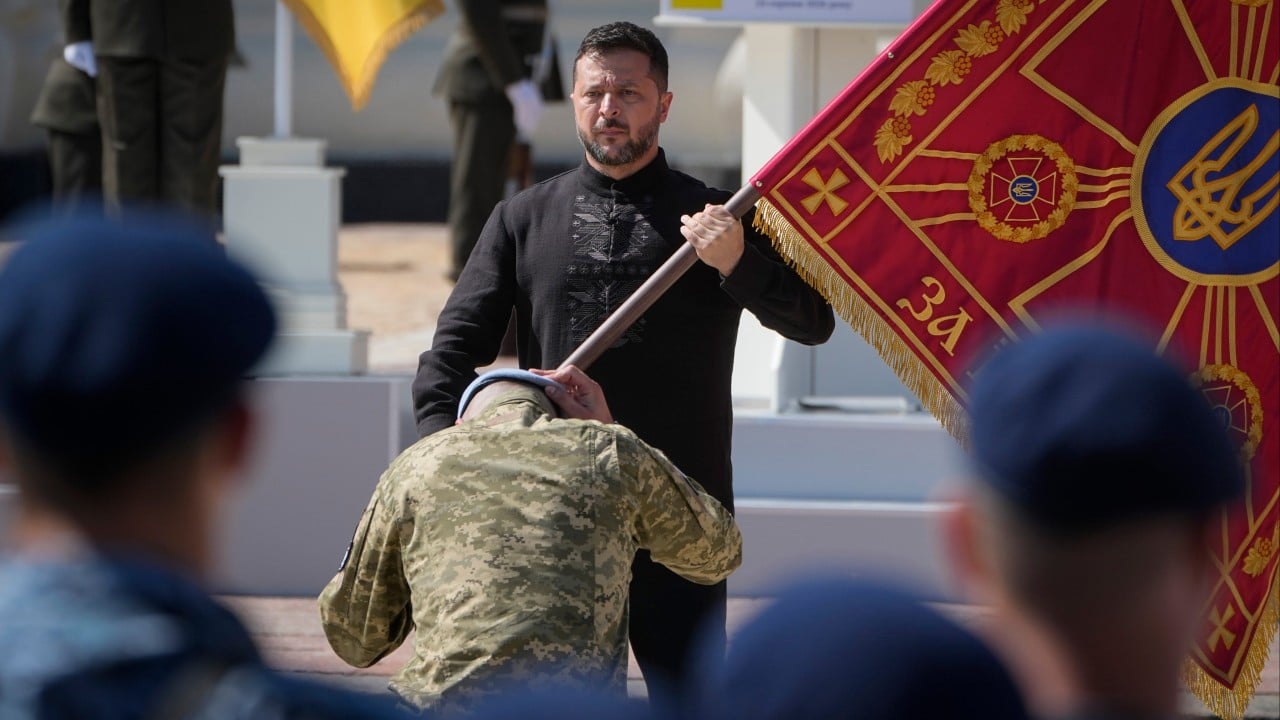
It is Independence Day. Outside, the cathedral bells ring out, iron tongues striking bronze in a rhythm that feels defiant against the grey autumn sky. People walk the cobblestones with their shoulders squared, wrapped in blue and yellow flags, children riding on fathers' shoulders, old women clutching bouquets of late summer asters. There is a quiet grace to it. A dignity that refuses to shatter, no matter how many times the sirens wail before dawn.
And yet, behind the quiet courage etched into every face, the question hangs suspended in the charged atmosphere: How much longer?
President Volodymyr Zelensky stands before the cameras, his green fatigues unadorned, his face marked by the relentless exhaustion of a man who lives on minutes rather than hours. He speaks plainly. The message is clear, stripped of diplomatic polish. Ukraine wants peace. Everyone wants peace when their homes have been turned to rubble and their friends’ names are carved into improvised memorials in city squares.
But peace is not the same thing as erasure.
When people talk about ending a war from comfortable armchairs thousands of miles away, they often treat borders like ink on a napkin. They speak of compromises, concessions, and pragmatic solutions, as if a nation's sovereignty were a line item in a corporate merger. They forget what it means to look out a window and see a landscape fundamentally altered by violence. They forget the human cost of simply giving up.
Zelensky makes a definitive distinction. Ukraine wants peace, but it will not simply surrender.
Consider what surrender actually means on the ground. It is not a signature on a piece of paper in a neutral capital. It is not a polite handshake across a mahogany table. For a mother in Kharkiv or a machinist in Zaporizhzhia, surrender means waking up under a flag that tried to erase your language, your history, and your right to exist. It means filtration camps. It means unmarked graves in forests. It means teaching your children a history that tells them they were never truly a people to begin with.
To surrender is to accept annihilation by installments.
History offers grim reminders of what happens when aggressors are fed small slices of a nation to keep the peace. Appeasement is an appetite that only grows with every meal. The architects of this war do not want a compromise; they want total subjugation. They want an empty map where Ukraine used to be.
Against that kind of absolute erasure, defense is not a political choice. It is a biological imperative. It is the breath in the lungs of a culture that has fought for centuries against empires that tried to grind it into dust.
Think of Maria, a hypothetical yet entirely real composite of a thousand teachers, doctors, and artists currently holding the fabric of Ukrainian society together. Before the war, she spent her autumns grading essays on poetry and drinking bitter coffee in cafes that now stand as shattered skeletons of brick and glass. Today, she runs a volunteer logistics hub out of a damp basement, sorting thermal socks, tourniquets, and dried soup packets. Her hands are calloused. Her eyes carry a permanent shadow.
When asked about peace, Maria does not quote geopolitical theorists. She simply points to the horizon, where the dull, rhythmic thud of distant artillery reminds everyone that the front line is never truly far away.
"We want peace more than anyone," she says, her voice steady, devoid of theatrics. "We are the ones dying for it. But peace means we get to wake up tomorrow. Surrender means we are already dead."
The international community watches these developments with a mixture of awe and anxiety. Leaders in Western capitals calculate grain shipments, energy prices, and military stockpiles, balancing human survival against economic inflation. They debate authorization ranges for missiles and the speed of aid deliveries. Every delay in Washington or Brussels is measured in blood on the steppes of the east.
Every time a package stalls in a parliament, the cost goes up. A shattered power grid. A bombed-out hospital. Another village reduced to a ghostly collection of chimney stacks.
Yet, the core resolve of the nation remains remarkably stubborn. Independence Day is not just a historical anniversary anymore. It is an active, daily practice. It is the baker opening his shop at six in the morning despite the air raid sirens. It is the railway workers fixing blown tracks under the cover of night. It is the coder writing software in a bomb shelter by the flickering light of a laptop battery.
They are holding the line for a principle that the modern world often takes for granted: that people have a fundamental right to choose their own destiny, to govern themselves, and to live free from the shadow of an imperial neighbor's boot.
If Ukraine were to fold, the shockwaves would not stop at its borders. It would send a chilling signal to authoritarian regimes everywhere that might makes right, that international law is a suggestion, and that borders can be redrawn with tanks and missiles whenever a dictator feels nostalgic for empire. The security architecture of the entire globe rests on the gritty, unyielding resistance happening right now in the mud of the Donbas and the skies above Kyiv.
Zelensky’s words are a reminder to a weary world that true peace cannot be bought by sacrificing the innocent. It cannot be achieved by turning a blind eye to injustice disguised as realpolitik.
The sun begins to dip below the horizon, casting a long, golden light over the golden domes of the capital. The evening curfew approaches. The crowds on the streets slowly disperse, heading back to their apartments, checking their phones for updates, preparing for another night of vigilance.
The air grows colder. Somewhere in the distance, a generator hums to life. In the quiet hours before midnight, under a sky that holds both stars and the silent threat of drones, the nation breathes in, holds its ground, and refuses to let go.