The Myth of the Storybook Ending
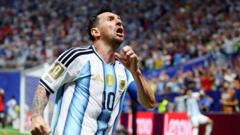
Lionel Messi wept because the script almost broke. When the final whistle blew in Lusail, the narrative of the greatest soccer player in history achieving his ultimate destiny was cemented. Media outlets rushed to frame the moment as a flawless, poetic culmination of a legendary career. They focused on the romance of the trophy, the symmetry of the achievement, and the tears of relief that washed away sixteen years of international frustration.
That framing misses the entire point of what actually happened on the pitch.
The reality of Lionel Messi World Cup victory is not a neat fairy tale. It was a grueling, chaotic exercise in survival that exposed the absolute limits of individual genius in a hyper-modern team sport. To understand why Messi wept, you have to look past the trophy and examine the terrifyingly narrow margins between immortality and catastrophic failure. Argentina did not win because of a flawless masterclass. They won because they managed to drag an aging icon across the finish line before his legs gave out completely, surviving a tactical and physical onslaught that nearly ruined the legacy everyone was desperate to validate.
The Anatomy of Tactical Insulation
Modern international soccer is a young man sport defined by high-pressing systems, relentless data-driven positioning, and suffocating defensive blocks. A thirty-five-year-old forward who does not defend is a massive tactical liability in this environment. No matter how brilliant that forward is with the ball at his feet, his inclusion forces a profound structural compromise on the rest of the collective.
Argentina manager Lionel Scaloni understood this brutal reality better than anyone else. He did not build a team to complement Messi. He built a frantic, hyper-aggressive insurance policy to protect him.
The Running Men
To offset Messi lack of defensive work rate, Scaloni deployed a midfield engine room designed specifically to cover ground on his behalf. Rodrigo De Paul, Alexis Mac Allister, and Enzo Fernandez did not just play soccer; they ran themselves into the ground to absorb the defensive burden Messi abandoned.
- Defensive Coverage: De Paul functioned essentially as a tactical bodyguard, drifting into areas Messi vacated to disrupt opposition counter-attacks before they could exploit the space.
- Pressing Metrics: The Argentine midfield consistently ranked among the highest in the tournament for successful pressures in the middle third, masking the fact that their primary playmaker was walking for long stretches of the game.
This was not a traditional tactical system. It was a highly specialized eco-system designed to isolate one man from the physical realities of modern athletic competition. When it worked, it allowed Messi to preserve his energy for moments of devastating spatial awareness. When it failed, it left Argentina completely exposed to teams with superior athletic depth.
The Mirage of Control
The final against France was not a exhibition of dominance. It was a case study in how quickly a tactical insulation system can disintegrate under sheer physical pressure. For seventy minutes, Argentina executed their plan flawlessly, suffocating a sluggish French side and building a two-goal lead.
Then, the physical toll of the tournament caught up with them.
When Kylian Mbappé scored twice in ninety seconds, the romantic narrative shattered. Suddenly, the aging icon was trapped in a chaotic, transition-heavy match that favored youth, speed, and raw power. The tactical structure holding Messi up began to buckle. Every extra minute of extra time became a grueling test of endurance rather than a showcase of skill.
The genius of Messi late-career performance was not that he dominated these chaotic sequences, but that he survived them. He scored a messy, instinctive goal in extra time that lacked the aesthetic grace of his youth but possessed the pure, pragmatic desperation of a veteran who knew he would never get another chance. He converted his penalty with ice-cold precision. But relying on a penalty shootout to secure a legacy is a high-wire act over a canyon of permanent sports villainy.
The Unspoken Toll of National Obsession
We demand that our sporting icons carry the emotional weight of entire nations, yet we rarely analyze the psychological cost of that burden. In Argentina, Messi was not just competing against eleven players on the field; he was competing against the ghost of Diego Maradona and the collective neurosis of forty-five million people who viewed footballing success as a metric of national self-worth.
For over a decade, this expectation manifested as a toxic relationship between the player and his homeland. He was accused of lacking passion, of being more Spanish than Argentine, and of failing when it mattered most.
The tears shed in Qatar were not joy. They were the physical manifestation of an immense, suffocating pressure cooker finally releasing its valve. Had Emiliano Martínez not made a desperate, outstretched left-leg save against Randal Kolo Muani in the 123rd minute, the narrative today would be entirely different. Messi would have been branded a tragic failure who choked away a two-goal lead in his final act on the world stage. One millimeter of leather changed the entire history of sports journalism.
The Final Blueprint
The lesson of Messi World Cup career is not that individual greatness can overcome any obstacle. The lesson is that individual greatness requires an extraordinary amount of logistical, tactical, and psychological engineering to manifest at the highest level.
As the sporting world looks for the next generational talent to occupy the throne, teams must realize that finding a genius is only half the battle. The harder part is building a machine willing to break its own back just to let that genius walk.