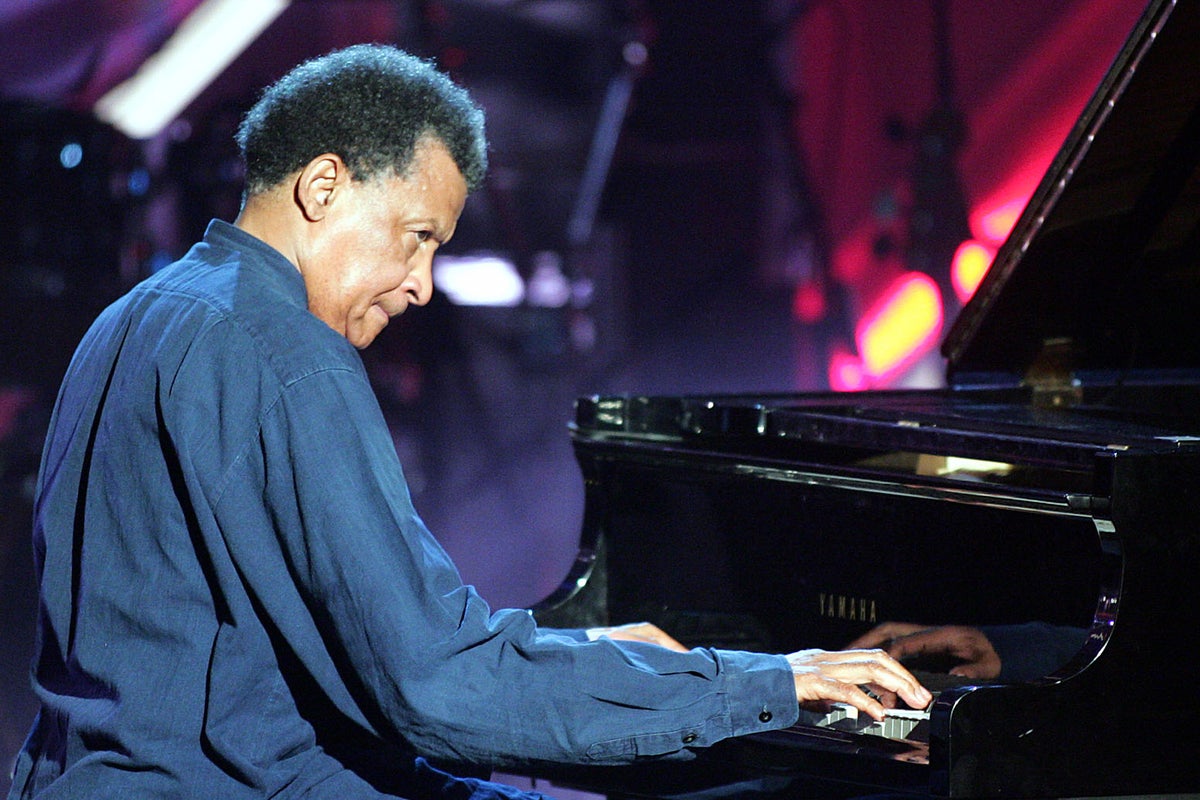
The legendary South African pianist and composer Abdullah Ibrahim has died in Germany at the age of 91 after a brief illness. His passing, confirmed by his family on June 15, 2026, marks the end of an eight-decade musical odyssey that weaponized the piano keyboard against state-sponsored tyranny. Ibrahim did not merely play jazz. He engineered a sonic refuge for a brutalized nation and, in doing so, fundamentally altered how the Western world understood modern music. While standard obituaries frame his death as the quiet departure of a senior statesman, the reality of his life was an exercise in radical defiance, intense spiritual discipline, and structural rebellion.
He began life as Adolph Johannes Brand in Cape Town in 1934, growing up in the diverse, vibrant enclave of District Six before the apartheid state bulldozed it into dust. By the late 1950s, performing under the moniker Dollar Brand, he was already tearing down the artificial barriers erected by racial segregation. Modern ears often forget the sheer physical danger of his early career.
The apartheid regime did not just enforce physical separation; it policed cultural expression. Jazz, with its inherent requirement for racial integration and intellectual freedom, was viewed by the state as an existential threat. When Ibrahim formed the Jazz Epistles alongside legendary trumpeter Hugh Masekela and saxophonist Kippie Moeketsi, they were not just a band. They were a direct provocation to the Nationalist government.
The Myth of the Accidental Exile
Mainstream history loves a tidy narrative of discovery. The common story dictates that Duke Ellington stumbled upon Ibrahim in a Zurich nightclub in 1963 and simply bestowed international stardom upon him. This version minimizes the deliberate, calculated survival strategy employed by Ibrahim and his future wife, the brilliant jazz vocalist Sathima Bea Benjamin.
The Sharpeville massacre of 1960 had effectively turned South Africa into a police state. The Jazz Epistles had shattered records by recording the first full-length jazz LP by Black South African musicians, Jazz Epistle Verse One, but the state responded by shutting down venues and banning gatherings. Exile was not a creative choice; it was an escape from psychological and professional strangulation.
When Benjamin persuaded an exhausted Duke Ellington to watch Ibrahim play at the Africana Club in Zurich, it was a moment of tactical brilliance born of desperation. Ellington recognized that Ibrahim was not imitating American bebop. He was synthesizing something entirely new: a complex musical language that fused the ragas of port-city Cape Town, the traditional marabi and mbaqanga rhythms, and the solemnity of African Methodist Episcopal Church hymns.
Ellington did not just sponsor an album; he validated a distinct branch of modernism. When Ibrahim substituted for Ellington at the head of the Duke Ellington Orchestra on five tour dates in 1966, it proved that a musician from the tip of Africa could command the definitive institution of American jazz.
The Sound of Insurgency
In 1968, Brand converted to Islam, adopting the name Abdullah Ibrahim. This was more than a personal religious pivot. It was a conscious stripping away of the colonial identity imposed upon him. This spiritual grounding manifested directly in his playing style, transforming his concerts from standard jazz sets into intense, meditative rituals.
The Geography of a Masterpiece
To understand Ibrahim’s impact on the global landscape of music, one must dissect his 1974 masterpiece, Mannenberg. Recorded during a brief, tense return to Cape Town, the track became the definitive soundtrack of the anti-apartheid liberation struggle.
| Element | Technique | Socio-Political Impact |
|---|---|---|
| The Groove | Heavy, repetitive marabi-inflected bassline | Instantly recognizable to working-class South Africans; provided a sense of collective identity |
| The Melody | Accessible, folk-like phrasing on an old, slightly out-of-tune upright piano | Evoked the communal warmth of District Six before its forced demolition by the state |
| The Subtext | Disguised musical protest under the guise of an infectious dance tune | Smuggled into prisons, including Robben Island, to sustain political prisoners like Nelson Mandela |
The track was a trojan horse. While censors heard an upbeat instrumental, the dispossessed population heard an anthem of defiance. Mandela would later famously refer to Ibrahim as "our Mozart." The comparison is telling: Ibrahim possessed the structural precision of Western classical music but infused it with an unyielding revolutionary spirit.
The Architecture of Quiet
While his contemporaries often favored explosive, rapid-fire virtuosity, Ibrahim developed what modern pianists call a fearlessness with silence. He rejected the frantic density of late-period bebop in favor of an unhurried modernism.
He understood that space in a musical composition holds as much weight as a striking chord. Dissonant clusters of notes would appear with sudden nonchalance, only to resolve into a traditional folk melody. This was not accidental minimalism. It was the musical manifestation of a worldview forged under oppression: a calm, internal sanctuary that no external force could conquer.
This deliberate pacing extended to his physical life. Ibrahim spent his later decades living in the quiet hills of Bavaria, Germany, practicing traditional martial arts and refining his compositions far from the commercial pressures of the international music industry. He resisted the temptation to become a legacy act, constantly recontextualizing his older material so that it retained its sharp, urgent edge.
Even his final public performance at the Cape Town International Jazz Festival in March 2024 was defined by this hushed mystery. He sat at the grand piano, a fragile but unyielding figure, holding the audience captive not with volume, but with the profound gravity of his touch.
The quest he spoke of throughout his eighty-year career did not end with the fall of apartheid, nor does it end with his death in Bavaria. Ibrahim leaves behind a blueprint for how art can dismantle systems of oppression without losing its aesthetic integrity. He proved that a piano, when struck with absolute conviction, can hit with the force of an army.
:max_bytes(150000):strip_icc()/high-angle-view-of-black-widow-spider-on-plant-681958901-5b4607d346e0fb0037bf3962.jpg)