The tea was still hot when the floorboards began to groan. In Kathmandu, the monsoon does not arrive as a polite visitor; it comes as an eviction notice. For months, the air had been thick with something heavier than humidity. It was the weight of political street corners crowded with shouting young men, of parliamentary desks abandoned, of a government cobbled together from fragile alliances that felt as permanent as wet clay.
The politicians had spent the spring trading accusations in wood-paneled rooms while the clouds gathered over the Himalayas. They argued about portfolios, about who should hold the reins of a fractured republic, about constitutions and coalitions. They were so busy watching each other that they forgot to watch the sky.
Then came the rains.
Consider what happens when a country already holding its breath is hit by a deluge that refuses to stop. In late September, continuous, torrential downpours turned the mountain kingdom into a series of isolated islands. Rivers that usually gurgled quietly over gray stones swelled into brown, roaring corridors of destruction, tearing through highways, swallowing bridges, and washing away entire homesteads before dawn.
To understand what happened next, you have to look past the macroeconomics of disaster relief and into the courtyard of a home in Lalitpur.
Meet Sunita. (We use her name to give a face to the hundreds of thousands whose stories are otherwise flattened into morning news bulletins.) Sunita runs a small guesthouse, a place where travelers heading toward the Annapurna circuit usually pause to drink ginger lemon tea and map out their treks. When the Bagmati River breached its banks, the water didn't just flood her ground floor; it filled her livelihood with mud.
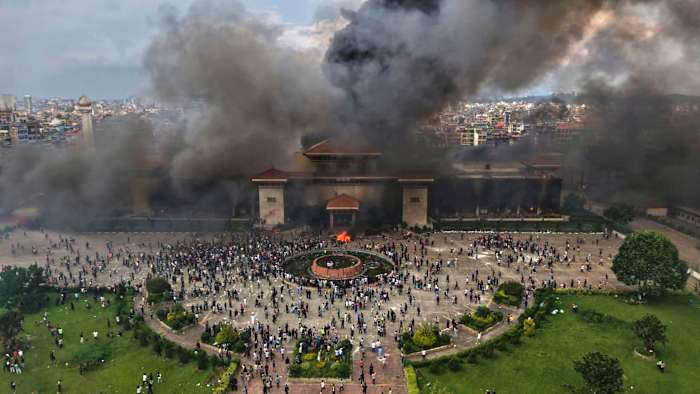
"We thought the hardest part of the year was behind us," she told neighbors later, standing waist-deep in the wreckage of what took a decade to build. She wasn't talking about the weather. She was talking about July. She was talking about the protests, the curfews, the sudden resignation of a prime minister, the tear gas drifting past ancient pagodas, and the paralyzing uncertainty that froze the tourism industry right as the autumn trekking season was supposed to breathe life back into local wallets.
Nepal's new government, rushed into power amid civil unrest just weeks before the floods, suddenly found itself tested not by parliamentary debate, but by mudslides.
This is the cruel irony of governance in the high mountains. When you inherit a state apparatus that is already frayed at the edges, you do not get a honeymoon period. You get a crisis.
The logistical nightmare that followed was staggering. Major arteries connecting the capital to the rest of the country—highways carved into the sides of vertical cliffs—disappeared in massive landslides. Imagine waking up to find that the road to your job, your food supply, and your rescue services has simply slid down a three-thousand-foot drop into a raging torrent. Thousands of travelers were stranded in remote valleys, staring up at gray mist, waiting for helicopters that couldn't fly through the blinding squalls.
In the capital, the new ministers sat around tables once again. But this time, the maps were not political party alignments; they were topographical charts marked with red ink.
How does a new administration, barely dry behind the ears of its oath-taking ceremony, respond when the infrastructure it promised to reform is literally washing away?
Slowly, and then with desperate urgency.
The state machinery, notoriously bureaucratic and often paralyzed by red tape, had to pivot overnight. Soldiers were deployed with shovels before they had even finished unpacking their barracks. Local youth groups—many of whom had been marching against the government just weeks earlier in street demonstrations—dropped their protest placards and picked up ropes, forming human chains to pull stranded families from rooftops in the southern plains.
Crisis has a way of rearranging priorities. The ideological divides that paralyzed Kathmandu for months dissolved the moment the muddy waters reached the steps of government ministries.
Yet, the questions left behind by the receding floodwaters are sharper than the rocks in a mountain stream.
When the roads are cleared and the tourists eventually return—because Nepal always pulls them back with the hypnotic pull of its snow-capped giants—what kind of state will be waiting for them? Will it be one capable of proactive disaster management, or will it remain trapped in the reactive cycle of political survival?
The disaster exposed the fragility not just of mud-brick homes built too close to riverbeds, but of institutional resilience. Climate scientists have long warned that the Himalayan region is warming faster than the global average, melting glaciers and supercharging monsoon cycles into violent anomalies. The weather is no longer playing by historical rules.
And neither is the populace.
The people of this country have survived earthquakes, blockades, insurgencies, and endless changes of flag. They possess an extraordinary, stubborn grace. You see it in the way an old man cleans his courtyard with a twig broom five minutes after the mud has stopped flowing, refusing to let the chaos win. You see it in the young entrepreneurs who built digital relief-tracking apps on their phones while the power grid flickered out.
The new government survived its baptism by flood. But survival is a low bar for a nation that deserves to thrive.
As the sun finally broke through the dense clouds, casting a sharp, golden light over the valley of Kathmandu, the mountains stood tall and indifferent, their white peaks piercing the blue. Below them, the repair work began. Hammers struck nails. Heavy machinery scraped asphalt. The tea kettles were lit once more.
The test was over, but the exam continues.