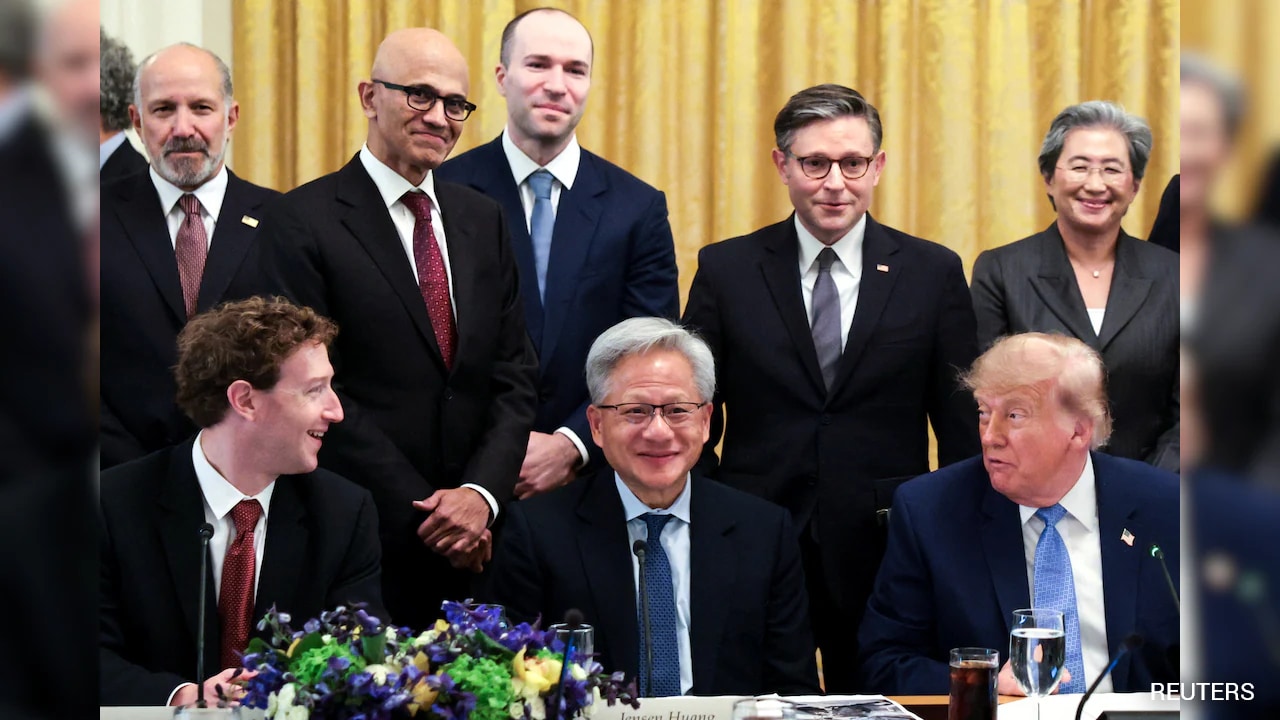
Washington just handed out golden tickets to Nvidia and roughly two dozen of America’s biggest artificial intelligence firms, anointing them official "National Champions." The mainstream tech press is eating it up, framing the move as a muscular, strategic masterstroke to outmaneuver Beijing and lock down domestic compute dominance.
They are completely wrong.
History does not look kindly on governments picking winners in fast-moving technology markets. When bureaucrats start handing out crowns, innovation stops and rent-seeking begins. By wrapping a select club of Silicon Valley giants in the American flag, Washington isn't securing the future of domestic AI. It is building a brittle, state-backed cartel that will choke off the exact kind of scrappy, garage-level disruption that made American tech unbeatable in the first place.
The Lazy Consensus Around Industrial Policy
The standard narrative goes like this: artificial intelligence requires unprecedented capital, massive clusters of graphics processing units, and gigawatts of electrical power. Because the barrier to entry is measured in tens of billions of dollars, only a handful of hyperscalers and foundational model labs can compete on the global stage. Therefore, the federal government must step in, clear regulatory hurdles, subsidize energy access, and shield these "National Champions" to win a geopolitical arms race.
That argument sounds logical until you look at how technological revolutions actually unfold.
I have spent over a decade watching enterprise software and hardware cycles play out from the inside, and I have seen companies blow hundreds of millions of dollars chasing government-subsidized moats. Every single time an industry trades market discipline for federal protection, the product gets worse, the prices go up, and the engineering talent gets lazy.
When you tell a company it is too strategic to fail, its primary customer ceases to be the enterprise buyer or the developer. Its primary customer becomes the Department of Commerce and the Pentagon. Lobbyists replace product managers. Compliance officers outnumber research scientists.
What National Champion Status Actually Buys You
Let’s strip away the patriotic branding and define what "National Champion" status means in cold economic terms. In industrial economics, a national champion is a private corporation designated by the state to receive preferential regulatory treatment, subsidized capital, sovereign procurement contracts, and diplomatic protection in exchange for aligning its roadmap with national security objectives.
Notice what is missing from that definition: customer satisfaction and unit economics.
Consider the history of state-backed tech champions across the globe:
- European Telecoms in the 1990s: Governments protected state-adjacent monopolies to ensure domestic sovereignty. The result was bloated cost structures, glacial rollout speeds, and an entire continent missing out on the consumer internet boom.
- Japan’s Fifth Generation Computer Systems Project: In the 1980s, Tokyo poured massive state resources into a hand-picked consortium to dominate artificial intelligence and parallel computing. Meanwhile, unsubsidized American startups working on commodity microprocessors and open software architectures ate their lunch.
- Solar and Semiconductor Missteps: Even within the United States, Solyndra became the textbook warning of what happens when political capital substitutes for market validation, while the CHIPS Act has already demonstrated how quickly federal money gets bogged down in environmental reviews, labor mandates, and construction delays.
Nvidia did not become a multi-trillion-dollar juggernaut because a committee in Washington liked its business plan. Jensen Huang bet the company on CUDA in 2006 when Wall Street thought he was burning cash on a science project for academic researchers. That bet survived because Nvidia had to fight tooth and nail for every dollar of revenue in brutal, unforgiving commercial markets.
Turning Nvidia and two dozen peers into protected wards of the state removes the exact evolutionary pressure that forged their dominance.
The Innovator’s Dilemma on Steroids
Clayton Christensen laid out the mechanics of disruption decades ago, and his framework exposes the fatal flaw in Washington's AI strategy. Incumbents naturally focus on sustaining innovations—making their existing high-margin products faster, bigger, and more expensive for their most profitable customers. They systematically ignore low-end or new-market disruptions because those early products look like toys with terrible margins.
Right now, the "National Champions" are entirely focused on scaling laws: bigger clusters, trillions of parameters, massive data centers, and multi-million-dollar enterprise contracts.
Imagine a scenario where a three-person team in Austin or Zurich figures out a novel, neuromorphic architecture or a sparse mathematical shortcut that runs frontier-level reasoning on a $500 edge chip with zero cloud connectivity. Under normal market conditions, that startup starves the giants of oxygen and forces the entire industry to adapt.
Under a National Champion regime, the giants do not have to adapt. They simply walk down K Street, whisper "national security risk" into a senator's ear, and get the startup's hardware export-controlled, its open-source weights restricted under safety licensing mandates, or its compute access throttled through "Know Your Customer" cloud rules.
Dismantling the Wrong Questions
Whenever Washington announces a major tech intervention, investors and founders immediately start asking the wrong questions. Let’s look at the actual questions circulating in boardrooms right now—and why their premises are broken.
"Which stocks benefit most from the National Champion list?"
If you are trading on a six-month horizon, sure, buy the press release. Sovereign contracts and expedited permitting for data center power interconnects will juice short-term revenue visibility.
If you are investing for the next decade, you are looking at a massive value trap. State-backed champions inevitably face margin caps, clawback provisions, and political interference in their supply chains. Look at defense prime contractors like Lockheed Martin or Northrop Grumman. They have guaranteed government revenue, virtually zero startup competition, and trades at a fraction of the valuation multiples of commercial tech firms because the government dictates their profit margins and restricts who they can sell to. Turning Silicon Valley into the next Raytheon is a terrible deal for shareholders.
"Don't we need this to beat China?"
This is the ultimate trump card used to shut down any debate, and it relies on a fundamental misunderstanding of why America leads in software and semiconductors.
China already runs a top-down, state-directed National Champion model. Beijing pours hundreds of billions of yuan into hand-picked AI and chip conglomerates through its Big Fund. If America tries to out-centralize China, we are playing an away game on their home turf—and we are worse at authoritarian central planning than they are.
America’s asymmetric advantage has always been chaotic, bottom-up, permissionless innovation. We win because a college dropout can rent server space on a credit card, publish an open-source model on GitHub on a Tuesday, and out-innovate a trillion-dollar incumbent by Friday. You do not beat a centralized state apparatus by building a slower, more bureaucratic version of your own.
"Won't this solve the AI energy and data center bottleneck?"
Federal intervention is the reason we have an energy bottleneck in the first place. Decades of permitting gridlock, environmental litigation, and hostility toward nuclear and natural gas baseload power made it nearly impossible to build transmission lines in the United States.
Granting special fast-track exemptions to two dozen favored AI companies does not fix the grid. It creates a two-tier economy where politically connected tech giants get guaranteed megawatts while traditional manufacturing, small businesses, and everyday consumers eat brownouts and surging utility bills. That is a recipe for a populist backlash that will eventually turn on the AI industry as a whole.
The Hidden Tax on the AI Ecosystem
Every dollar of subsidy and every regulatory carve-out granted to the chosen two dozen acts as an invisible tax on the thousands of AI startups left off the list.
| Market Dynamic | Open Free Market | National Champion Cartel |
|---|---|---|
| Capital Allocation | Flows to highest return on invested capital and technical breakthroughs. | Flows to firms with the best Washington lobbying operations. |
| Regulatory Burden | Uniform rules; lightweight compliance allows rapid iteration. | Heavy safety/audit mandates that only incumbents can afford to pay. |
| Talent Distribution | Engineers leave giants to found rival startups, spreading expertise. | Talent locks into high-paying, low-risk sovereign monopolies. |
| Compute Access | Priced dynamically by supply, demand, and spot-market efficiency. | Rationed via federal priority tiers and sovereign reserve mandates. |
This is regulatory capture in broad daylight. OpenAI, Anthropic, Google, Microsoft, and Nvidia have spent the last two years warning lawmakers about existential risks and begging for federal oversight. They didn't suddenly develop a deep philosophical concern for humanity's survival. They recognized that heavy federal regulation is the cheapest moat money can buy. If compliance costs $50 million a year, a tech giant writes a check and smiles while its seed-stage competitors die in the crib.
The Counter-Intuitive Reality Check
Before you assume I am arguing for pure, unbridled anarchy, let’s be honest about the downsides of my own contrarian stance. Abandoning the National Champion model carries real, painful risks.
If Washington steps back, refuses to subsidize domestic compute clusters, and leaves the market entirely to private capital, American firms will face severe short-term capital disadvantages. State-backed foreign competitors do not care about quarterly earnings or return on invested capital; they can dump subsidized compute onto global markets at a loss for years to bankrupt Western rivals. Furthermore, without coordinated federal intervention on power permitting and critical mineral supply chains, private companies simply cannot build gigawatt-scale infrastructure fast enough on their own—private equity cannot overturn the National Environmental Policy Act.
The answer is not to let foreign state monopolies crush domestic firms, nor is it to crown an American oligopoly. The answer is infrastructure neutrality.
What Founders and Investors Must Do Instead
If you are building, funding, or buying enterprise AI right now, you cannot afford to treat this announcement as background noise. The rules of the game just shifted toward crony capitalism, and your playbook needs to change immediately.
- Stop competing head-on in foundation model scaling. If you are raising venture capital to train a general-purpose frontier model without being on Washington’s golden list, stop. You are bringing a knife to a drone strike. You will never match the subsidized cost of capital or the sovereign compute allocations of the anointed champions.
- Pivot ruthlessly to inference efficiency and edge deployment. The National Champions are addicted to massive, power-hungry data centers because that is where their moats live. Your biggest advantage is building models that run locally on consumer hardware, enterprise on-premise servers, and industrial edge devices. Make their trillion-dollar data centers irrelevant to your customer's workflow.
- Treat open-source weights as your primary weapon. Proprietary, closed-API models are easy for regulators to audit, tax, and gatekeep. Open-weight models distributed globally across decentralized developer communities are nearly impossible for any cartel to corner. Build your stack on open architectures so no single vendor—or government agency—can pull your API key.
- Audit your cloud vendor lock-in immediately. As cloud hyperscalers integrate deeper into federal national security frameworks, expect new compliance friction, usage monitoring, and sudden policy shifts on what workloads you are allowed to run. Architect your training and inference pipelines to be completely cloud-agnostic, utilizing bare-metal providers and decentralized GPU networks where possible.
Washington wants to believe that greatness can be legislated, subsidized, and managed from a conference room on the Potomac. It never works. Real breakthroughs happen in the dark, built by people nobody in power has ever heard of, using tools the incumbents dismissed as toys.
Let the champions enjoy their medals. The people who are actually going to own the next decade of computing weren't invited to the ceremony.