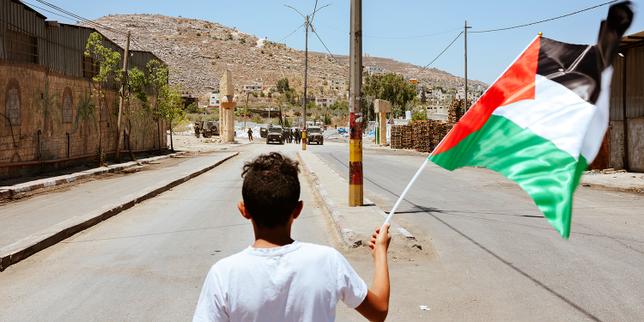
The modern documentation of protracted conflict operates under a structural failure mode. Traditional news photography prioritizes immediate shock value, feeding an ephemeral attention economy that discards context the moment a news cycle shifts. Within the West Bank, this velocity-driven approach creates a critical distortion: systemic, generational conditions are reduced to isolated incidents of acute violence. Documenting childhood under chronic occupation requires a fundamentally different operational framework—one that transitions from transient reportage to permanent infrastructural archiving. When photographers like Sakir Khader focus their lenses on the day-to-day existence of West Bank youth, the objective is not simply to record suffering, but to construct a durable data repository of institutional memory. This analysis deconstructs the mechanics of visual preservation, examining how long-term documentation functions as an essential countermeasure against historical erasure.
The Information Economy of Conflict Documentation
To understand the value of long-term visual archives, one must first analyze the economic and structural constraints governing international media production. News agencies operate on strict resource allocation models that favor high-yield, high-drama events. This creates a quantifiable blind spot regarding slow-burn realities, such as administrative restrictions on movement, economic stagnation, and the psychological attrition experienced by children growing up behind separation barriers.
- Transient Reportage: Prioritizes breaking news, producing high volumes of images with a short half-life and minimal contextual depth.
- Archival Documentation: Prioritizes longitudinal consistency, tracking cumulative changes over years rather than hours.
- Structural Erasure: Occurs when short-term reporting fails to capture the cumulative impact of daily systemic pressure, allowing institutional memory to degrade.
Sakir Khader’s work bypasses the transient model by anchoring its focus on continuity. By returning repeatedly to the same subjects and environments, the documentation captures the compound interest of occupation. A single photograph of a checkpoint delay holds limited analytical value in isolation; a chronological sequence spanning years maps the systemic degradation of developmental milestones for an entire generation. This longitudinal approach transforms photography from a reactive medium into a proactive archival science.
The Three Operational Pressures on Visual Preservation
Preserving the memory of survival in an asymmetric environment is constrained by severe logistical and physical friction points. These pressures dictate what can be recorded, how it is stored, and whether the data survives institutional or physical destruction.
1. Access Constraints and Spatial Friction
The West Bank is characterized by hyper-fragmented geography, divided into administrative zones that restrict physical movement. Photographers attempting to maintain continuous observational data face arbitrary checkpoints, military closures, and targeted surveillance. These barriers create data collection gaps, forcing an over-reliance on episodic snapshots rather than continuous observation. The tactical response requires decentralized documentation networks and localized operatives who can maintain observational continuity when external access is restricted.
2. Temporal Decay and Data Integrity
Analog and digital archives in conflict zones face immediate threats of physical confiscation, server seizures, or digital corruption. Unlike corporate archives housed in climate-controlled server farms, survival archives depend on distributed redundancy. The primary challenge is not merely capturing an image, but ensuring its cryptographic and contextual metadata remains intact over decades. Without verified timestamps, locations, and subject identifiers, visual data loses its utility as a historical record, degrading into anonymous art.
3. Institutional Erasure and Narrative Control
Official state narratives often employ institutional suppression or semantic redefinition to alter the historical record of occupied territories. Visual archives serve as a direct check against this manipulation. However, without formal indexing and institutional backing, independent photojournalism remains vulnerable to algorithmic suppression on modern distribution platforms. The survival of an image depends entirely on its structural integration into verifiable historical databases rather than ephemeral social feeds.
The Mechanics of Memory Retention Versus Immediate News Cycles
The fundamental distinction between mainstream photojournalism and archival documentation lies in their target metrics. Mainstream outlets optimize for engagement rates, click-through metrics, and emotional arousal. Archival projects optimize for fidelity, replicability, and historical accountability.
When analyzing how children in the West Bank are portrayed, a clear bifurcation emerges between sensationalized victimhood and structural resilience. Sensationalism frames the subject as a passive recipient of external forces, stripping away agency and reducing complex socio-political dynamics to a spectacle of grief. Conversely, rigorous documentary frameworks capture the active strategies children employ to navigate hostile environments—the informal education systems, the adaptation of public spaces into play areas despite structural hazards, and the psychological compartmentalization required to function under constant threat.
This distinction changes the utility of the data. When human rights investigators, legal teams, or historians reconstruct the timeline of an occupation, they do not rely on front-page splashes from daily newspapers. They rely on dense, cross-referenced archives that establish patterns of behavior, systemic impacts on infrastructure, and quantifiable metrics of displacement. Sakir Khader's methodology aligns with this evidentiary standard, treating the photographic frame as a primary source document rather than an emotive illustration.
The Cost Function of Visual Erasure
When societies fail to invest in rigorous, long-term visual archiving during active crises, a specific economic and historical penalty is paid. The absence of verified documentation allows dominant political narratives to rewrite the lived reality of populations on the ground.
- Loss of Baseline Data: Without continuous visual records of infrastructure degradation, measuring the exact rate of community displacement becomes speculative rather than empirical.
- Erosion of Legal Accountability: International humanitarian law requires demonstrable evidence of systemic impact. Ephemeral media lacks the chronological depth necessary to prove systematic targeting or long-term institutional harm.
- Identity Fragmentation: For the subjects themselves, the loss of a coherent visual history seps generational continuity, disconnecting the youth from the historical survival strategies of their predecessors.
Addressing these deficits requires treating visual documentation as critical public infrastructure. Just as municipalities maintain registries of deeds, births, and infrastructure health, conflict-affected regions require independent, cryptographically secure visual registries to protect against historical erasure.
Strategic Operational Blueprint for Crisis Archiving
To elevate conflict documentation from an artistic endeavor to an impenetrable historical record, practitioners and institutions must adopt rigorous operational protocols:
- Implement Decentralized Redundancy: Store raw captures across multiple encrypted, off-site digital repositories to neutralize the risk of physical seizure or hardware destruction.
- Enforce Metadata Rigor: Attach immutable timestamps, precise geographic coordinates, and verified contextual notes to every frame at the point of capture, eliminating ambiguity for future historians.
- Prioritize Longitudinal Continuity: Shift resource allocation away from one-off crisis reporting toward multi-year commitments to specific communities, ensuring the documentation captures structural trends rather than acute anomalies.
- Establish Institutional Partnerships: Link independent archives with academic research centers and human rights documentation bodies to institutionalize the data and protect it from political obsolescence.
The preservation of memory in the West Bank is not a passive cultural exercise; it is an active logistical defense against the systematic erasure of a population's daily reality. By moving past the constraints of the twenty-four-hour news cycle and treating visual documentation as high-fidelity data collection, photographers establish an unalterable historical ledger that outlasts the temporary architecture of occupation.