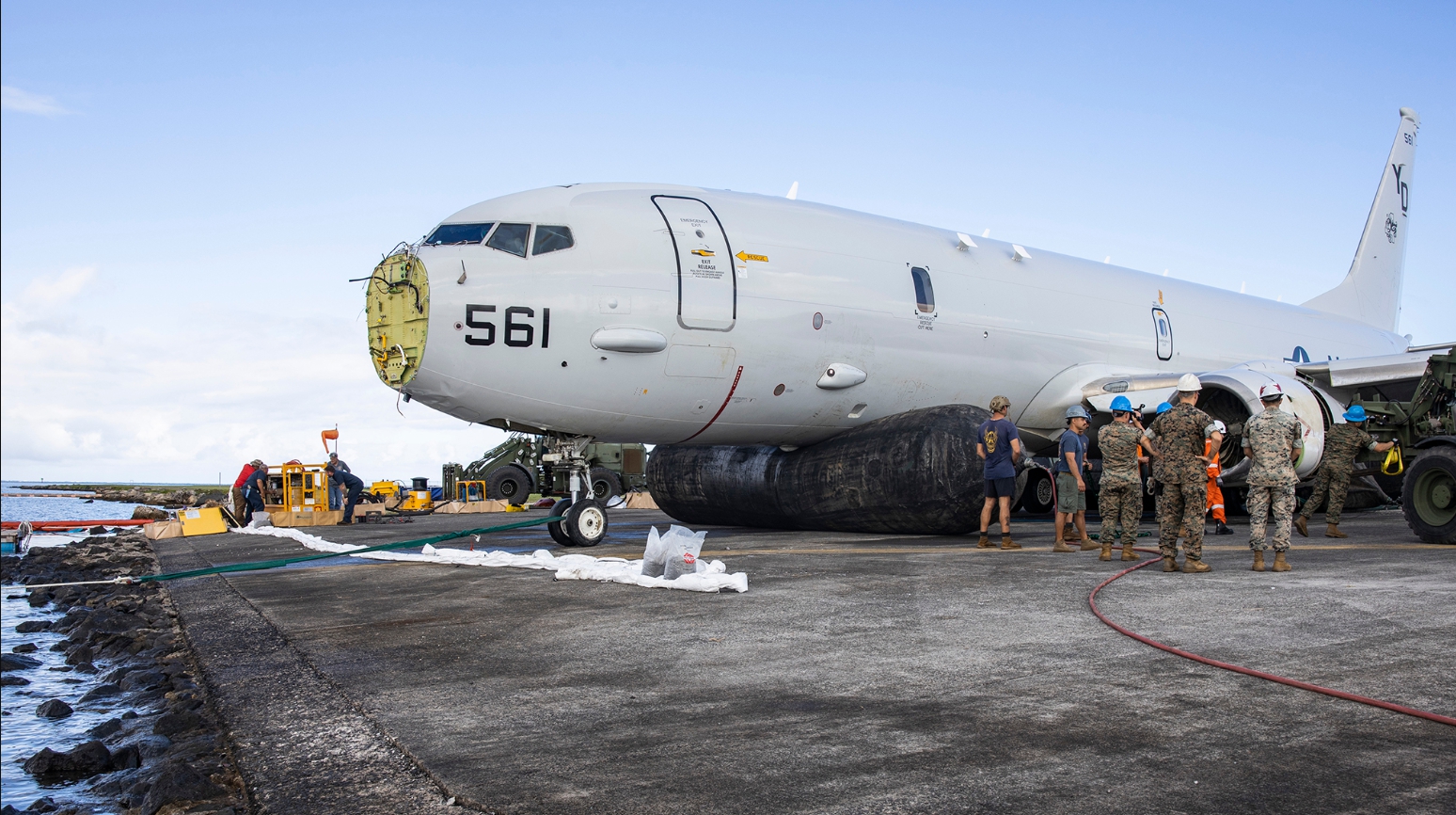
The cockpit of a Boeing P-8A Poseidon is a sanctuary of hums and digital chirps, suspended miles above the churning slate of the Pacific. Inside, the air is recycled and thin, smelling faintly of electronics and stale coffee. For the crew of the Royal New Zealand Air Force, the mission is often framed in the dry vocabulary of "maritime surveillance" and "international law." But when the radar screen blinks with a sudden, jagged signature, the dry vocabulary evaporates.
Outside the window, a gray silhouette emerges from the haze. It is a Chinese fighter jet. It isn't just passing by. It is close. Close enough for the New Zealand pilots to see the banking of the wings, the sun glinting off the canopy, and the silent, lethal intent of a superpower marking its territory.
This is the sharp edge of modern diplomacy. It isn't happening in a mahogany-paneled room in Wellington or a grand hall in Beijing. It is happening in the vibrating fuselage of a patrol plane, where a handful of men and women are tasked with holding a line that nobody can see, but everyone feels.
The Weight of the Watch
New Zealand is a small nation that has long prided itself on a certain kind of isolation. We are the "shaky isles" at the bottom of the world, protected by vast moats of saltwater. Yet, that distance is an illusion. The Pacific is not a barrier; it is a highway. And right now, that highway is the most contested piece of real estate on the planet.
When New Zealand sends a P-8A Poseidon into the East China Sea, it isn't looking for a fight. It is looking for ships that shouldn't be there—vessels slipping through the cracks of international sanctions to keep North Korea’s nuclear ambitions fueled. It is a police beat on a global scale. But in the current geopolitical climate, even a police beat is viewed as an act of defiance.
The Chinese government recently issued a sharp rebuke, accusing New Zealand of "provocative" actions. They claim the flights are a violation of their security. From a high-altitude perspective, this is a clash of definitions. To Wellington, the flight is a contribution to global stability. To Beijing, it is a Western intruder sniffing around the front porch.
Consider the hypothetical perspective of a sensor operator on that plane. Let’s call her Sarah. Sarah isn't thinking about the grand "Indo-Pacific Strategy" or the nuances of the United Nations Security Council resolutions. She is looking at a monitor, tracking a freighter that has gone "dark"—turning off its AIS transponder to hide its location. Her job is to prove that the world’s rules still apply, even in the middle of a lonely ocean.
When the Chinese interceptors arrive, Sarah feels a physical tightening in her chest. The plane doesn't just represent New Zealand. It represents the idea that no single nation gets to own the horizon.
The Invisible Stakes
Why does a small country with a modest military budget find itself in the crosshairs of a dragon? The answer lies in the concept of the "Rules-Based Order." It sounds like a textbook chapter title, but it is actually the glue that keeps the world from sliding back into a might-makes-right chaos.
If New Zealand stops flying these patrols because they are "uncomfortable" or "dangerous," a precedent is set. It signals that international waters are only international as long as the local power allows them to be. For a country that survives on trade—on ships moving freely across the sea—the loss of that principle is an existential threat.
The tension is a slow-motion collision.
New Zealand’s Ministry of Defence defended the flight with a stoicism that belies the adrenaline of the actual event. They noted that the aircraft remained in international airspace and operated according to long-standing norms. But norms are fragile. They require constant, physical reassertion. If you don't use the space, you lose the space.
The P-8A itself is a marvel of engineering, a converted 737 packed with more sensors than a spy satellite. It is designed to find needles in haystacks. But it is also a giant, flying target. It has no guns. It has no missiles for dogfighting. It relies entirely on the shield of international law. When a fighter jet pulls up alongside it, that shield feels paper-thin.
The Cost of the Quiet Life
There is a segment of the public that asks a simple question: Why us? Why can’t we just stay home and mind our own business?
It is a seductive thought. The "Quiet Life" approach suggests that if we don't poke the dragon, we won't get burned. But the reality is that the dragon is already in the room. The Pacific is our neighborhood. If the neighborhood becomes a place where only the loudest voice is heard, the quietest houses are the first to be overlooked.
The New Zealand government’s defense of this patrol is a rare moment of steel in an otherwise cautious foreign policy. It marks a realization that "neutrality" is not a shield; often, it is just an invitation for others to decide your fate for you.
The pilots who fly these missions are the ones paying the price for this realization. They endure hours of monotony punctuated by minutes of high-stakes tension. They are the eyes of a nation that prefers not to look at the gathering clouds.
Imagine the moment the P-8A turns back toward its base. The fighter jets have peeled away, returning to their coastal hangars. The crew exhales. The mission was a success—they documented the vessels, they gathered the data, they stood their ground. But the quiet in the cabin is different now. It is a heavy quiet. It is the sound of a small country realizing that the world is getting smaller, and the "far away" is getting much closer.
There are no easy exits from this narrative. New Zealand isn't going to stop being a Pacific nation, and China isn't going to stop being a superpower. The friction is the new permanent state of affairs.
We often think of war and peace as a binary, like a light switch. But this is the gray zone. It is a world of shadows, radar pings, and radio warnings. It is a world where a wingtip's distance can be the difference between a routine report and an international crisis.
The next time a RNZAF crew climbs into that cabin, they will check their gear, review their flight path, and drink their coffee. They will fly into the blue, knowing that somewhere out there, someone is waiting to tell them they don't belong. And they will stay, simply because the moment they leave, the horizon changes forever.
The sea doesn't care about flags, but the people on it do. The water remains cold, indifferent, and deep. And high above it, a thin line of New Zealanders continues to trace the edge of a world that is struggling to remember how to share.