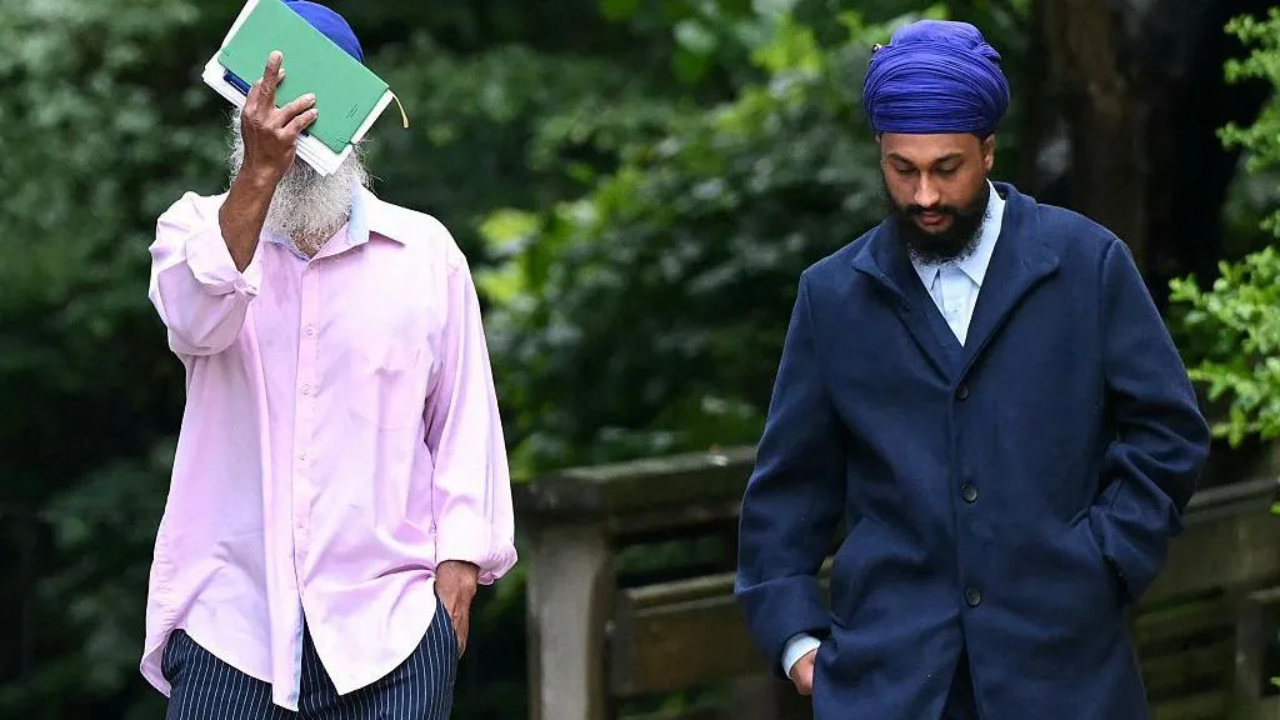
Just 24 hours after a judge handed him a life sentence for murder, Vickrum Digwa was back in a courtroom dock.
This time, the 23-year-old wasn't alone. Standing right beside him at Southampton Magistrates' Court were his father, Moga Singh, and his brother, Gurpreet Digwa. The trio faced a wave of fresh weapons charges following a police raid that completely shatters any lingering defense narrative that the fatal stabbing of 18-year-old student Henry Nowak was an isolated, panic-driven incident. In similar updates, take a look at: The Real Reason the Canada Immigration Debate is Boiling Over.
The timeline here is staggering. On June 1, 2026, Digwa was told he would serve at least 21 years behind bars for the brutal December 2025 slaying of Nowak. By June 2, he was wearing a dark suit, blue tie, and blue turban, facing magistrates alongside his immediate family to answer for a private arsenal discovered the day after the murder.
This case isn't just a local tragedy anymore. It has morphed into a national debate about religious exemptions, police incompetence, and the hidden stockpiles of deadly weapons sitting in suburban British homes. The Guardian has provided coverage on this important subject in great detail.
The St. Denys Road Stockpile
When Hampshire Police raided the Digwa family home on St. Denys Road on December 4, 2025—less than 24 hours after Henry Nowak was stabbed five times—they didn't just find a few kitchen knives. They uncovered an extensive collection of highly illegal weaponry hidden away in a private residence.
All three men face six counts of possessing an offensive weapon in a private place. The inventory reads like a medieval armoury mixed with modern street gang gear. Police recovered:
- A flick knife
- An extendable baton
- Multiple knuckledusters
- A machete
- Swords
- Kusaris (traditional Japanese chain weapons)
The legal trouble runs even deeper for the older brother, 27-year-old Gurpreet Digwa. He faces four additional public weapons charges. Prosecutors allege he was out in the community carrying an ASP (tactical expandable baton), an axe, a prohibited air rifle, and a kirpan.
During the brief hearing, prosecutor Natalie Angel explicitly noted the scale of the haul, stating simply that "a number of weapons were recovered in this case." Defence solicitor Harmail Gill requested a four-week adjournment so both sides could figure out exactly which charges the Crown will push forward with. The chair of the magistrates, Jennifer Pitt, agreed, pushing the next court date to July 9, 2026.
Moga Singh, 52, and Gurpreet Digwa walked out of the court on unconditional bail. Vickrum was granted technical bail, which means nothing to his immediate daily life, considering he was escorted right back to a maximum-security prison van to begin his life sentence.
Exploiting the System and the Kirpan Loophole
To understand why this second court appearance matters so much, you have to look back at the murder trial that concluded just days earlier.
On the night of December 3, 2025, Henry Nowak, a first-year finance student at the University of Southampton, was walking home after a night out with his football teammates. He crossed paths with Vickrum Digwa. Nowak, a young guy who loved filming videos on his phone, jokingly asked Digwa if he was a "bad man."
Digwa’s response? "I am a bad man." He grabbed Nowak’s phone, a physical struggle ensued, and Digwa pulled a massive, sheathed dagger, plunging it into the unarmed student's chest and legs.
Here is the kicker. Digwa was wearing a small ceremonial kirpan around his neck under his clothes, which perfectly met his religious obligations as an initiated Sikh. British law explicitly protects the right to carry a kirpan in public. But Digwa used that legal protection as a smokescreen. He chose to carry a second, massive, non-religious dagger explicitly to use as a street weapon.
During the trial, the Sikh Federation heavily criticized the Crown Prosecution Service for muddying the waters by calling the murder weapon a kirpan, arguing it brought unfair shame on their religion. Judge William Mousley KC didn't hold back during sentencing, telling Digwa: "Your actions have stirred up racial tension in Southampton and across the country which have made many Sikhs worried about their safety."
The discovery of the family's broader weapons stockpile completely undermines the defense’s trial claim that Vickrum was just a regular guy who panicked and acted in self-defense. The prosecution paints a far darker picture: a family obsessed with collecting and carrying lethal blades.
The Shocking Failures on the Scene
What makes this whole saga even more unpalatable for the British public is how the police handled the immediate aftermath of the stabbing.
When officers arrived at Belmont Road that December night, Vickrum Digwa and his family spun a web of lies. Digwa claimed he was the victim of a racially motivated assault and complained about a swollen eye. His brother made a 999 call denying any weapons were used. Meanwhile, Digwa’s mother, Kiran Kaur, actively removed the actual murder weapon from the crime scene. She was recently convicted of assisting an offender and has spent the last seven months in custody.
In a horrifying twist of frontline incompetence, police actually handcuffed a dying Henry Nowak as he bled out on the pavement, believing Digwa's false accusations of a racial assault.
The backlash has been fierce. High-profile figures, including X owner Elon Musk, slammed the frontline footage, and Cabinet Office Minister Nick Thomas-Symonds called the police conduct "shocking." The Independent Office for Police Conduct (IOPC) is currently running a full-scale investigation into Hampshire Police.
Mark Nowak, Henry's father, spoke outside court with a raw, justified anger: "Henry did not die with dignity. The way he was treated was inhumane and degrading. We are calling on the government to treat knife crime as the national emergency that it is."
Where the Law Goes From Here
The Hampshire Police and Crime Commissioner, Donna Jones, has already announced intentions to write to the Prime Minister demanding a formal, nationwide review of laws concerning the carrying of bladed articles under religious exemptions.
While the government has historically been hesitant to touch religious exemptions—focusing instead on banning zombie knives and tightening online sales—the Digwa case proves that individuals are actively weaponizing these legal loopholes to carry street blades with near-impunity.
For ordinary citizens and communities worried about rising knife violence, the next logical steps don't lie in waiting for a slow-moving parliamentary review. If you want to actually impact local community safety right now, the focus needs to shift toward supporting grass-roots knife surrender initiatives and demanding localized weapon sweeps in high-risk areas. If you live in Hampshire or the wider Southampton area, engaging with local policing boards to demand transparent updates on the IOPC investigation is the quickest way to ensure accountability.
The Digwa family will stand in court again on July 9 to face the music for their private armoury. But for the Nowak family, no amount of weapons charges will bring back a son whose life was stolen by a man obsessed with blades.