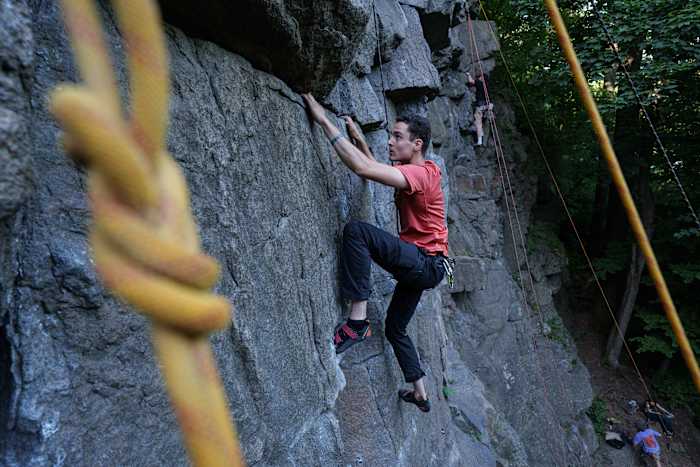
The air in the Dnipro climbing gym tasted of chalk dust and cheap espresso. Outside, the low, rhythmic thud of air defense artillery vibrated through the floorboards—a sound that had long ceased to be an interruption and had simply become the bassline of daily life.
Misha tied into the rope, his fingers white with magnesium carbonate. His hands shook, but not from fear of the wall. Two days ago, he had been digging through the rubble of a residential building three blocks away. Today, he was staring at a piece of brightly colored plastic bolted to a plywood overhang.
It looked absurd. It felt essential.
When war reshapes the horizontal world into a grid of checkpoints, trenches, and restricted zones, the only direction left to look is up. Across Ukraine, a loose collective of mountaineers, weekend hobbyists, and traumatized civilians are doing exactly that. They are building a new outdoor culture from scratch, born from the debris of conflict and modeled after a legendary American valley half a world away.
They are looking for their own Yosemite in the shadow of a frontline.
The Geography of Confinement
Before the full-scale invasion, Ukrainian climbing was defined by variety. Romantics headed south to the sun-bleached limestone crags of Crimea. Trad purists spent summers in the granite canyons of Aktove or the rugged spans of the Carpathian Mountains.
Then the maps changed. Crimea remained unreachable. The crags of the east became active artillery ranges or fields littered with tripwires and butterfly mines. Nature, once a refuge, was suddenly weaponized.
Consider the math of modern siege. If you subtract the occupied territories, the active combat zones, and the forested areas rendered lethal by unexploded ordnance, the physical space available for civilian recreation shrinks by nearly sixty percent. For a community defined by movement, this is a form of suffocation.
But human desire does not abide by military blockades. When the traditional crags became inaccessible, the climbing community did not dissolve. It compressed, intensified, and began searching for verticality in the most unlikely places.
They found it in abandoned granite quarries on the outskirts of central cities. They found it on the concrete pillars of unfinished bridges. They found it by looking at the topology of their country not as a casualty of war, but as a blank canvas for resilience.
The Ghost of Camp 4
To understand what is happening in Ukraine right now, you have to look back to California in the late 1950s and 60s.
Yosemite’s Camp 4 was more than a campground; it was a sanctuary for societal dropouts. The dirtbags who gathered there—pioneers like Yvon Chouinard and Royal Robbins—were fleeing the rigid, consumerist conformity of post-war America. They lived on canned sardines, slept in the dirt, and invented modern big-wall climbing because the world at sea level felt profoundly hollow.
In Ukraine, the modern climbing revival shares that exact DNA, but the stakes are inverted. These climbers are not fleeing a boring society; they are fleeing a broken one. They are not dropping out; they are holding on.
Hypothetically, let us imagine a climber named Olena. Before the war, she was an architect in Kharkiv. Today, her weekends are spent clearing brush from an overgrown, disused quarry three hours outside of Kyiv. She drills bolts into the rock with a battery-powered hammer drill, her ears tuned constantly to the sky.
When Olena bolts a new line, she is doing what the Yosemite pioneers did: she is claiming autonomy over a space that society had abandoned. Every route established is a small, stubborn flag planted in the face of annihilation. It is a declaration that the future exists, that someone will be here tomorrow to clip these bolts.
The Therapy of the Hard Move
There is a psychological phenomenon well-known to anyone who has ever found themselves horizontal on a rock face, forty feet above their last piece of protection. The brain cannot hold two terrors at once.
When you are micro-adjusting your body weight onto a crystal the size of a matchstick, the existential dread of the geopolitical landscape vanishes. The macrocosm shrinks to the microcosm. The mind simplifies.
- The Grip: The texture of the stone demands total sensory compliance.
- The Breath: Lung expansion regulates the heart rate against immediate, physical gravity, forcing the nervous system out of a chronic fight-or-flight state.
- The Focus: You cannot worry about the winter energy grid when your immediate problem is a failing left heel-hook.
This is not escapism. It is tactical recovery.
Medical professionals working with veterans and displaced civilians in western Ukraine have begun to notice the therapeutic collateral of this movement. The intense physical focus required by climbing acts as a temporary circuit breaker for Post-Traumatic Stress Disorder (PTSD). It forces a broken narrative back into the present tense.
For a few hours, the body is used for creation, for ascension, rather than survival or defense.
The New Dirtbag Ethos
The culture emerging from this crucible is distinctively Ukrainian, yet instantly recognizable to anyone who has ever spent a season sleeping in the back of a truck in Utah or Chamonix.
It is characterized by a radical sharing of resources. Gear is scarce. Ropes are used until they are fuzzy and questionable; carabiners are passed from hand to hand like precious currency. If someone has a car with a quarter-tank of fuel, five people fill the seats, their packs piled high on their laps.
They gather around small campfires in the evenings, just beyond the curfew zones, speaking in quiet tones about new sectors they hope to develop. They talk about the rock quality in liberated territories. They dream of the day they can return to the cliffs of the south, not with mine-detectors, but with chalk bags.
This lifestyle is lean, gritty, and fiercely communal. It stripped away the commercialized veneer that had crept into global climbing over the last two decades. There are no sponsored athletes here, no discussions of brand synergy or social media metrics. There is only the rock, the rope, and the people holding the other end.
The Indelible Line
On a Sunday afternoon, the sun finally breaks through the overcast sky above a newly developed crag near Vinnytsia. The rock is dark granite, rough and unforgiving on the skin.
A young man pulls through the final roof of a project he has been trying for weeks. His friends cheer from the base, their voices echoing off the stone walls of the canyon. For a moment, the illusion is perfect. The world is whole. The landscape is peaceful.
Then, the air siren on a distant hill begins its long, mournful wail.
Nobody lowers down. The belayer keeps his eyes locked on the climber. The climber reaches up, chalks his fingers, and targets the next hold. They keep moving upward, because staying still is the only thing they cannot afford to do.