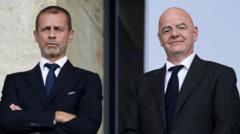
Power smells like fresh carpet adhesive and damp raincoats in the lobby of a Swiss hotel. Outside, the lake is the color of a bruised thumb. Inside, behind frosted glass that cost more than a small stadium, men in bespoke suits are checking their watches. They do not look at each other. They look at their phones.
A notification drops. A subpoena. A threat written in the precise, bloodless syntax of high-stakes litigation.
UEFA, the sovereign guardian of European football’s crown jewels, is preparing criminal legal action against Gianni Infantino, the man sitting at the apex of global governance at FIFA.
Stop for a second and listen to that. The governing body of the continent that birthed the modern sport is drawing knives against the head of the international federation. This is not a dispute over transfer fees or offside rules. This is a territorial war for the soul, the cash, and the administrative monopoly of the world's most popular pastime.
To understand why this matters, you have to strip away the sponsor banners and the television graphics. You have to look at how power actually moves in Zurich and Nyon.
Imagine walking into a boardroom where the air conditioning hums at a clinical 18 degrees Celsius. On the mahogany table sits a pie. Not a literal pie, but the staggering, multi-billion-dollar revenue generated by international television rights, tournament sponsorships, and commercial partnerships. For decades, the division of that pie was predictable. UEFA ran the continent; FIFA ran the world cup quadrennial show. They stayed out of each other's sandboxes. They maintained a polite, aristocratic distance, punctuated by handshakes at luxury resorts and quiet nods at executive committee dinners.
Then the financial gravity shifted.
The expansion of the Club World Cup, backed by sovereign wealth and aggressive commercial ambitions, collided directly with the European calendar. UEFA’s Champions League is the beating heart of club football economy. It pumps life—and cash—into Real Madrid, Manchester City, Bayern Munich, and hundreds of smaller ecosystems down the pyramid. When FIFA decides to expand its own club tournament into a bloated, month-long summer monolith, it is not merely adding fixtures. It is crowding the calendar. It is poaching attention. It is dipping its hand directly into the revenue stream that European clubs rely on to survive.
Friction became heat. Heat became smoke. Now, smoke has turned to fire.
Let us be entirely clear about the mechanics here. When an organization of UEFA's magnitude explores criminal legal action against a sitting FIFA president, it crosses a psychological Rubicon. This is no longer civil arbitration. This is not a sternly worded letter from corporate counsel. It is an assertion that administrative overreach has crossed the line into actionable legal territory. It is an accusation that the governance model of international sport has broken down so thoroughly that only the courts can reestablish the boundaries.
(Note: When I speak of criminal action here, I am describing the mechanisms of Swiss and European jurisprudence where private complaints and institutional grievances regarding unfair competition, abuse of dominant position, or corporate governance violations can cross the threshold of prosecutorial review.)
We have seen this script before, though usually starring different actors.
Remember the chaotic days of the early 2010s, when federal indictments tore through FIFA like a chainsaw through rotten timber. Suits were seized. Executives were extradited in dawn raids at luxury Zurich hotels. The world gasped, pretending to be shocked that an organization handling billions of dollars with minimal external oversight might attract corruption.
That purge was supposed to clean the house. It was supposed to usher in a golden age of transparency.
Instead, it simply redistributed the levers of control. The old guard was replaced, but the systemic hunger for expansion and revenue remained untouched, perhaps even amplified. Infantino stepped into the wreckage promising unity, democracy, and a globalized game that looked past traditional European hegemony. He courted the global South, small federations, and emerging markets, building a voting bloc that made him functionally untouchable within the FIFA congress.
Except UEFA cannot be voted out of the room. UEFA represents the economic engine of the sport. Without European television markets, European stadiums, and European superstar players, a global tournament is a Hollywood blockbuster without a screen to play on.
This brings us to the invisible stakes.
What happens when two multi-billion-dollar sporting empires wage open war? The casualties will not be the men in the bespoke suits. They will not be the executives drawing seven-figure salaries or flying private between Miami, Doha, and Geneva.
The casualties will be the players.
A modern elite footballer's body is already pushed to the absolute edge of human biology. Sports science tells us that optimal recovery requires specific blocks of rest between competitive high-intensity matches. Yet, the calendar keeps expanding. Nations League, expanded European Championships, revamped Champions League formats, and now a bloated Club World Cup. The human machine cannot bend infinitely without snapping. When players tear their ACLs in November of a congested season, that is not bad luck. That is the physical manifestation of institutional greed.
And what about the fans?
The people who save for months to buy a ticket, who stand in the rain on Tuesday nights, who pass down club jerseys like family heirlooms—they are treated as captive consumers in a turf war. Ticket prices climb. Kick-off times are bastardized to suit Asian or American television prime time. Matches are moved to neutral countries halfway across the globe for a quick cash injection.
The soul of the game is being monetized into white noise.
When UEFA prepares legal action against Infantino, they are trying to protect their market share disguised as a defense of sporting integrity. Let us not be naive. UEFA is no saintly patron of the arts. This is a cartel protecting its turf against a rival cartel. But in their collision, they are exposing the fragile, autocratic reality of how football is run.
Two men or two committees fighting over who gets to slice the pie, while the kitchen burns down around them.
Consider what happens next. If criminal proceedings gain traction, the reputational damage to FIFA will be catastrophic, triggering a new wave of institutional instability just as the sport prepares for the most commercially lucrative World Cup cycle in history. Sponsors will grow twitchy. Broadcasters will insert penalty clauses into contracts. The lawyers will bill by the hour, and the public trust—already hanging by a frayed thread—will snap completely.
The irony is staggering. Football was created in muddy fields by factory workers and schoolboys who needed nothing more than a bladder wrapped in leather and four jumpers to mark the goalposts. It was an escape. It was a shared language of movement and collective joy that required no translation.
Today, it is governed by jurisdictional disputes, antitrust claims, and criminal complaints filed by men who likely haven't kicked a bouncing ball in forty years.
The lake outside the Swiss hotel remains grey. The rain taps against the glass. Inside, the phone buzzes again. Another motion filed. Another deadline approaching. The game goes on, frantic and brilliant on the pitch, while in the shadows, the accountants and the litigators carve it up piece by piece.
Nobody is watching the ball anymore. They are watching the ledger. And the ledger is bleeding.


