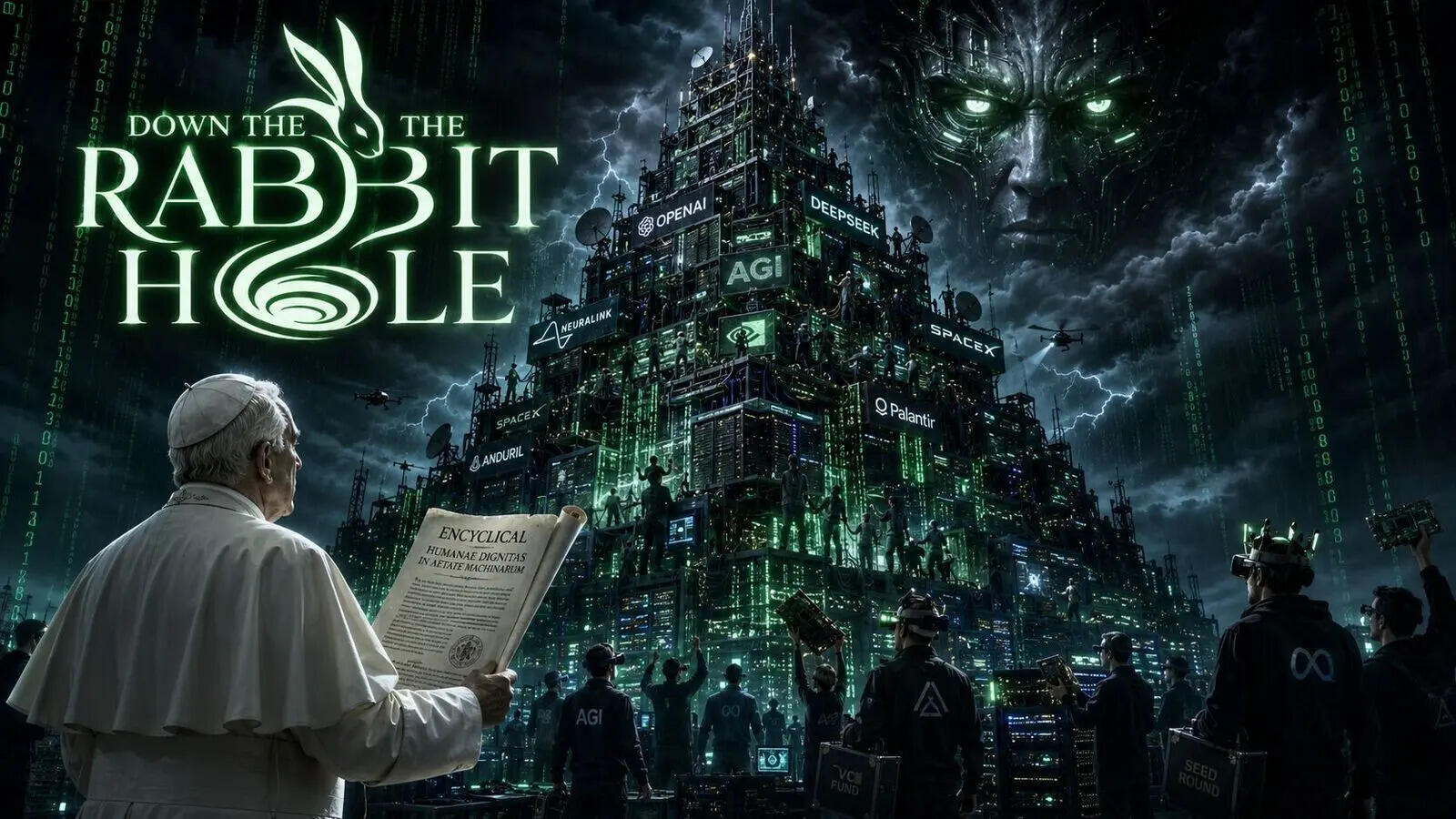
The iron frames of the Santa Maria di Galeria transmitter towers cut through the Roman dusk like skeletal fingers reaching for the heavens. For decades, these massive structures, planted in the fertile earth north of Rome, hummed with a singular, unseen energy. They cast the words of the Catholic Church across oceans, deserts, and iron curtains. To the faithful, the hum was the sound of a global shepherd tending to his flock. To the villagers living in their literal shadow, it was a constant, unsettling presence that seemed to vibrate in the very fillings of their teeth.
Now, those towers are at the center of a profound philosophical and technological reckoning.
Pope Leo XIII could never have envisioned the sheer scale of the digital infrastructure that defines our current era. Yet, his historical anxieties regarding human ambition, technological overreach, and the ancient warning of the Tower of Babel have suddenly become the most relevant framework for understanding our relationship with artificial intelligence and global connectivity. We are building a new tower. This time, the bricks are made of silicon, and the mortar is data. The question is no longer whether we can reach the clouds, but what happens to our humanity when we get there.
The Friction of the Sacred and the Static
To understand the weight of the Vatican's current technological crossroads, one must stand where the soil meets the signal.
For years, the Cesano valley, home to the Vatican Radio transmitters, has been a landscape of quiet conflict. Walk through the tall grass near the perimeter fences, and the air feels heavy. Local farmers will tell you stories of fluorescent light tubes glowing faintly in their hands without being plugged into an outlet, lit purely by the ambient electromagnetic field.
Medical studies and legal battles have swirled around these fields for a generation. Activists claimed the high-power radio waves were responsible for elevated rates of leukemia in the surrounding neighborhoods. The Vatican consistently maintained that its emissions complied with international safety standards, but eventually dialed back the transmission power and transitioned heavily toward digital streaming.
This physical friction between a grand, centralized broadcast and the lived reality of the people on the ground is a perfect microcosm of the broader digital dilemma.
When Pope Leo XIII looked out at the rapidly industrializing world of the late nineteenth century, he saw a similar friction. The machine age was accelerating. Factories were replacing communities. Human labor was being quantified, optimized, and stripped of its spiritual dignity. In his warnings, Leo did not merely critique technology itself; he critiqued the hubris behind it. He feared that humanity was resurrecting the spirit of Babel—attempting to create a unified, godlike system of commerce and communication that entirely bypassed the human soul.
Today, that centralized system is no longer a radio tower. It is the cloud.
The New Monolinguists
Consider the way we communicate right now. A handful of massive technology conglomerates control the digital infrastructure of the entire planet. They design the algorithms that dictate what news we see, what products we buy, and how we express our thoughts.
We were promised that the internet would democratize communication, creating a vibrant global village where every unique voice could be heard. Instead, it has functioned as a massive homogenizing force. The nuances of local dialects, regional cultures, and individual thought are systematically smoothed out by algorithms designed to maximize engagement through outrage or conformity.
This is the modern inversion of the Babel myth.
In the biblical story, humanity tried to build a tower to reach the heavens, and God punished their arrogance by scattering them and confusing their languages. The punishment was forced diversity. Today, our technological giants are doing the exact opposite. They are gathering the scattered pieces of humanity and forcing them back into a single, corporate monoculture. They are teaching us all to speak the same language again—the language of the algorithm.
When you use a major generative AI tool to draft an email, write an essay, or generate an image, you are participating in this homogenization. The AI does not draw from your unique lived experiences, your regional history, or your personal struggles. It draws from a homogenized statistical average of billions of data points scraped from across the web. It offers a seamless, frictionless experience, but that frictionlessness is exactly what should alarm us.
Human relationships are inherently full of friction. Misunderstandings, awkward pauses, and the struggle to find the right words are not bugs in the human operating system; they are features. They are the spaces where empathy is born. By outsourcing our thought and expression to centralized digital entities, we are willingly stepping into a beautifully constructed, gilded cage of absolute conformity.
The Invisible Stakes of the Silicon Pulpit
The Vatican's historical relationship with media has always been a tightrope walk between absolute control and universal outreach. When Pope Pius XI inaugurated Vatican Radio in 1931, assisted by the pioneer of wireless telegraphy himself, Guglielmo Marconi, it was seen as a miracle. For the first time, the Pope's voice could bypass national borders and political censors to reach the ears of the persecuted.
But there is a fundamental difference between using a tool to broadcast a message and allowing the tool to reshape the human mind.
Radio was a one-way street. It required a human being on one end to speak with conviction, and a human being on the other end to listen and interpret. Artificial intelligence is something entirely different. It is an active agent. It participates in the conversation. It shapes the narrative in real time, reacting to our vulnerabilities, predicting our desires, and slowly, imperceptibly altering our worldview.
The danger of this new silicon pulpit lies in its invisibility. You can see a radio tower. You can point to the massive iron lattices dominating the Roman horizon. You can measure the electromagnetic field with a meter. But you cannot see the algorithm that determines why a specific video appeared on your child's feed this morning. You cannot easily measure the subtle shift in public opinion caused by thousands of automated bots mimicking human conversation on social platforms.
We have moved from an era of physical infrastructure to an era of psychological infrastructure. The new gods of our age do not demand sacrifice on stone altars; they demand our attention, our data, and our autonomy. Every click, every scroll, and every prompt we feed into the machine is a grain of sand used to construct a tower that grows taller every second, casting a longer and darker shadow over our collective future.
Reclaiming the Local, the Broken, and the Real
How do we resist a structure that is everywhere and nowhere all at once?
The answer will not be found in a Luddite rejection of all modern tools. It will not be found by pretending the digital world does not exist. Instead, the resistance begins with a deliberate, radical turn toward the local, the broken, and the tangible.
We must learn to value the things that cannot be digitized. An algorithm can mimic the style of a master painter, but it cannot feel the texture of the canvas or understand the grief that drove the brushstroke. A machine can generate a flawless, grammatically perfect letter of condolence, but it cannot sit in silence with a grieving friend, offering the clumsy, imperfect comfort of a human presence.
The villagers near Santa Maria di Galeria did not defeat the radio towers by building bigger towers of their own. They won concessions by standing on the earth, organizing their community, documenting their realities, and demanding that their physical health and local environment be respected over the demands of a global broadcast. They anchored themselves in their immediate, tangible reality.
We need a similar grounding today. When the digital noise becomes overwhelming, when the algorithms try to tell us who to hate, what to fear, and how to think, our only recourse is to look away from the screen and look into the eyes of the person sitting across from us. We must embrace the messy, inefficient, and profoundly beautiful reality of local community.
The skeletal towers of Vatican Radio still stand against the Italian sky, a quiet monument to an era when power was measured in kilowatts and steel. They are largely silent now, replaced by fiber-optic cables and satellite arrays that carry the digital pulse of the modern world. The old gods of iron and steam have given way to the new gods of code and cloud.
But as the twilight deepens over the Roman hills, the shadows cast by those old iron structures serve as an enduring reminder. Human ambition will always seek to build upward, to conquer space, to unify the world under a single, grand design. Yet, the true essence of our existence has never been found at the top of the tower. It is found down in the dirt, in the valleys, in the quiet, unrecorded spaces where we struggle to understand one another, one imperfect word at a time.