The Last Ocean of Ink
The air at 8,000 feet in the Atacama Desert is thin enough to make your heart hammer against your ribs like a trapped bird. It is cold. It is dry. It is so quiet that you can hear the blood rushing in your ears. But when the sun finally drops behind the jagged spine of the Andes, the world dissolves into a darkness so profound it feels physical.
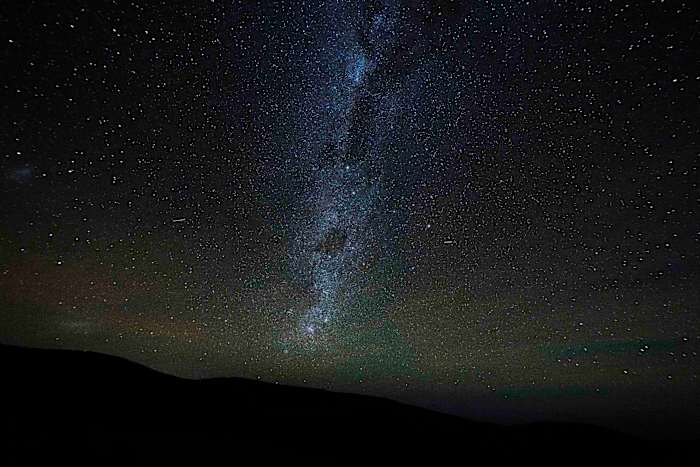
For millennia, this was the human default. We lived under a sky that felt like a heavy, diamond-encrusted blanket. In the Atacama, that ancient reality still exists. You don't just see the stars here; you see the texture of the universe. The Milky Way isn't a faint smear; it is a glowing, turbulent river of dust and fire that casts actual shadows on the desert floor.
But a new kind of fog is rolling in. It isn't made of water vapor. It is made of us.
The Glow on the Horizon
Consider a hypothetical astronomer named Elena. She has spent her life traveling to the high plateaus of northern Chile, the "capital of the world's shadows." She relies on the fact that the Atacama is the driest non-polar place on Earth, where the atmosphere is so stable that the stars don't even twinkle—they shine with a steady, laser-like intensity.
Lately, when Elena looks toward the southern horizon, she sees something that shouldn't be there. A sickly, orange dome of light. It is the footprint of Antofagasta, a city fueled by the lithium and copper mining booms. It is the reflection of LED streetlights, stadium beams, and industrial complexes bouncing off the few particles of moisture in the air.
This is light pollution. To the casual observer, it looks like progress. To the sky, it is a shroud.
The problem is technical, but the loss is spiritual. High-pressure sodium lamps used to emit a narrow, warm spectrum of light that astronomers could easily "filter out" of their data. But the global shift to cheap, energy-efficient LEDs has introduced a flood of blue-rich white light. This blue light scatters more easily in the atmosphere, creating a persistent haze that washes out the faintest, oldest signals from the deep past.
We are effectively turning off the history of the universe.
The Invisible Stakes
Why does a washed-out sky matter to someone who isn't holding a telescope?
The stakes are biological. Our bodies are tuned to the rhythm of the rising and setting sun. When we saturate the night with artificial blue light, we suppress the production of melatonin, the hormone that tells our brains it is time to repair and rest. In the Atacama, this doesn't just affect the humans living in growing mining towns. It affects the entire ecosystem.
The desert is home to specialized nocturnal creatures that have evolved for millions of years in total darkness. Migrating birds use the stars as a map. When we replace those stars with the glare of a highway, they lose their way. They circle light towers until they drop from exhaustion. Insects are drawn into the "vacuum cleaner" effect of streetlights, dying in billions and disrupting the food chain for the lizards and foxes that depend on them.
Then there is the data. Chile hosts nearly 70 percent of the world’s astronomical infrastructure. Billions of dollars have been poured into the desert to build giants like the Extremely Large Telescope (ELT). These machines are designed to see the very first stars that flickered into existence after the Big Bang.
If the sky continues to brighten at its current rate—roughly 2 percent per year globally—these multi-billion dollar eyes will go blind. We are building the greatest time machines in human history just as we are closing the curtains.
A Ghost in the Machine
The threat isn't just coming from the ground. Elena looks up and sees a different kind of interference: a train of bright, fast-moving dots.
Low Earth Orbit (LEO) satellite constellations, like Starlink, are a modern marvel of connectivity. They bring the internet to the most remote corners of the globe. But they also act as mirrors. Each satellite reflects the sun’s light long after the ground has gone dark. On a clear night in the Atacama, there are moments when more moving satellites are visible to the naked eye than stationary stars.
For a professional observatory, a single satellite streak can ruin a long-exposure photograph that took hours to capture. It’s like someone walking through a dark movie theater with a flashlight. You can’t just "photoshop" it out; the data underneath the streak is physically overwritten.
There is a profound irony here. We are launching satellites to connect the world, yet in doing so, we are severing our oldest connection to the cosmos.
The Cost of the Glow
We often talk about pollution as something we can touch—plastic in the ocean, smog in the lungs. Light pollution is different. It is the presence of something where it doesn't belong. It is the theft of the night.
In the Atacama, the local government has begun to fight back. They are implementing some of the strictest lighting regulations on the planet. They are mandating that streetlights point downward, that they be shielded, and that the light used be "warmer" on the Kelvin scale to reduce blue light scattering.
But regulations face the relentless pressure of economic growth. As the world demands more lithium for electric car batteries and more copper for green energy grids, the mines in the Atacama expand. And where the mines go, the lights follow.
The conflict is a mirror of our modern dilemma. We want the technology that saves the planet, but that technology requires the very industrialization that threatens our last windows into the universe.
Recovering the Dark
Is it possible to have both?
Change starts with the realization that light is a pollutant when it is wasted. A light that shines upward into the sky serves no one. It is spent energy. It is a design failure. By simply shielding our fixtures and using lower-intensity bulbs, we can reclaim the night without sacrificing safety or commerce.
Think about what we lose when we lose the dark. We lose the perspective of our own insignificance. Under a truly dark sky, it is impossible to feel like the center of the universe. You realize you are standing on a small, fragile rock hurtling through an unimaginably vast cathedral. That feeling—the "overview effect" usually reserved for astronauts—is a powerful antidote to the narrow, tribal anxieties of daily life.
Elena packs her gear as the first hint of dawn touches the horizon. The orange dome of Antofagasta is still there, a persistent glow on the edge of the world. She knows that every year, she has to look a little harder, filter a little more, and travel a little further to find the pure black she fell in love with as a student.
The stars aren't going anywhere. They are still there, burning with the same ferocity they have for eons. We are simply painting over them with a thin, bright layer of ourselves.
We are becoming the only species in history to build its own cage out of light.
The desert wind picks up, biting through her jacket. She takes one last look at the Milky Way before it fades into the morning blue. It is still there, for now. A silent, glowing witness to everything we are and everything we are in danger of forgetting.
If we don't learn to turn down the lights, our children will grow up in a world where the stars are just a myth told in books, a ghost story about a time when the sky used to talk back.