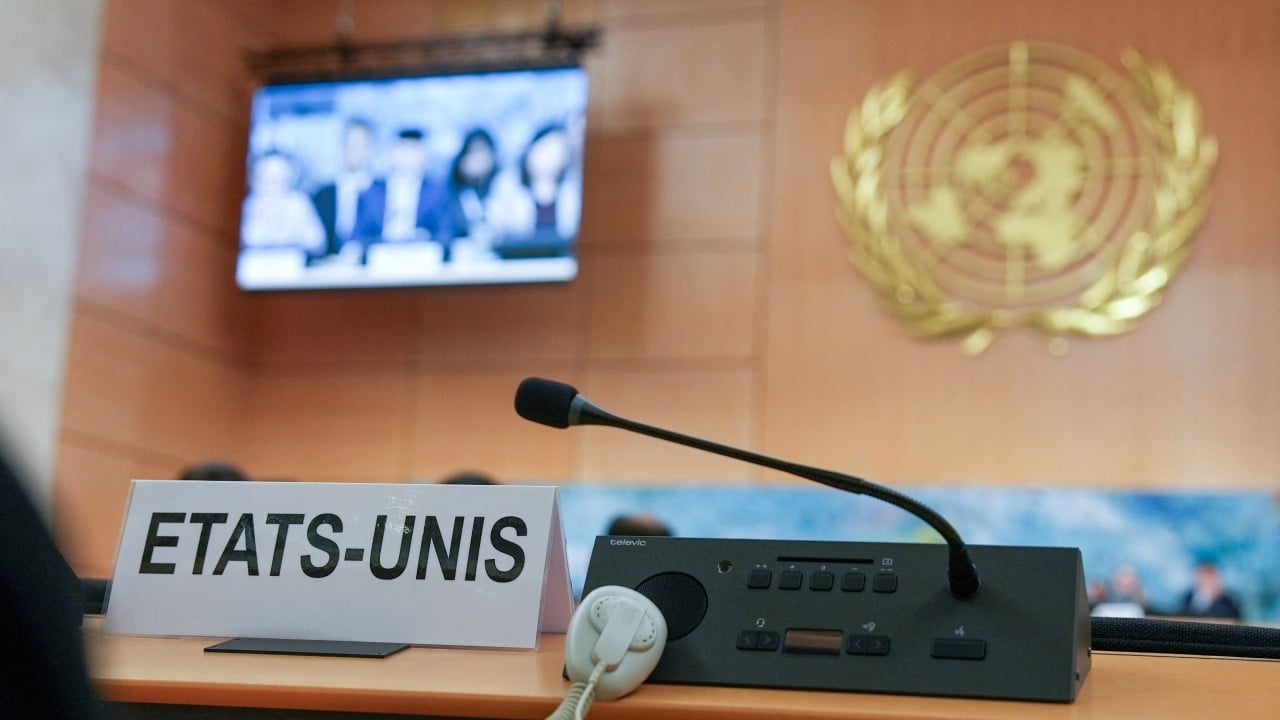
An empty chair in Geneva tells a louder story than a three-hour diplomatic speech ever could. When the United States again failed to show up for its Universal Periodic Review at the United Nations Human Rights Council, the absence didn't just trigger procedural confusion among diplomats—it raised sharp questions about international accountability, diplomatic norms, and how global watchdogs function when a major superpower steps out of the room.
For years, the Universal Periodic Review (UPR) operated on a simple premise. Every single UN member state, regardless of wealth, military power, or political system, sits before its peers roughly every four and a half years to defend its human rights record. No exceptions. No vetoes. When the US delegation leaves its nameplate sitting over an empty seat, it breaks a precedent that took decades to build.
What the Universal Periodic Review Actually Is
Most people hear "UN Human Rights Council" and immediately tune out, assuming it's just another endless loop of bureaucratic red tape. That's a mistake. The UPR mechanism, established by the UN General Assembly in 2006, was specifically designed to avoid the selective finger-pointing that plagued older human rights bodies.
Instead of singling out specific nations for condemnation, the UPR puts all 193 UN member states on a rotating schedule. During a standard review cycle, three main documents hit the table:
- A national report prepared by the country under review, detailing its laws, policies, and progress since the last cycle.
- A compilation prepared by the Office of the High Commissioner for Human Rights (OHCHR), pulling findings from independent UN experts and treaty bodies.
- A summary of submissions from civil society groups, non-governmental organizations, and national human rights institutions.
It's a peer-review system on a global scale. Diplomats from dozens of countries line up to ask pointed questions and offer concrete recommendations. Those recommendations cover everything from prison conditions and voting access to police accountability and immigration detention. The country being reviewed doesn't have to accept every recommendation, though it does have to formally state which ones it supports and which ones it notes.
When the United States skips the session, that entire feedback loop stalls out. Civil society groups that spent months compiling data and flying to Geneva find themselves presenting to an empty delegation desk.
The History Behind US Friction With the UN Human Rights Council
To understand why the US chair went empty, you have to look at Washington's rocky, on-again, off-again relationship with Geneva. The US approach to the Human Rights Council has swung wildly depending on who occupies the White House.
When the council launched in 2006 under the George W. Bush administration, Washington declined to seek a seat, arguing the body lacked credibility because countries with poor human rights records were allowed to serve as members. Three years later, in 2009, the Barack Obama administration reversed course, joined the council, and participated in the first US Universal Periodic Review in 2010.
Then came 2018. During Donald Trump's first term, then-UN Ambassador Nikki Haley announced the US was withdrawing from the council entirely, citing chronic bias against Israel and a failure to reform membership rules. Following that exit, the US also distanced itself from various UN human rights mechanisms. When Joe Biden took office in 2021, Washington rejoined the council and engaged with its review obligations, only for the pendulum to swing back again when Trump returned to the White House in 2025 and signed an executive order pulling the US out of the council once more.
Here's the catch that trips up a lot of casual observers. Even when a country isn't an elected member of the 47-seat Human Rights Council, it's still a member of the United Nations. Under UN rules, UPR participation isn't tied to council membership—it applies to every UN member state. Stepping down from a seat on the council is one thing. Refusing to show up for your own peer review is an entirely different escalation.
Two Very Different Arguments Over the Empty Seat
Depending on whom you ask in Washington or Geneva, the US absence looks either like a principled stand against a broken institution or a damaging retreat from global leadership. Both perspectives rely on specific historical grievances and strategic calculations.
The Case From Washington Critics of the Council
Supporters of the US boycott argue that participating in the UPR lends legitimacy to a forum that routinely shields authoritarian governments. Critics of the Human Rights Council point out that nations like China, Russia (prior to its 2022 suspension), Cuba, and Venezuela have all held seats on the council while suppressing dissent at home.
From this viewpoint, sitting in Geneva to take lectures on civil rights from representatives of authoritarian states is diplomatic theater at best and hypocrisy at worst. Proponents of disengagement argue that the US already has robust domestic accountability mechanisms—independent federal courts, a free press, congressional oversight, and state-level protections—that far exceed what UN panels can enforce. Why submit American domestic policy to a forum where bad-faith actors use human rights language as a geopolitical weapon?
The Warning From Diplomats and Rights Advocates
Human rights organizations, legal scholars, and veteran diplomats see the situation from the opposite angle. Organizations like Human Rights Watch, Amnesty International, and the American Civil Liberties Union have consistently argued that showing up for the UPR isn't about validating authoritarian council members—it's about keeping the universality rule intact.
Once the world's most powerful democracy decides the review process is optional, every other government gets an easy excuse to skip its turn. If Washington doesn't have to answer questions about asylum policies, capital punishment, or racial disparities in the justice system, why should Beijing answer questions about Xinjiang, or Tehran answer questions about crackdown on protesters?
Veteran diplomats also note that the UPR isn't just adversarial. During past reviews in 2010, 2015, and 2020, US delegations used the floor to highlight domestic reforms, acknowledge ongoing challenges transparently, and press other countries to match that openness. Walking away hands the microphone over to geopolitical rivals who are more than happy to fill the vacuum in Geneva.
What Happens Procedurally When a Country Doesn't Show Up
The UN Human Rights Council doesn't have a police force, and it can't drag a delegation into the Palais des Nations. Still, the council has established procedures for non-cooperation, largely shaped by the only previous cases where countries boycotted their reviews—most notably Israel in 2013 (which later returned to the process) and Nicaragua in recent cycles.
When a state fails to appear for its scheduled UPR working group session, the council doesn't simply erase the review and move on. Instead, the body typically adopts a formal decision noting the state's absence, urges the government to resume cooperation, and reschedules the review for a future session.
During the interim, the compiled UN reports and stakeholder submissions remain part of the public record. Independent experts and civil society coalitions still hold side events in Geneva, briefing diplomats and journalists on the findings that would have been discussed on the floor. In many ways, a boycott draws far more media scrutiny to those reports than a routine, politely scripted diplomatic session ever would.
Why Domestic Civil Society Groups Feel the Impact First
It's easy to view UN procedures as distant diplomatic chess, far removed from daily life in Chicago, Atlanta, or Phoenix. Yet for domestic advocacy groups, the UPR serves a practical function that's hard to replicate elsewhere.
Grassroots organizations working on housing access, Indigenous land rights, disability accommodations, and maternal mortality use the UPR cycle as an organizing deadline. Months before a review, coalitions across the US hold local consultations to document gaps between federal promises and lived reality. Submitting those shadow reports to Geneva creates an international paper trail that advocates later cite in domestic litigation, municipal policy debates, and congressional briefings.
When the federal government refuses to send a delegation, those groups lose their direct face-to-face engagement with interagency officials. Normally, preparing for a UPR forces officials from the State Department, Department of Justice, Department of Homeland Security, and Department of Health and Human Services to sit in the same room, review incoming criticisms, and coordinate official responses. Without that forcing mechanism, interagency accountability quietly evaporates.
How This Shifts Leverage in Global Diplomacy
Foreign policy rarely operates in isolated compartments. What happens in a human rights committee room in Geneva spills over into trade negotiations, security partnerships, and coalition-building at the UN General Assembly in New York.
For decades, US diplomats have leaned on international human rights standards when pressing allies and adversaries alike on democratic governance, press freedom, and the rule of law. That diplomatic leverage depends heavily on consistency. When Washington demands that other nations cooperate with UN special rapporteurs, allow independent monitors into detention facilities, or honor treaty commitments, counterparts inevitably point back to Geneva.
Allies feel the squeeze, too. European democracies, Canada, Australia, and other partners that invest heavily in multilateral institutions rely on US participation to keep the rules-based order credible. When Washington steps back, middle powers are left trying to defend universal standards while opponents dismiss those rules as selective tools applied only to weaker states.
How to Track What Happens Next in Geneva
You don't need diplomatic credentials to follow how the UN responds or to read the exact evidence submitted ahead of the review. Everything generated during the UPR process is public and searchable.
- Read the OHCHR Country Page: Visit the Office of the High Commissioner for Human Rights UPR portal to download the official UN compilation reports and the summaries of stakeholder submissions for the United States.
- Review Civil Society Shadow Reports: Check submissions from groups like the US Human Rights Network, ACLU, and Human Rights Watch to see the specific domestic policy areas flagged for international review.
- Watch Council Decisions on Rescheduling: Follow the Human Rights Council's session outcomes via UN Web TV and official council press releases to see when the working group sets a new review date and how member states respond on the floor.
Whether Washington eventually sends a delegation to a rescheduled session or keeps its seat empty, the underlying tension won't disappear. Universal accountability only works when the rules apply to everyone in the room—especially the countries powerful enough to walk out.