You don't scramble a dozen massive aerial refueling tankers out of eastern England on a random Tuesday unless someone in intelligence sees a very real, very immediate problem.
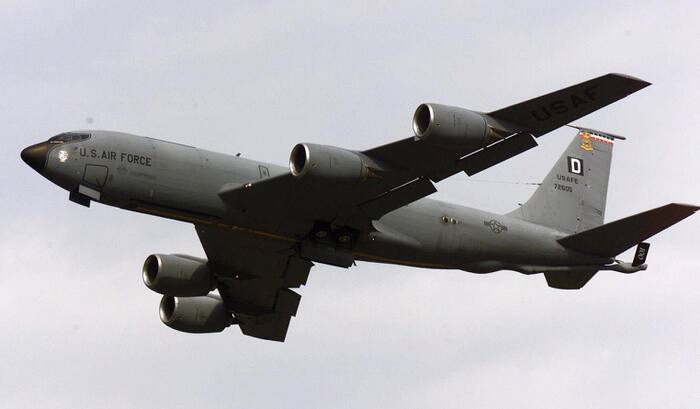
On November 9, 2026, aviation spotters around Suffolk noticed something bizarre. The skies above RAF Mildenhall suddenly emptied out. Within 48 hours, at least 12 KC-135 Stratotankers and three CV-22 Osprey tiltrotors vanished from the tarmac, scattering across Europe to bases in Germany, Spain, Scotland, and neighboring RAF Lakenheath.
According to The Wall Street Journal, the Pentagon ordered the rapid evacuation after receiving intelligence pointing to an Iranian-backed threat against the British airbase. At the exact same time, commanders cranked security at both Mildenhall and nearby Lakenheath up to Force Protection Condition (FPCON) Charlie—the second-highest alert level in the U.S. military.
Most mainstream wire reports treated this like a routine defensive shuffle. They missed the bigger picture. When you look at the geography of modern air warfare, the vulnerability of giant non-stealth aircraft, and what happened at another British base just weeks earlier, this evacuation tells a much more alarming story about how vulnerable Western airbases have become.
What Actually Happened at RAF Mildenhall
Let's look at the hard facts first. U.S. officials got alerted to a threat on Monday, November 9, and wasted zero time clearing the ramp.
Flight tracking data and ground observers confirmed that KC-135s from the 100th Air Refueling Wing didn't just fly routine training sorties. They dispersed. Two tankers initially diverted to Germany in the morning, followed quickly by a broader wave heading to Spangdahlem Air Base and Ramstein Air Base in Germany, Moron Air Base in Spain, and Glasgow Prestwick International Airport in Scotland. Meanwhile, three CV-22 Ospreys hopped over to RAF Lakenheath.
Britain's Ministry of Defence gave its standard diplomatic brush-off, telling reporters it doesn't comment on allied operations and noting that aircraft "move regularly according to operational requirements."
Sure. Aircraft move all the time.
Except commanders don't slap FPCON Charlie onto two major installations simultaneously for routine scheduling. That specific alert level means intelligence indicates a terrorist action or direct targeting of personnel and facilities is likely. Even though U.S. officials told the Journal they hadn't determined whether the threat was immediate or broader in scope, they clearly weren't willing to gamble hundreds of millions of dollars in irreplaceable aviation assets to find out.
Why Tankers Are Sitting Ducks on the Ground
If you haven't spent time around military airfields, it's easy to misunderstand why the Air Force panicked over tankers instead of fighter jets.
Fighter bases like RAF Lakenheath—which houses F-35As and F-15Es—have Hardened Aircraft Shelters. You can taxi an F-35 inside a reinforced concrete bunker, close the blast doors, and protect it from shrapnel or small commercial drones.
You can't do that with a KC-135 Stratotanker.
The KC-135 has a wingspan of 131 feet and stands over 41 feet tall. Retired Air Force Col. Troy Pananon, who commanded RAF Mildenhall from 2019 to 2021, pointed out a brutal logistical reality—airbases simply don't have hardened shelters big enough to hide aircraft of that size. They sit parked out in the open on wide concrete aprons, separated from public country roads by little more than chain-link fences and perimeter patrols.
And here's why losing even three or four of them would cripple U.S. operations.
Tankers are the literal lifeblood of American power projection. Fighters have short legs. Bombers need gas to cross oceans. Without the 100th Air Refueling Wing operating out of England, NATO's entire air bridge between North America, Europe, and the Middle East slows to a crawl.
If an adversary wants to blind or ground the U.S. Air Force without firing a single long-range ballistic missile, they don't attack stealth fighters in concrete bunkers. They target exposed tankers sitting on a tarmac 2,500 miles away from Tehran.
The RAF Fairford Warning Sign Nobody Should Ignore
Mildenhall wasn't an isolated scare. It was the second time in less than two months that Iranian-linked security threats forced the U.S. Air Force to pull high-value planes out of the United Kingdom.
Back on September 27, 2026, British police detained five men after spotting three suspicious vans heading toward RAF Fairford in Gloucestershire. Fairford isn't just any airfield—it's the U.S. Air Force's premier forward operating base for heavy bombers in Europe. B-1B Lancers flying out of Fairford played a central role in U.S. strikes against Iran earlier in the year.
Following those arrests, the U.S. quietly yanked its B-1 bombers out of Fairford on security grounds.
The details that emerged afterward explain why intelligence agencies on both sides of the Atlantic are on edge:
- British authorities charged two men under the National Security Act over the Fairford incident.
- A U.S. federal indictment later revealed that the plot against Fairford was partly coordinated from inside an American jail by a dual Iranian-Iraqi national.
- In October, the head of MI5 publicly warned that Iran had stepped up efforts to target military bases on British soil, noting that UK counterterrorism police had made 50 arrests over the prior year to disrupt Tehran-backed operations.
See the pattern?
Tehran knows it can't match American airpower head-to-head in the Middle East. Instead, Iranian intelligence networks have pivoted to asymmetric proxy operations inside Europe—recruiting local operatives, criminal networks, or sympathizers to conduct surveillance and launch low-cost attacks right outside perimeter fences.
The Drone Threat Changing British Airbase Security
You don't need a squad of elite commandos to destroy a $100 million aircraft anymore. You need a couple of modified quadcopters, a backpack full of explosives, and a parked van two miles downwind from a runway.
We've watched this exact tactic devastate airfields in Ukraine and Russia over the last few years. Now that playbook has arrived in Western Europe.
Just days after the Mildenhall evacuation, on November 13, a suspected drone incursion over RAF Lakenheath triggered another major security response (though a civilian pilot later claimed he and his friends might have accidentally caused the scare by flying three light aircraft in formation nearby). Regardless of that false alarm, the threat is real enough that Britain's Royal Air Force is completely overhauling how it protects its own fleet.
By late November, reports confirmed the RAF began moving its warplanes indoors into hangars every night after dark and installing heavy anti-drone netting over any exposed aircraft.
Think about how wild that is. The United Kingdom—an island nation separated from the Middle East by an entire continent—is actively stringing up anti-drone nets over its airfields because perimeter fences no longer mean anything against commercial-grade unmanned aerial vehicles.
What Dispersal Actually Costs the Military
Scattering planes across Germany, Spain, and Scotland sounds smart on paper. In military doctrine, it's called Agile Combat Employment—spreading your assets out so an enemy can't take out your whole fleet with one cheap strike.
In practice, it's a logistical nightmare.
When 12 KC-135s suddenly relocate from Suffolk to bases like Ramstein or Moron, they leave behind their dedicated maintenance crews, specialized spare parts, engine test stands, and established fuel supply contracts. A tanker isn't a Cessna. Every hour a KC-135 spends in the air requires dozens of hours of ground maintenance by technicians trained specifically on airframes built during the Eisenhower and Kennedy administrations.
You can fly a plane out of England in two hours. Moving the 500 mechanics, avionics specialists, and supply chains required to keep those planes flying takes weeks.
That tells you everything you need to know about how seriously Pentagon planners took the November 9 intelligence. Commanders hate breaking up a wing's maintenance hub because it immediately degrades readiness rates. They only pull the trigger on an emergency dispersal when staying put carries an unacceptable risk of catastrophic loss.
How to Track Future Airbase Security Shifts
If you follow defense news, OSINT (open-source intelligence), or geopolitical risk, you don't have to wait for a leaked Wall Street Journal scoop to spot the next major security alert. Military airbases telegraph their posture long before press offices issue statements.
Pay attention to three specific indicators over the coming months:
- Public ADS-B flight tracking anomalies. Tankers and cargo aircraft almost always fly with their transponders on when operating in European civilian airspace. When multiple KC-135s or C-17s depart a home base simultaneously toward disparate diversion airfields like Prestwick or Moron without a scheduled NATO exercise on the calendar, something is happening on the ground.
- Base gate closures and local traffic advisories. British bases like Mildenhall and Lakenheath regularly post gate hours and road access updates on their official community social media pages. Sudden, unexplained closures of secondary gates or extended local police patrols around perimeter roads almost always accompany an unannounced jump to FPCON Charlie.
- NOTAMs (Notices to Air Missions) restricting airspace. Watch for sudden temporary flight restrictions (TFRs) or drone-prohibition warnings issued by the UK Civil Aviation Authority around Gloucestershire, Suffolk, or Lincolnshire.
The era where U.S. and British airbases in Europe operated as untouchable rear-echelon sanctuaries is over. Whether the tankers return to Mildenhall next week or stay scattered across the continent, perimeter defense just became a front-line problem.